Tolerance For Happiness

GallupWellbeing

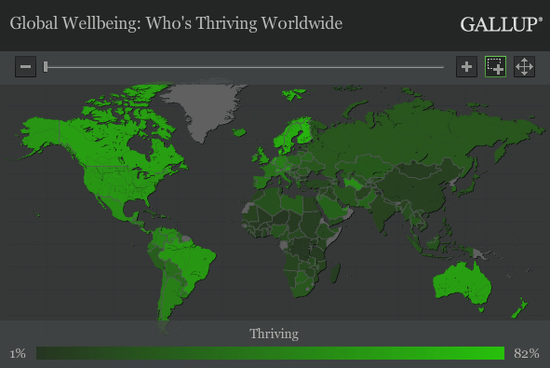
Richard Florida compares happiness levels across nations:

[W]hile income and the level of economic development play an important role in the happiness of nations, well-being is also related to the type and nature of economic development and the values it engenders. There is something in the nature of post-industrial economies and in their values that appears to affect the happiness of their people over and above the effects of income.

Perhaps it is that people with higher levels of education have more flexibility or choice in pursuing their dreams, building families and social relationships that are more fulfilling, or simply in their ability to adjust to misfortune or bad times. Perhaps it is that knowledge-based jobs are more challenging and fulfilling. It's also clear that the most troubled societies — those with the highest reported levels of suffering — also, generally speaking, face the highest levels of intolerance. While income and the level of economic development certainly need to be top of mind considerations when we think about or attempt to act on the happiness of nations, one simply cannot neglect the effects of economic and social structure and of values in social well-being.

(Image from Gallup. Interactive version here.)

What The Public Thinks

Drum grants that "polls do give us a general idea of where we're starting from," but also argues public opinion isn't hardened on a subject until it is the center of debate:

[W]e often take a look at polls and think they tell us what the public thinks about something. But for the most part, they don't. That is, they don't until the issue in question is squarely on the table and both sides have spent a couple of months filling the airwaves with their best agitprop.

Gender In The Masthead, Ctd

Friedersdorf joins the debate:

There is a case to be made for diversity in newsrooms, and if you’re running an all white newspaper in a multicultural town, you’re probably doing something wrong. But no one is helped by peddling diversity mantras that betray an utter failure to grapple with a difficult issue. Furthermore, should the Washington Post newsroom grow more diverse in future years — and I hope that it does — let me be the first to assert that the minority staffers should be covering Congress, Bethesda, and the University Club as often as sitting on the Metro desk or reporting on Southwest DC.

Mr. Alexander would probably say he’d never suggest otherwise, but when you approvingly quote someone saying, “If you have a community of basketball players, it’s difficult for a newsroom of opera lovers to cover them,” it’s fair enough to wonder if you’re also saying the opposite. Of course, this whole exercise presumes that basketball and opera themselves are inherently racial rather than cultural phenomena, which is also wrong.

In related news, Politico was recently scolded for its lack of non-white men in an editorial meeting.