Technorati's authoritah index – basically a measure of how linked a blog is by other blogs – now puts the Dish at #17 in the world. I don't remember ever being that high, but who does? We're even ahead of Daily Kos and the only political blog ahead of us is the Huffington Post. The Dish's traffic this July clocks in at around 9 million page views – compared with 5 million in July 2008 and 3 million in July 2007. Thanks to Chris and Patrick, and the guest-bloggers.
Month: July 2009
The Daily Wrap
Today on the Dish we primarily covered health care; Tumulty surveyed the political landscape; Andrew opined on Obama's approach; Drum was taken aback by Andrew's pragmatism on the public plan; Ezra laid into Megan, while she went back-and-forth with Marc over obesity.
As Gates-gate winds down, TNC sniffed at the beer summit and Dave Chappelle channelled the awful truth. In other creepy police news, we received a dispatch from DC, discovered disturbing cases from Tennessee and Idaho, caught wind of a terrorist knitter, and noticed once again who the most dangerous president could be on civil liberties.
In Iran news, Trita Parsi argued against the US going ahead with negotiations. Larison disagreed. And Juan Cole showed how even the hardliners are getting fed up with the violence.
Finally, Andrew recommends you read this book and this book.
— C.B.
Whose Police State?
I think it's pretty silly for Andrew Sullivan to refer to the "Obama-Bush police state." The beginnings of modern acquiescence to excesses in law enforcement and incarceration begins with Richard Nixon's "Law and Order" campaign of 1968, and has been nurtured by both parties and several administrations since. A more accurate title might be the "Nixon-Ford-Carter-Reagan-Bush-Clinton-Bush-Obama police state."
That does have a ring to it. Serwer's larger point:
More important, both Obama and Bush recognized that the ballooning incarceration rate was something that needed to be dealt with. Bush stuck his toe in the water by supporting the Second Chance Act, and Obama has gone further by supporting a repeal of the crack/powder disparity, putting millions in Justice Department grants for re-entry programs, and picking a drug czar who wants to de-escalate the war on drugs. Personally, I'd like to see the president do a lot more, like bring an end to fusion centers and paramilitary raids on nonviolent drug dealers. Still, this administration is already a welcome change from tradition.
Outing Iran: Shirin Neshat

A reader writes:
One of my personal favorite Iraninan artists is Shirin Neshat. Her photographs are often done in black and white and have strong feminist tones to them. I find her work to be simple yet beautiful and captivating.
Wikipedia says:
[Neshat] grew up in a westernized household that adored the Shah of Iran and his ideologies. Neshat has stated about her father, “He fantasized about the west, romanticized the west, and slowly rejected all of his own values; both my parents did. What happened, I think, was that their identity slowly dissolved, they exchanged it for comfort. It served their class”. As a part of Neshat’s “Westernization” she was enrolled in a Catholic boarding school in Tehran. Through her father’s acceptance of Western ideologies came an acceptance of a form of western feminism.
("Speechless", 1996, B/W RC print and ink. More photos by Shirin Neshat here and here.)
Face Of The Day
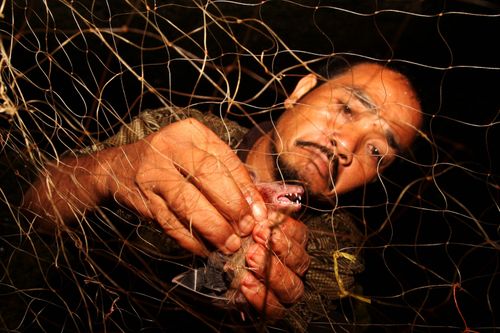
Bat catcher Gunawan collects bats captured in a cave on July 31, 2009 in Yogyakarta, Indonesia. A typical catch numbers around 800 bats a month. The Imogiri people believe that the meat of the local bat has healing properties for asthma and respiratory problems. By Ulet Ifansasti/Getty.
The Long Play
Adoni tells Obama how to repeal DADT:
Wait until October when Chairman of the Joint Chiefs Mike Mullen's two year term ends. In choosing a new Chief, make sure the general or admiral has impeccable military credentials and is firmly in favor of repealing DADT. Make sure he understands this is a top priority and it is his mission to accomplish this in the first few months of his term. Also instruct the future Chairman that he is to be open and honest about his opinion and plans for DADT during the Senate confirmation hearings.
“Death To Khamenei”

(Hat tip: Mackey.)
They Fired Dan Froomkin
And they're sill giving us this.
First Principles
Greenwald responds to Michael Massing's New York Review Of Books article. Glenn thinks that the "prime beltway affliction" is misunderstanding the line between constitutional principles and political squabbling:
Garden-variety political questions — what should be the highest tax rate? what kind of health care policy should the government adopt? to what extent should the government regulate private industry? – are ones intended to be driven by "the practical considerations policymakers must contend with." But questions about our basic liberties and core premises of our government — presidential adherence to the law, providing due process before sticking people in cages, spying on Americans only with probable cause search warrants, treating all citizens including high political officials equally under the law — are supposed to be immune from such "practical" and ephemeral influences. Those principles, by definition, prevail in undiluted form regardless of public opinion and regardless of the "practical" needs of political officials. That should not be controversial; that is the central republican premise for how our political system was designed.
Keep Your Eye On The Cash
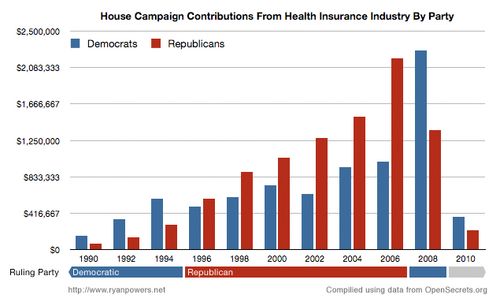
Ryan Powers produces this chart of House health industry donations from OpenSecrets.org data. He's trying to counter the Blue Dog claim that they receive more money from health interests simply because industry agrees with their positions most of the time. Yglesias opines:
This is why the very same members likely to be concerned that expanding coverage to the poor is too expensive also tend to be the same members who oppose saving money through the introduction of a robust public option embedded in a strong health insurance exchange. There are some visions of “health care reform” that are compatible with the interests of insurers, and the job of on-the-take Democrats is to try to steer legislation into that harbor.
 The Dish