Beneath it All, Desire of Oblivion Runs

Macy Halford plucks out a few choice paragraphs from philosopher Jean-Luc Nancy's The Fall of Sleep:

By falling asleep, I fall inside myself: from my exhaustion, from my boredom, from my exhausted pleasure or from my exhausting pain. I fall inside my own satiety as well as my own vacuity: I myself become the abyss and the plunge, the density of deep water and the descent of the drowned body sinking backward. I fall to where I am no longer separated from the world by a demarcation that still belongs to me all though my waking state and that I myself am, just as I am my skin and all my sense organs. I pass that line of distinction, I slip entire into the innermost and outermost part of myself, erasing the division between these two putative regions.

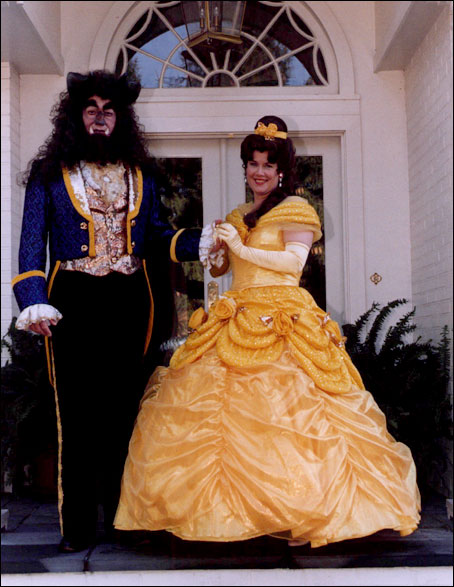
Sometimes a great image and a poseur alert are very close together.

Your Government Is Monitoring Your Listserv

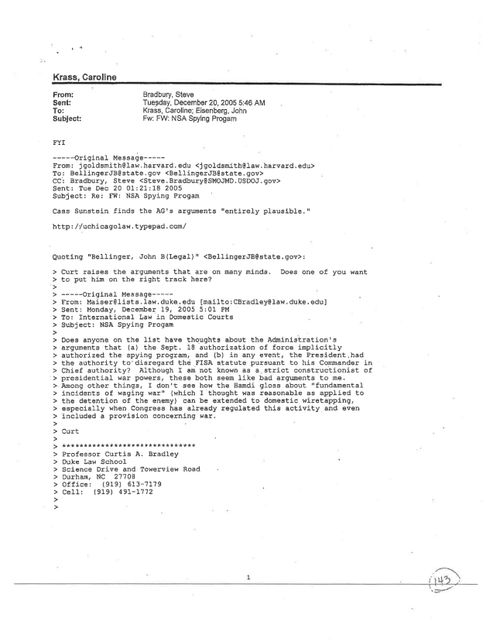
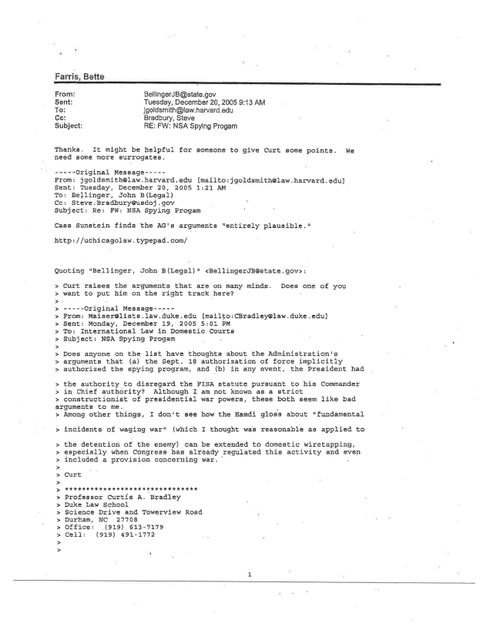
Two interesting documents from the Friday DOJ doc dump: emails between John Bellinger (at State) and a recently out-of-government Jack Goldsmith (from his Harvard Law School address), ccing Steve Bradbury (at DOJ), discussing how to find surrogates to make the government's case, after noting debates on a law professor list-serv. I have no idea where this went, and there may be no outrage here. It just creeps me out a little to find private emails being forwarded to government officials who strategize how to find other professors to push back. Maybe I'm too squeamish. Make of them what you will:

20091031JUSTICE_8

20091031JUSTICE_8b

Asexuals Among Us

Scientific American:

[S]ome scientists believe that there may be a fourth sexual orientation in our species, one characterized by the absence of desire and no sexual interest in males or females, only a complete and lifelong lacuna of sexual attraction toward any human being (or non-human being). Such people are regarded as asexuals. Unlike bisexuals, who are attracted to both males and females, asexuals are equally indifferent to and uninterested in having sex with either gender. So imagine being a teenager waiting for your sexual identity to express itself, waiting patiently for some intoxicating bolus of lasciviousness to render you as dumbly carnal as your peers, and it just doesn’t happen. These individuals aren’t simply celibate, which is a lifestyle choice. Rather, sex to them is just so … boring.

(Hat tip: 3QD)

In Defense Of Brain Drain

Michael Clemens and David McKenzie want to scrap the term:

Conventional wisdom once held that the wealth of a country declined when it imported foreign goods, since obviously cash was wealth and obviously buying foreign goods sent cash abroad. Adam Smith argued that economic development — or the "wealth of nations" — depends not a country's stock of cash but on structural changes that international exchange could encourage. In today's information age, the view has taken hold that human capital now rules the wealth of nations, and that its departure in any circumstance must harm a country's development. But economic development is much more complex than that.

But thanks to new research, we have learned that the international movement of educated people changes the incentives to acquire education, sends enormous quantities of money across borders, leads to movements back and forth, and can contribute to the spread of trade, investment, technology, and ideas. All of this fits very uncomfortably in a rhyming phrase like "brain drain," a caricature that would be best discarded in favor of a richer view of the links between human movement and development.

Brain competition?

How To Write Badly Well

An instructional blog. For example, always use a thesaurus:

She manipulated the garment in a cogitative mode. ‘Hmm,’ she vocalised. ‘This attire is verifiably marvellous. What is it constituted from?’ ‘From the most meritorious velveteen,’ defined her interlocutor, simpering coincidentally. ‘Is it?’ iterated the party of the first part. ‘That’s felicitous.’

‘Additionally, this specified object has the property of being subdivided in terms of its defining mercantile characteristic, and can be taken possession of for the diminutive quantity of merely a half-dozen currency units,’ the retail employee informed. ‘Exoneration?’ supplicated the protagonist appropriately.

The commercial tertiary sector worker eyeballed her perspicaciously. ‘I said it’s five ninety-nine. Do you want it or not?’

(Hat tip: Kottke)