The Daily Wrap

Today on the Dish, we shared some exciting home news and readers reacted. Andrew debated fear versus hope in the Arab 1848, and investigated how Bush's torture regime could have contributed to the uprisings. The wave reached Oman, Tehran tightened its grip, and another prime minister bit the dust in Tunisia. Edward Rees explored Libyan logistics for a no-fly zone, James Traub explored Qaddafi's former appeal, and the right lumped together all Muslims. Egyptians queued up for simple things like a bus, and hit a bump in the sectarian road.

Andrew established new rules for Boner (Boehner) and Cock (Koch), and Chait tested the Kochs' libertarian commitments.  Will Wilkinson connected the Tea Party to leftist protests in Wisconsin, and Nate Silver calculated their political power. Hertzberg traced Wisconsin's fault lines, Reagan appreciated a compromise, and evangelicals looked down on debt as a sin. Christians needed to accept the normalization of gay marriage, Boehner promised a DOMA decision this week, and David Link unraveled Newt's take on Obama's gameplan. Doug Mataconis celebrated the condoms, the ACLU defended the Ten Commandments, A. Barton Hinkle made the liberal case for property rights, and Calculated Risk summed up the jobs we've lost. The NYT changed with the times, gender gaps plagued journalism, and Rumsfeld condescended to Condi.  GPS stopped kids from playing hooky, sidewalk rage helped society, and nuns had suffrage before many women. Facebook captivated the world, one man converted to a beard devotee, and some dogs are dumber than other dogs.

Chart of the day here, quote for the day here, Malkin award here, VFYW here, MHB here, and FOTD here.

–Z.P.

Labor Lines

109479155

Rick Hertzberg fears the end of unions:

If a Republican Party that has lately become rigidly, fanatically “conservative” can succeed in reducing public-sector unions to the parlous condition of their private-sector brethren, then organized labor—which, for all its failings, all its shortsightedness, all its “special interest” selfishness, remains the only truly formidable counterweight to the ever-growing political power of that top one-thousandth—will no longer be anything close to a match for organized money. And that will be the news, brought to you by a few very rich, very powerful Americans—and many, many billions of dollars.

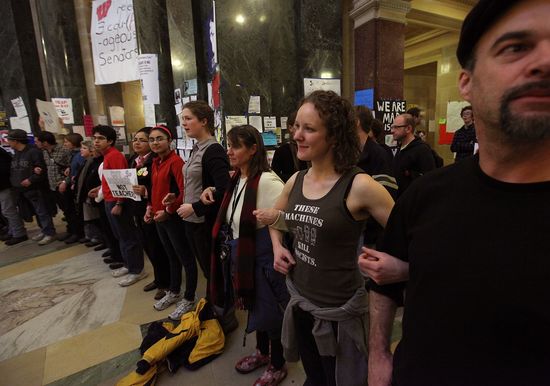
(Photo: Demonstrators protest in the capitol rotunda after they were given a deadline by the police to leave the building on February 27, 2011 in Madison, Wisconsin. Demonstrators have occupied the building with a round-the-clock protest for the past 13 days protesting Governor Scott Walker's attempt to push through a bill that would restrict collective bargaining for most government workers in the state. Law enforcement official have said they would clear protestors from the building so that it can be cleaned today at 4 PM, the building's regular Sunday closing time. By Scott Olson/Getty Images)

Crowdsourcing The Revolution

Sarah Kessler talks to filmmaker Jigar Mehta about his new mission:

The project, #18DaysInEgypt, asks people who witnessed the protests to label what they recorded of them on Twitter, Flickr and YouTube with specific tags. Eventually, Mehta will put the entries together to create an interactive narrative. … “We all know what happened at the end, but there are a lot of interesting turns that this story took,” Mehta says. “I think we’re just seeing the tip of the iceberg of what was shot during those 18 days.”

“The Growing Bovine Menace”

107294611

Charles Kenney compares human and cow immigration. It's an entertaining article with a serious point:

From a global perspective, it is unfortunate that cows get treated so much better at the border than people. Migration is pretty much the fastest and most reliable method for improving quality of life in the human population. Work by my colleague Michael Clemens at the Center for Global Development suggests that the same worker with the same skills doing the same job can earn six times more in the United States than in India, for example. Eight out of 10 Haitians worldwide who are living on more than $10 a day are living in the United States, leaving less than one-fifth of those relatively high earners living in Haiti itself. A lot of the income that Haitian immigrants are earning — $1.5 billion-plus a year — is sent home in the form of remittances. 

(Hat tip: Yglesias; Photo by Joel Saget/AFP/Getty Images)

How Powerful Are Unions Politically?

Nate Silver calculates that the union vote increases the Democratic party's congressional vote by 1.7 to 2.4 points. He warns the GOP:

Republican efforts to decrease the influence of unions — while potentially worthwhile to their electoral prospects in the long-term — could contribute to a backlash in the near-term, making union members even more likely to vote Democratic and even more likely to turn out. If, for instance, the share of union households voting for Democrats was not 60 percent but closer to 70 percent, Republicans would have difficulty winning presidential elections for a couple of cycles until the number of union voters diminished further.

A new PPP poll measures the political hit that Walker has taken in Wisconsin:

[I]f voters in the state could do it over today they'd support defeated Democratic nominee Tom Barrett over Scott Walker by a a 52-45 margin.

Cuckoo Qaddafi: English Edition

Robert Mackey relays the latest ramblings of the Libyan dictator:

Speaking in English to British and American reporters on Monday in Tripoli, the Libyan capital, Col. Muammar el-Qaddafi insisted that the Libyan people "love me, all." The BBC has posted video and a partial transcript of the interview with Colonel Qaddafi, which was conducted mainly in English, by Jeremy Bowen of The BBC, Christiane Amanpour of ABC News and a correspondent for London's Sunday Times. Here's a flavor of the exchange:

Jeremy Bowen: In recent years you had a rapprochement with Western countries, you had important Western leaders like Tony Blair coming here. Now there are Western leaders who are queuing up to say that you should go. Do you feel a sense of betrayal about that?

Colonel Qaddafi: Of course it's betrayal. They have no morals. Besides, if they want me to step down, what do I step down from? I'm not a monarch or a king.

Jeremy Bowen: But you make speeches at the U.N. and you identify very much with Libya even if you don't have a formal title.

Colonel Qaddafi: It's honorary, it's nothing to do with exercising power or authority. In Britain, who has the power? Is it Queen Elizabeth or David Cameron? You don't understand the Libyan system.

Jeremy Bowen: I understand the system you have here, but internationally you are regarded as the leader–

Colonel Qaddafi: You don't understand the system here. No, no, no: don't say, 'I understand. You don't understand. And the world don't understand the system here. The particular system: the authority of the people. You don't understand it.

Jeremy Bowen: But how do the people show their authority then? Because some people who have gone out on to the streets, to protest, say that your people have shot at them.

Colonel Qaddafi: No demonstration at all in the streets. Did you see demonstrations?

Jeremy Bowen: Yes I have.

Colonel Qaddafi: Where?

Jeremy Bowen: I saw some today.

Colonel Qaddafi: Where?

Jeremy Bowen: I saw some in Zawiya, yesterday I saw demonstrations.

Colonel Qaddafi: Are they supporting us?

Jeremy Bowen: No, they're not supporting you.

Colonel Qaddafi: They are not against us.

Jeremy Bowen: Some were against you, and some were for you.

Colonel Qaddafi: No. No one against us. Against me for what? Because I'm not president. They love me. All my people with me. They love me, all. They will die to protect me, my people. No, no, no.

Christiane Amanpour: If you say they do love you, then why are they capturing Benghazi and they saying they're against you there?

Colonel Qaddafi: It is Qaeda. It is Qaeda. It is Qaeda. Not my people. It is Qaeda.

Christiane Amanpour: Al Qaeda?

Colonel Qaddafi: Qaeda. Qaeda, yes. They came from outside.

Mackey disproves Qaddafi's utterly unhinged words with yet another batch of videos showing violent protests in the streets today. And here Mackey has clips of fighting in Libya's third-largest city, Misurata. The latest from the NYT:

Col. Muammar el-Qaddafi’s forces struck back at his opponents on three fronts on Monday, using fighter jets, special forces units and regular army troops in an escalation of hostilities that brought Libya a step closer to civil war. But the rebels dismissed the attacks as ineffectual, and Colonel Qaddafi faced a growing international campaign to force him from power, as the Obama administration announced it had seized $30 billion in Libyan assets and theEuropean Union adopted an arms embargo and other sanctions.

The Guardian posts a summary of today's events, including:

David Cameron said the UK did not rule out the use of force against Muammar Gaddafi (see 4.21pm). The British prime minister also said he had asked colleagues to work on plans for a no-fly zone. The White House also said allies were in talks about this (see 4.25pm). Cameron said the UK would consider arming the Libyan opposition. The US military is repositioning naval and air forces around Libya, a Pentagon official said, describing this as "planning and preparing" for missions, "whether humanitarian or otherwise".

The DOJ vs Whistleblowers

Obama during his presidential campaign pledged to protect them, but Greenwald says he's failed to do so:

Those pretty words have given way to the most aggressive crusade to expose, punish and silence "courageous and patriotic" whistleblowers by any President in decades.  As the Federation of American Scientists' Steven Aftergood put it, "They’re going after this at every opportunity and with unmatched vigor."  And last May, The New York Times described how "the Obama administration is proving more aggressive than the Bush administration in seeking to punish unauthorized leaks."  This war has entailed multiple indictments and prosecutions of Bush-era leaks which exposed various degrees of corruption, ineptitude and illegality… But it's the DOJ's increasing willingness to target journalists as part of this crusade that has now escalated its seriousness. 

Utopian Totalitarianism

James Traub describes how the Libyan dictator appealed to many:

Qaddafi did in fact succeed in destroying Libya's political and economic institutions — though only, of course, to remove obstacles to his own brand of despotism. Arab elites came to view him as a loose cannon and a dangerous crank. And yet his revolutionary language and his open support for violence against Israel and the West made him for a time a popular hero in the Arab world. In A History of Modern Libya, Dirk Vandewalle writes that "to many in Libya and within the region, there was something riveting and audacious about his analyses and his proposed solutions." Qaddafi "spoke the unpalatable truths that others" — those elites — "did not dare to articulate." Libya's hero offered deeply satisfying answers to the growing Arab sense of failure.

Many Islams

109100304

A few days ago, the Assyrian International News Agency reported that Egyptian armed forces attacked a monastery outside of Cairo, wounding two monks and other Coptic workers. Terry Mattingly bemoans the dearth of media coverage:

It is crucial, at this stage, to realize that there have been high-profile demonstrations in recent weeks in which many Muslims and Copts have stood together in calling for reform and for peace and cooperation between the vast majority of the nation that is Muslim and the 10 percent of the population that is Coptic, as well as members of Egypt’s other minority religions.

As always, however, it’s crucial to remember that there is no one Islam in this scene, including in the leadership of the nation’s army. That is a fact that is worthy of news coverage.

(Photo: Egyptian Coptic Christians hold a cross high during a joint communal gathering of anti-government protesters in Cairo's Tahrir square on February 06, 2011. By Mohammed Abed/AFP/Getty Images)

The Liberal Case For Property Rights

A. Barton Hinkle cheers Virginia Democrats who are open to reforming eminent domain laws, arguing that the left shouldn't be put off by the fact that the cause is usually associated with the right:

Property rights, like free-speech rights, benefit everyone — and eminent-domain reform should be a liberal cause for a number of reasons… there's the David-vs.-Goliath aspect. You don't hear about many eminent-domain cases pitting scrappy local governments against Lockheed Martin, Exxon or Proctor & Gamble. To the contrary, recent cases have involved:

•Roanoke seizing a building that belonged to the owners of a mom-and-pop flooring company so it could turn the property over to Carilion, a billion-dollar health-care corporation.

•Norfolk trying to seize the property of Central Radio so it could hand the land over to Old Dominion University.

•VDOT trying to cheat a small day-care owner out of just compensation — and spending more on lawyers to fight the case than it would have shelled out by paying her original asking price.

In these and other cases, those rooting for the underdog share common cause with property-rights activists.

Balko agrees:

This is a pretty important credibility issue for the left. We aren’t talking about public use, here. If you can’t bring yourself to support laws barring the government from taking land from poor people to give it to rich developers, it’s pretty darned clear that your priority isn’t protecting or advocating for the poor, it’s preserving government power. Or just opposing property rights because you don’t like the people who support them.