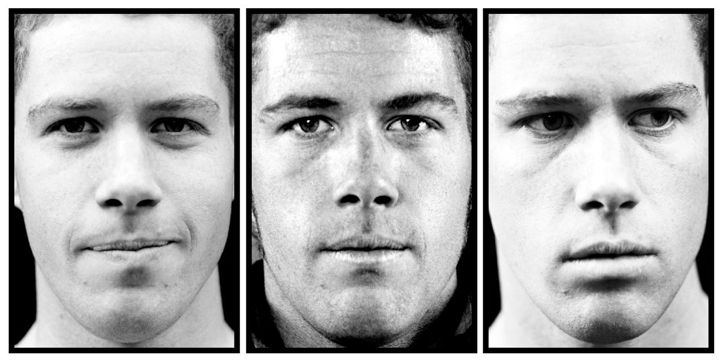
Remon, from the series Here are the Young Men, by Claire Felicie. Felicie photographed marines from the 13th infantry company of the Royal Netherlands Marine Corps before, during and after their their war experiences.
(Photo courtesy of the artist.)
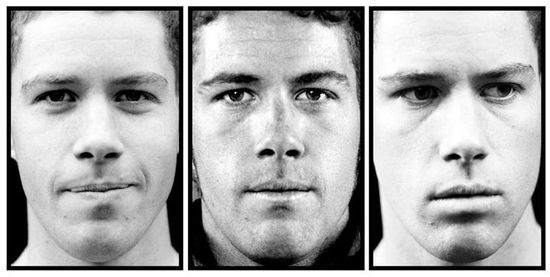
Remon, from the series Here are the Young Men, by Claire Felicie. Felicie photographed marines from the 13th infantry company of the Royal Netherlands Marine Corps before, during and after their their war experiences.
(Photo courtesy of the artist.)
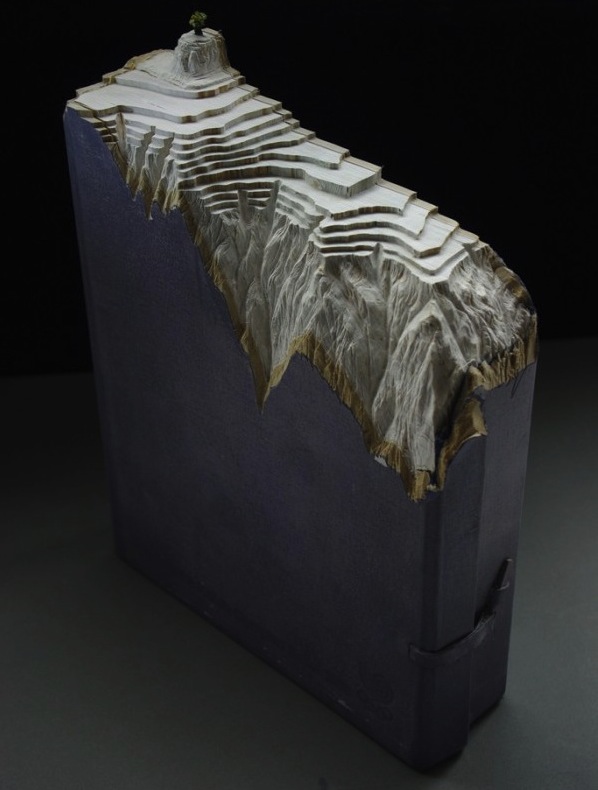
The ending of "Year's End" by Richard Wilbur:
These sudden ends of time must give us pause.
We fray into the future, rarely wrought
Save in the tapestries of afterthought.
More time, more time. Barrages of applause
Come muffled from a buried radio.
The New-year bells are wrangling with the snow.
The beginning of the poem here.
(More carved book landscapes by Guy Laramee here)
A compendium of studies helps you plan. The gist:
Studies show that the most common birthday—the one shared by the largest number of people nationwide—is September 16. This means most babies are conceived during the winter holiday season—hey, that’s right around now. When else do couples get lucky? At midnight, during spring break, when it rains, and when they haven’t just lost their jobs, recent research reveals.
More than 600 different chemical compounds, among other things:
Some tips on how to treat your hangover:
Alcohol makes you pee a lot, and that means that not only do you get dehydrated, you drain a lot of important nutrients, chief among them potassium. A George Mason University researcher writes, "In addition to the liquid expelled during frequent urination, certain salts and potassium – required for proper nerve and muscle function – are also lost." Naturally, the go-to potassium delivery agent is bananas. But you can branch out starting with this University of Michigan list that includes things you might actually want to eat with a hangover, such as potato chips, orange juice, and avocados.
And this factoid should give you pause:
Alcohol, as we've established, is a diuretic, and most of what you lose when you pee is water. In fact, that George Mason article contains this terrifying little gem about where that hangover headache comes from: "The body’s organs will attempt to replenish their own water, usually by stealing water from the brain, which causes it to decrease in size and pull on the membranes which connect it to the skull, which in turn results in a headache." Shudder.

Krulwich highlights the time zone with the most people able to celebrate New Years at one time:
If you look at this world time zone map, one zone, which we've highlighted it in yellow has, as you can see, all of China, all 1.3 billion of 'em, plus a hunk of Siberia, plus Taiwan, Hong Kong, the Philippines, Malaysia, Singapore, Brunei, a chunk of Indonesia, Timor and a cut of Australia. Altogether, that's got to be at least 1.5 billion people who will greet 2012 at the very same moment.
Freakonomics reports that walking a mile drunk turns out to be eight times more dangerous than driving one mile drunk:
In 2009, the most recent year for which we have data, about 34,000 people died in traffic accidents. Roughly half of them were drivers — 41 percent of whom were drunk. There were more than 4,000 pedestrians killed — and 35 percent of them were drunk. Of course, a drunk walker can’t hurt or kill someone else the way a drunk driver can, and people drive drunk much farther distances than they’d walk drunk. But the danger is hardly insignificant, says trauma surgeon Thomas Esposito.

Times Square, 11.10 am
A new study debunks the myth that 27 is the most dangerous year for musicians:
After analyzing statistics on 1,046 musicians who had number one hits in the U.K. (which actually excluded Hendrix, Joplin, and Morrison), the researchers found that only 7% had died during that period. There were quite a few deaths between 20 and 40, but researchers determined the rockers weren't more likely to die young due to some evil sorcery. It seems the spike in early deaths can be attributed to a strange condition called "doing a fuckton of drugs."
The "27 Club" myth exists due to the human brain's tendency to look for patterns and ignore things that don't fit.
Anahad O'Connor adds, "[T]he decline in premature deaths was tied to better treatment for drug overdose, as well as changes in lifestyles as pop music became more prevalent than hard rock."
Buzzfeed closes out 2011:
We've seen the worst fails of the year, and now it's time for a supercut of the best wins of 2011.
Pivoting off David Brooks, Reihan revisits the "Thatcherite thesis":
According to [Shirley] Letwin, an American-born British intellectual historian, Thatcherism was never a theory, of which there could be orthodox and less orthodox interpretations. Rather, it was a vision of a society that cultivated and rewarded certain qualities in citizens:
The individual preferred by Thatcherism is, to begin with a simple list: upright, self-sufficient, energetic, adventurous, independent-minded, loyal to friends, and robust against enemies.
… Note that Thatcherism is notably different from Reaganism. Though the left saw Reagan as a profoundly antagonistic figure, hostile to the welfare state, to cultural permissiveness, and much else that liberals hold dear, the Reagan of 1980 was, due in no small part to the supply-side credo, the champion of a "non-zero-sum" politics that aspired to a classless, frictionless politics of shared prosperity.
Read the supply-siders of the late 1970s and you'll find that they intend to use increased tax revenues generated by tax cuts to generously fund the welfare state. Reaganism reflected a basic confidence that the vigorous virtues were intact. Thatcherism, in contrast, rested on a more forthrightly antagonistic view of the world — there was a non-zero-sum conflict between individuals and families of all classes who celebrated and adhered to the vigorous virtues (a minority, quite possibly) and everyone else.
 The Dish