Bullying Bully

The documentary will be released unrated rather than go along with the R-rating given by the Motion Picture Association of America. Andrew O'Hehir unloads:

[W]hile the MPAA board pretends to be a source of neutral and non-ideological advice to parents, it all too often reveals itself to be a velvet-glove censorship agency, seemingly devoted to reactionary and defensive cultural standards. In the "Bully" case, the board has ended up doing what it usually does: favoring the strong against the weak, further marginalizing the marginalized, and enforcing a version of "family values" that has all sorts of unspoken stereotypes about gender and sexuality and race and other things baked into it. In short, the MPAA has sided with the bullies and creeps.

How a PG-13 rating can make or break a movie: 

Seven out of the nine films nominated for Best Picture at this year's Oscars were rated PG-13. Eight of the Top 10 grossing films of last year in the U.S. sported that rating. …  Movies rated PG-13 make more money on average ($42 million per picture versus G's $38.5 million, PG's $37 million and R's $15 million). Getting blessed with PG-13 ensures that the odds are ever in your favor.

Cynthia Hawkins looks for a better way:

While Weinstein ponders Bully’s eventual level of accessibility, Flavorwire’s Jason Bailey, inspired by the whopping box-office profits of The Hunger Games (which, by the way, had little trouble finagling a PG-13 despite its gritty kid-on-kid violence) parses how and when the majority of us see our films – in theaters, on demand, online, etc.  Big-budget "event movies" such as The Hunger Games, Bailey points out, are pretty much the only sort of movies we’ll go see en masse in theaters anymore. So why not side-step the ratings issue altogether and make Bully, with its potential to enlighten and empower parents, teachers, and students, "available to as many parents, teachers and students across the country" as possible and focus its distribution online?

Earlier Dish coverage of Bully here, here and here.

Making It On Wikipedia

Jack Stuef reports on an exhibitionist subculture:

Out of the over 3.8 million articles Wikipedia says it has now, the page for "autofellatio" is the 3110th most visited. It describes autofellatio as "the act of oral stimulation of one's own penis as a form of masturbation." Like many Wikipedia entries, this one features a photograph of what it’s describing. Jiffman wanted to be the guy in that photo. When people looked up autofellatio, he wanted them to see him doing it. But he wasn’t the only one.

There are 16 photographs categorized under autofellatio on Wikimedia Commons, Wikipedia’s sister site and a resource of over 12 million freely licensed images that are used or could be used in Wikipedia articles. But if fellating oneself wasn’t such a rare uh, skill — let’s say skill — there would probably be many more. The Wikimedia Foundation’s stated purpose is to educate, but Commons has become a dumping ground for exhibitionists like Jiffman.

Money quote from the above clip:

Wow, he really made it.

Sleeping With Your Favorite Porn Star

Tracy Clark-Flory did it

I asked my friend to tell him that I liked him and then ran and hid at the bar. Mid-sip, I felt a tap on my shoulder. “I hear you’re a fan of my work,” he said — and suddenly I was starring in my own personal porno, bad script and all. 

Unlike the cocky man he plays on-screen, he seemed stunned by my interest. “I don’t run into female fans all that often — or ever.” His voice was much higher than expected. I realized I’ve only watched him with the sound off for fear of a roommate overhearing. …

There’s no need to go into great detail — do a Google search for “porn” and you’ll find an approximate representation of what followed between us. It’s exactly what I had breathlessly watched him do many times before, but this time it seemed mechanical and theatrical. Instead of being entertained, I was doing the entertaining, and I suspect he was too — but for whom, exactly? We were the only audience. All of which is to say: It was like nearly every casual hookup I’ve ever had. Here were two strangers connected only by their fantasies of who each other are.

A Poem For Saturday

"The Bukowski in You" by Joel Dias-Porter:

The last lines of the poem:

You’re addicted to
knowing the cards love
no one
but the last hands
to hold them.
Is there anything
sexier than
putting it all-in and
having the moment
Morse code thru your veins?
Anything sexier
than the way
desperation’s dress
hugs her hips?
That’s why you return,
why you tease your chair
to the table’s edge
and post a blind bet,
why you peel the corner
of your hole cards
like they're prosperity’s
last pair
of good panties.

Jeffrey McDaniel hung out with Dias-Porter, also known as DJ Renegade, at one of the casinos where he now works and lives:

"Technically I’m homeless, but I stay in four-star hotels every night," he laughs. 

His overnight bag sits on the floor, barely opened; there’s no trace of Renegade in the room. It could be anyone’s room. As a consistent poker player, Renegade gets comped by the casinos, but there are strings attached; he gets his room for only two or three nights in a row, so every couple of days he hops on the AC jitney (a local tourist bus that loops from casino to casino): first taking his computer, then making a return trip for his overnight bag. Each individual casino will comp him only eight rooms in a month, and he can use only two in a week. … 

We sit at an empty poker table. It’s early, not even 7PM. “How have things been going lately at the tables?” I ask. Renegade grins, the absent tooth in his mouth seeming to shine, as he throws down a wad of hundreds in a money clip. “I’m the only homeless guy with $4,000 in his pocket.”

The Science Of Liquid Courage

A new study demonstrates how alcohol causes you to focus on a goal’s desirability rather than its feasibility. For instance:

[W]hen sober, people often avoid the low-feasibility high-desirability situation of successfully finding a new romantic partner because they focus on the likely (and feasible) cost of a depleted ego and not on the unlikely but highly desirable benefits of a lifetime of romantic happiness. Generally the expected value of these benefits still outweighs the expected costs, but it is only when alcohol creates a focus on desirability that people realize this.

A Button For Guilty Pleasures

A plea for more privacy functions built into online services such as Twitter, Rdio and Pinterest:

Every service needs the equivalent of stomping upstairs to your room, slamming the door shut and burying your head under a pillow — watching, reading or listening to whatever you want, without broadcasting it to anybody else. Or, more directly, just like Google Chrome's Incognito mode. You press the button, and for the duration of a session — whether you're watching a shitty Troma movie, playing "Super Bass" at the gym, reading a sleazy article in the Post — nobody sees what you're doing.

… Some services have this already, but it's often difficult to get to, because they want you to share as often as possible. And the services lose very little — they still know that you watched this or listened to that — you're just telling them not to put that on your permanent record or tell the whole world. The only things I'm ever tempted to steal anymore are terrible things I don't want people to see me consuming.

On a more technical front, Alexis Madrigal invokes privacy theorist Helen Nissenbaum:

She wants to import the norms from the offline world into the online world. When you go to a bank, she says, you have expectations of what might happen to your communications with that bank. That should be true whether you're online, on the phone, or at the teller.  Companies can use your data to do bank stuff, but they can't sell your data to car dealers looking for people with a lot of cash on hand. The answer, as applied by the FTC in their new framework, is to let companies do standard data collection but require them to tell people when they are doing things with data that are inconsistent with the "context of the interaction" between a company and a person. 

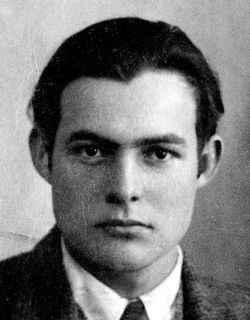
The Young Hemingway Is The Real Hemingway

This essay argues for the brilliance and creativity of his early work – the novels The Sun Also Rises and A Farewell to Arms, and stories like “The Snows of Kilimanjaro.” And for the way on which the self-parody Hemingway later became obscures his early genius:

“Those who knew Hemingway well, especially in these early years, reported that his braggadocio was something of a cover: Far from being the swaggering, insouciant rake Hemingwayof lore, he was emotionally fragile, stirred into panics by women’s rejections, prone to insomnia, workaholic and perfectionist (in Paris, he’d spend all day writing and sometimes come home with a single sentence), and given to weird and compulsive record-keeping projects, like tallying exact word counts or tracking his wife’s menstrual rhythms. He was what we would now call a neurotic, and the struggle to make sense of a life suddenly coming apart gave his work the urgency and contours earlier efforts had lacked…

“…What Hemingway captured, in other words, was the familiar, personal, very un-Jamesian experience of processing the world directly in time. His work of this period connects with our animal habits of consciousness. And the struggle it brings to the foreground is the struggle to make sense of—to find a line of narrative through—this disordered experience. Hemingway’s insight was to understand that this struggle was not just a literary one. It’s a fundamental part of how people themselves perceive and try to make sense of the world.”

In Praise Of Simple Stories

Tim Parks challenges the notion that the world needs intricate fiction to understand how to live:

The more complex and historically dense the stories are, the stronger the impression they give of unique and protracted individual identity beneath surface transformations, conversions, dilemmas, aberrations. In this sense, even pessimistic novels—say, J.M. Coetzee’s Disgrace—can be encouraging: however hard circumstances may be, you do have a self, a personal story to shape and live. You are a unique something that can fight back against all the confusion around. You have pathos.

This is all perfectly respectable. But do we actually need this intensification of self that novels provide? Do we need it more than ever before? I suspect not. If we asked the question of, for example, a Buddhist priest, he or she would probably tell us that it is precisely this illusion of selfhood that makes so many in the West unhappy. We are in thrall to the narrative of selves that do not really exist in the way we imagine, a fabrication in which most novel-writing connives.