The Daily Wrap

6a00d83451c45669e2016304a3d52e970d-550wi

Today on the Dish, Andrew debunked Jose Rodriguez's "big boy pants" case for torture, reflected on Ben-Zion Netanyahu's life, and discovered Israel's sassy gay friend. We predicted Israeli elections in the near future, broke down the GOP's excuses on bin Laden and Obama, listened to a defense of intervention in Syria, pondered the quandary created by a Chinese dissident in the US Embassy, questioned the morality of drone strikes, and chuckled at an Australian yes-man. Ad War Update here.

Andrew also criticized the response to North Carolina's Amendment 1, picked out a hopeful moment from the White House Correspondent's Dinner, and responded to critics of the event. We also worried about Citizens United leading to more PAC-driven corruption in Congress, explained why there was no counterpart to the FDA for the financial sector, dubbed Paul Ryan the "Wonk King of the Republicans," laid out the evidence that tax rates could increase without hurting productivity, and parsed Romney's economic plan. Racial profiling failed and the race of jurors mattered a lot.

We also debated whether America needed religion, put the challenge to the Catholic Church in stark terms, found a marriage ruined by monogamy, discovered that money bought happiness (for others) and wrapped our heads around the power of touch. Scientists moved towards in vitro therapies,  a father shared his experience raising his brain damaged son, Type II diabetes changed one's life outlook, community colleges failed, and second languages improved analytic thinking. Life experiences shaped film experiences, allergies helped us, homing pidgeons used the magnetic field, a giraffe got a CT in pieces, and the Washington Zoo live-tweeted the artificial insemination of a panda. Ask Tyler Cowen Anything here, Correction of the Day here, Quote for the Day here, VFYW here, MHB here, and FOTD here.

Z.B.

(Image by Manal Al Dowayan.)

Romney’s Economic Agenda

It lacks a short-term strategy:

For all of his talk about how much people are struggling right now, he’s not proposing ideas designed specifically to improve the economy in 2012 or 2013. His premise is that the long-term agenda will take care of the short-term problems—and that attempting to do more right away, as President Obama has proposed with his own jobs bill, will only make matters worse. 

Ad War Update

The Obama campaign debuts a new, supposedly "used" slogan:

Weigel surveys the use of "Forward":

It's a word previously seen on MSNBC, in the Chinese Communist Party, etc and etc. Because this is a business obssessed with the taste of its own tail, the MSNBC affiliation is the one getting all the attention.

But I think I see another antecendent for "Forward." In 2005, Tony Blair's Labour Party faced an election for an unprecedented (for a Labour PM) third term. The Iraq War has eaten into Blair's popularity; there was a sense that his party was tired, that it had disappointed the Left almost as much as it had offended the right. The best thing Blair had going for him was a still-weak Conservative Party, helmed by the unexciting consensus candidate Michael Howard. And so the Labour campaign began with this ad — Blair and then-Chancellor Gordon Brown (at the time, a more popular figure) riffing about their accomplishments. The slogan was "Forward, Not Back."

Meanwhile, the Romney camp fixates on spending:

The DNC hits Romney on education: 

And the Obama campaign highlights its opponent's "severe" positions on women's issues: 

Previous Ad War Updates: Apr 27Apr 26Apr 25Apr 24Apr 23Apr 18Apr 17Apr 16Apr 13Apr 11Apr 10Apr 9Apr 5Apr 4Apr 3Apr 2Mar 30Mar 27Mar 26Mar 23Mar 22Mar 21Mar 20Mar 19Mar 16Mar 15Mar 14Mar 13Mar 12Mar 9Mar 8Mar 7Mar 6Mar 5Mar 2Mar 1Feb 29Feb 28Feb 27Feb 23Feb 22Feb 21, Feb 17, Feb 16, Feb 15, Feb 14, Feb 13, Feb 9, Feb 8, Feb 7, Feb 6, Feb 3, Feb 2, Feb 1, Jan 30, Jan 29, Jan 27, Jan 26, Jan 25, Jan 24, Jan 22, Jan 20, Jan 19, Jan 18, Jan 17, Jan 16 and Jan 12.

Buying Congressmen Made Easy

What Citizens United hath wrought:

Both incumbents and potential challengers realize that a deep-pocketed PAC could decide their race. So when they get a call from that PAC’s director urging them to support this or that, they’re that much likelier to listen. The result, then, isn’t just that moneyed interests can throw congressional elections. It’s that they wield more influence after the election — and they can exercise that power without spending a dollar.

Face Of The Day

Gh1

Details from a daring raid:

At least 30 beagle puppies were rescued this weekend by animal rights activists from a notoriously inhumane breeding facility in Italy. Green Hill 2001 farms the animals out to vivisection labs, where the dogs are subjected to live experimental research and then death. Members of the Animal Liberation Front of Italy climbed over barbed wire fences on the grounds of Green Hill, then managed to squirrel the animals out through a breach in the fencing.

A Subjectively Great Film

Ebert defends one of his top ten:

Sometimes the way you consider a film depends on when and why you saw it, and what it meant to you at that time. "La Dolce Vita" has become a touchstone in my life: A film about a kind of life I dreamed of living, then a film about the life I was living, then about my escape from my life. Now, half a century after its release, it is about the arc of my life, and its closing scene is an eerie reflection of my wordlessness and difficulty in communicating. I still yearn and dream, but it is so hard to communicate that–not literally, but figuratively. So the Fellini stays.

His nomination for this year? "Tree Of Life."

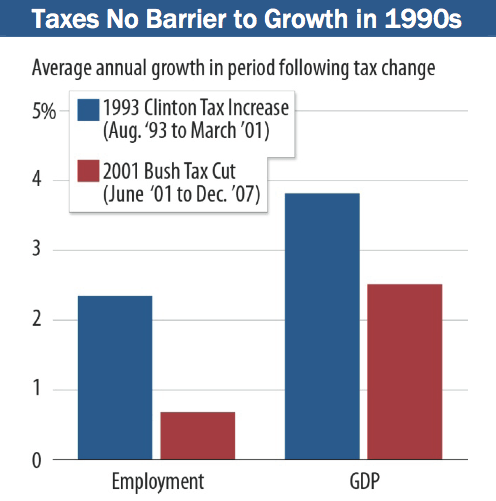
Debunking Supply-Side Dogma

Taxes_Growth

Chye-Ching Huang reviews [pdf] the economic evidence on tax increases. The findings are pretty clear:

Opponents of raising effective marginal income tax rates on high-income taxpayers claim that higher rates would discourage them from working, thereby reducing labor supply and harming the economy. But for high-income taxpayers in particular, as Leonard Burman recently observed, “evidence suggests their labor supply is insensitive to tax rates.”   The empirical evidence on how U.S. taxpayers have responded to tax increases indicates that, at most, high-income taxpayers respond to large cuts in tax rates with negligible increases in work hours.

Johns Hopkins economist Robert Moffitt and Purdue and Pennsylvania State University economist Mark Wilhelm report that work hours among working-age men remained essentially unchanged in response to the marginal tax rate changes made by the 1986 tax law.  Moffitt and Wilhelm’s finding is consistent with earlier empirical studies: University of Michigan Professor Reuven Avi-Yonah has written that the literature as a whole suggests “high-income men are unlikely to decrease hours worked as tax rates go up.”  Other groups, such as married women and older workers have been shown to be very responsive to tax rate changes, but the evidence generally doesn’t show similar responses for those at the top of the income distribution.

Jared Bernstein applauds.