by Gwynn Guilford
In an article in the latest NYT Magazine, Ruth Padawer took on the growing acceptance of “pink boys” – boys with a strong interest in traditionally female gender presentation but who identify as boys or biologically male kids who identify as both genders. (This contrasts with transgender children, such as one of the twins profiled in this excellent Boston Globe article.) Padawer documents the stories of a slew of such children, noting the evolution of their parents’ attitudes as well:
Many of the parents who allow their children to occupy that “middle space” were socially liberal even before they had a pink boy, quick to defend gay rights and women’s equality and to question the confines of traditional masculinity and femininity. But when their sons upend conventional norms, even they feel disoriented. How could my own child’s play — something ordinarily so joyous to watch — stir up such discomfort? And why does it bother me that he wants to wear a dress?
Despite a general dearth of data on the phenomenon, Padawer offers some preliminary research:
Studies estimate that 2 percent to 7 percent of boys under age 12 regularly display “cross-gender” behaviors, though very few wish to actually be a girl. What this foretells about their future is hard to know. By age 10, most pink boys drop much of their unconventional appearance and activities, either because they outgrow the desire or subsume it. The studies on what happens in adulthood to boys who strayed from gender norms all have methodological limitations, but they suggest that although plenty of gay men don’t start out as pink boys, 60 to 80 percent of pink boys do eventually become gay men. The rest grow up to either become heterosexual men or become women by taking hormones and maybe having surgery.
More comprehensive research on gender expression suggests “nature” weighs much more heavily “nurture”:
The largest study was a 2006 Dutch survey of twins, 14,000 at age 7 and 8,500 at age 10. The study concluded that genes account for 70 percent of gender-atypical behavior in both sexes. Exactly what is inherited, however, remains unclear: the specific behavior preferences, the impulse to associate with the other gender, the urge to reject limits imposed on them — or something else entirely.
E.J. Graff wonders if “the gender revolution is beginning for boys,” picking up on other signs of a shift in attitudes toward masculinity:
Researchers of workplace policies are finding that more and more young men want to take time during their children’s early years so that they can be part of those children’s lives—whether it’s parental leave when the child first arrives after birth or adoption, or the ability to be home for dinner during the week without stepping off the career track. If boys are allowed to have a little more variation in their behavior, might we end up with less bullying, fewer gay teen suicides, or even a drop in male violence at large?
Responding to photos of a camp for gender-variant children that accompanied the article, Lisa Wade sees something more akin to little drag queens than expanded masculinity:
I was struck by not just the emphasis on the dress/skirt, but the nail polish, jewelry, and high heels (on at least two of the children). Their poses are also striking, for their portrayal of not just femininity, but sexualized femininity. It’s hard to say, but these boys look pretty young to me, and yet their (or their camp counselors?) idea of what it means to be a girl seems very specific to an adult hyperfemininity. (After all, even most biological girls don’t dress/act this way most of the time and lots of girls explicitly reject femininity; Padawer comments that 77% of women in Generation X say they were tomboys as kids.)
Wade considers how this differs with non-conforming gender expressions biological girls:
In contrast, girls, when they enact a tomboy role — and now I’m off into speculation-land — don’t seem to go so far into the weeds. We don’t see girls dressing up like lumberjacks or business men in suits and ties. They don’t do tomman, they do tomboy. There’s something more woman about how some of these boys perform femininity.
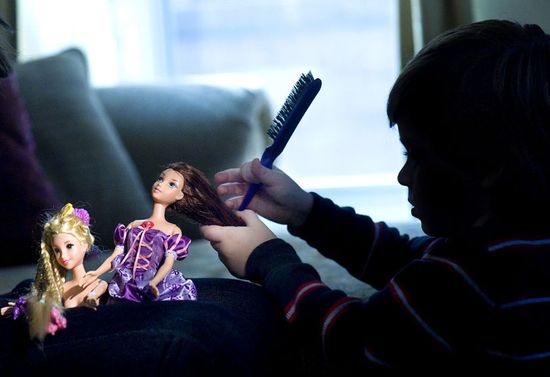
(Photo from “Raising my Rainbow“, a blog about “raising a slightly effeminate, possibly gay, totally fabulous son.” Previous coverage of the blog here.)
 The Dish