Everything Is More Expensive In Manhattan

Including Christmas tree lots. One Manhattan vendor paid roughly $50,000 for a stretch of SoHo Square to sell trees. Henry Grabar reports on the city's bidding wars:

The contested Washington Market space — one of 21 the parks department has auctioned off to vendors for the month — was the site, in 1851, of the first urban tree lot in the United States, for which a Catskill woodsman named Mark Carr paid a silver dollar in rent. Today, [George P.] Smith says he plays close to $30,000 a year for a mere 33 days of sales.

And those costs do trickle down to customers:

[T]he price of trees is steadily rising to levels that would shock residents of other cities. In 2010, a six-foot Fraser fir at SoHo Square ranged from $80 to $125. The Department of Parks' sample list of approved price ranges from 2011 indicates 10-foot Fraser firs running as high as $275. Prices on the street can be higher.

Designing A Better Cookie

A 3D-printed holiday snack:

Andrew Liszewski is wowed:

Designed in 3D modelling software the holiday treats are then printed using a cookie dough-filled syringe, instead of melted plastic like a traditional 3D model. And while the sugar-infused masterpieces lose some of their detail once they come out of the oven, they still kick the crap out of sugar cookie snowmen.

Meanwhile, Josh Ozersky finds most Christmas cookies inedible:

Christmas cookies were, and to an extent, still are, one of the few things not subject to postmodern market standards: they don’t have to be the munchiest, most chocolatey, ultra-decadent cookies the arts of food science can imagine, each one crammed full of sybaritic bliss. Instead, what’s supposed to matter about them is that your friend or relative made them and gave them to you. Or, better still, that you made them and gave them to someone you care about. “The reason a lot of cookies seem bad to you,” Mindy Segal, of Mindy’s Hot Chocolate in Chicago told me, “is that they are a kind of family cooking that you usually don’t see outside people’s houses. And most family cooks are amateur cooks.”

Christmas Gift Deflation

Mark Perry uses Christmas to demonstate the increased purchasing power of American consumers:

If you’re not convinced that today’s consumers are better off than at any time in history, spend some time browsing the old Sears, Wards, and J.C. Penney’s Christmas catalogs available here back to the 1930s, convert those old retail prices into their “time cost” equivalent using that year’s prevailing hourly wage, and you’ll quickly see that there has never been a better time to be a holiday shopper and consumers than right now. For that, you can thank the “miracle of the marketplace,” which brings us better and cheaper consumer goods all the time.

Facebook Isn’t Killing The Christmas Card?

Alexis counters Nina Burleigh:

The precipitous drop for Christmas mailings came in the wake of the financial crisis and the near destruction of the global economy, not with rising Facebook penetration rates. The card industry's statistics back that up. The Greeting Card Association estimates that 1.6 billion Christmas cards will be purchased this year, a small increase from last year. A report from the research firm, IBISWorld, anticipates that cards and postage will be the highest they've been in five years — $3.17 billion total. And finally, the card industry's biggest player, Hallmark, has had revenues of around $4.0 billion dollars since the mid-2000s, without much growth or decline.

Second, beyond the physical form of these cards, the spirit of Christmasness, of holidayness only grows more pervasive. No matter what time of the year, people now write contemplative letters with weird formatting to an ill-defined audience of "friends"; these are Christmas letters, whether Santa is coming down the chimney or not.

Face Of The Day

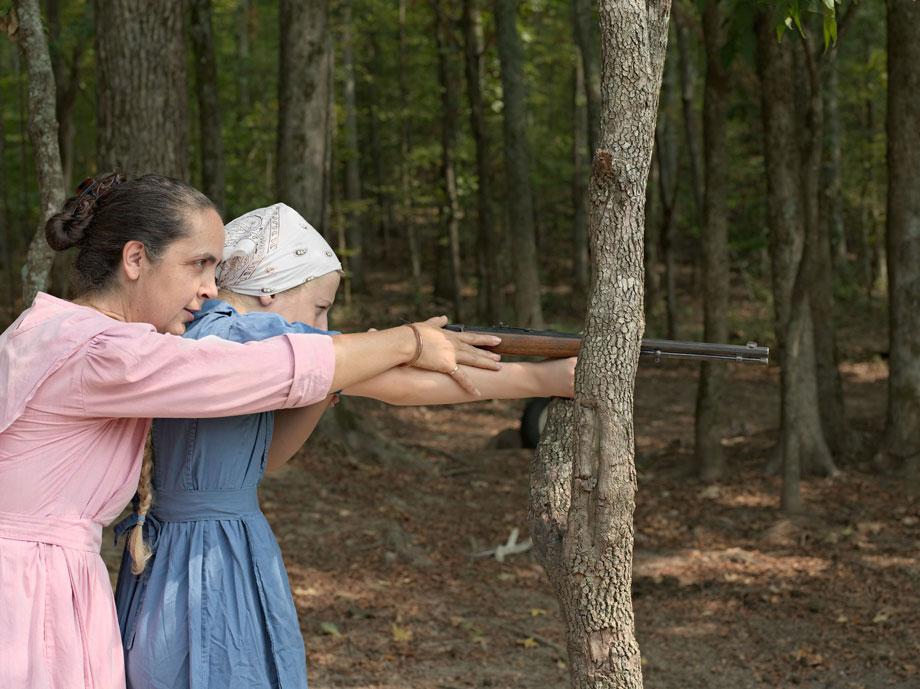
LucasFoglia_ANaturalOrder_RitaCoraAiming.jpg.CROP.article920-large

David Rosenberg spotlights a series from Lucas Foglia, who "spent four years photographing people who chose to reject modern urban living": 

"People have moved back to the land … because land is affordable and arable," began Foglia. "Because a well-chosen plot will likely have a freshwater spring on it, and because the libertarian philosophy that is ubiquitous in the region gives a person, family or community the freedom to live how they choose."

Foglia mentioned that living off the grid isn't an all-or-nothing venture. "Many (of the subjects) have websites that they update using laptop computers and cellphones that they charge on car batteries or solar panels. They do not wholly reject the modern world. Instead, they step away from it and choose the parts that they want to bring with them."

("Rita and Cora Aiming, Tennessee," from the book A Natural Order by Nazraeli Press)

The Voice Of Poetry In The Conversation of Mankind

Roses

It's one of the things that I'm proudest of on the Dish: our inclusion of poetry – classic, 20th century and brand new – in the daily buzz of the web. We used to do it by our own exhausted wit or your occasional brilliance in finding the exact poetic words for an event or a moment or a mood. But then, at a collective reading of the poems of Philip Larkin, I met Alice Quinn, executive director of the Poetry Society of America. She has already helped pioneer poetry in public spaces – on transportation in New York City, to name just one – and she graciously agreed to help bring poetry to this public space. She does it for no compensation, just for our shared love of poetry.

Which is why I invite you, if you care about poetry (and it's not to everyone's taste on a news and opinion site), to consider becoming a member of the Poetry Society of America. They are running a special year-end membership campaign from December 23rd to January 1st, in which anyone who joins at the basic membership level gets to choose a signed limited broadside by Mark Strand or by one of the organization's Frost medalists, Charles Simic and Marilyn Nelson. Any donation is tax-deductible – and for a short time, you also get a beautiful broadside in the bargain. Sign up for your membership here. And let me extend my personal thanks to Alice, and her co-conspirator, our literary editor, Matt Sitman. And wish them both the merriest of Christmases and a poetic new year.

The Zero Dark Debate, Ctd

More and more, people viewing it are disturbed and concerned that – even in the interstices – it gives an impression of something false: that torturing suspects with Nazi and Communist-style  techniques played some role in finding and killing the theocratic mass murderer, Osama bin Laden. The Senate Intelligence Report – the most exhaustive and penetrating study of Cheney's torture regime – says otherwise, we are authoritatively told by Senators Feinstein, Levin and McCain (pdf). The current deputy head of the CIA has also now weighed in:

In a message sent Friday to agency employees about the film, "Zero Dark Thirty," Mr. Morell said it "creates the strong impression that the enhanced interrogation torture techniques that were part of our former detention and interrogation program were the key to finding Bin Laden. That impression is false."

In fact, he said, "the truth is that multiple streams of intelligence led C.I.A. analysts to conclude that Bin Laden was hiding in Abbottabad," the city in Pakistan where a Navy SEAL team killed him in May 2011. "Some came from detainees subjected to enhanced techniques torture" Mr. Morell wrote, using the C.I.A.’s euphemism for harsh and sometimes brutal treatment that included waterboarding torture. "But there were many other sources as well."

He said that "whether enhanced interrogation techniques were torture was the only timely and effective way to obtain information from those detainees, as the film suggests, is a matter of debate that cannot and never will be definitively resolved."

So there you have it (I have translated the Orwellian text into plain English).

But notice that the CIA therefore in some tiny fashion backs up the movie. There is only one moment in the film when torture is shown to have played any role in the intelligence gathering, as I noted in my own review of the movie. It was when a clue was uncovered after someone had been tortured and then treated kindly and then bluffed into giving up a piece of information which, on its own, could not have led to finding bin Laden. And the acting CIA chief does say that some tiny fragments might have come from previously tortured suspects – and this is not something that those of us who oppose torture in all its forms would be surprised by. Of course, every now and again, torture will cough up something that is true. But it is so often surrounded by mountains of lies Ag13and misdirections that it soon becomes impossible to tell what is real evidence and what is not, what are blind leads and what are real ones. The case against torture is simply that it is torture, that capturing human beings and "breaking" them physically, mentally, spiritually is a form of absolute evil that negates the core principle of human freedom and autonomy on which the West is founded. It is more fatal to our way of life and civilization than terrorism.

And we can do better. We will never know, for example, if painstaking intelligence-gathering under the law would have discovered that nugget if Cheney had not insisted on torturing suspects to death in some instances. But it seems stupid and futile to say that such horrifying torture never produced anything remotely true. Just almost never anything remotely reliable, and at a cost in false leads and loss of moral integrity that vastly outweighs any tiny benefits. And remember it was long after the torture program had been ended that the real intelligence work to find and kill bin Laden worked. We were never up against the ticking time-bomb exception devised to justify a massive, on-going torture apparatus. And by the end of the Bush years, the movie makes clear that the effort to track bin Laden was a "failure" and that no one had been able to prevent by torturing suspects, any of the massive terror attacks – from London to Mumbai – that continued.

I do not want to be an apologist for those too cowardly to make a movie that tackles torture and its lies head-on. But I do believe that an artist and a movie should be judged in toto. I can only say, having watched the entire thing like a hawk, that it is a movie neutral about the use of torture, but one that also clearly demonstrates its barbarism and extremely limited utility. That is not the movie I would have written or made. It is, to my mind, too deferent to some who want somehow to justify retroactively the war crimes they committed. I do not believe that any American movie about a foreign country that tortures suspects would bend over backwards to be neutral about it.

But that simply makes Boal and Bigelow cowards rather than liars. And cowards can make great movies as well.

(The full Dish thread on Zero Dark Thirty here)

Has The Novel Lost Its Faith?

My old friend Paul Elie recently penned a long New York Times essay on the decline of great Christian novels in America. A summary of his case:

This, in short, is how Christian belief figures into literary fiction in our place and time: as something between a dead language and a hangover. Forgive me if I exaggerate. But if any patch of our culture can be said to be post-Christian, it is literature. Half a century after Flannery O’Connor, Walker Percy, Reynolds Price and John Updike presented themselves as novelists with what O’Connor called “Christian convictions,” their would-be successors are thin on the ground.

Alan Jacobs, while thinking Elie "maybe" is right, emphasizes the perennial difficulty of writing faith-informed fiction:

Faith, being the substance of things hoped for, the evidence of things not seen, has never been easy to portray aesthetically. This is why Johannes de Silentio, Kierkegaard’s pseudonymous author of Fear and Trembling, has to throw up his hands in incomprehension when faced with Abraham’s trust in a God he scarcely even knows. In any time or place, a strong and vivid and truthful story about faith is a rare bird indeed.

Meanwhile, D.G. Myers finds Elie's treatment of Marilynne Robinson, whose work brims with Christian themes, especially puzzling:

Her masterpiece, Gilead, would seem to be exactly what Elie is calling for. He dispenses with it, though, by placing a rigorous condition on the novel of belief. Gilead, he says, is “highly representative” of the American novel’s abandonment of religion: it is “set in the past, concerned with a clergyman, presenting belief as a family matter, animated by a social crisis.”

It is not immediately clear why a setting in the past should disqualify any novel from the category “of belief.” Perhaps the greatest religious novel ever written by an American—Willa Cather’s Death Comes for the Archbishop—is also set in the past. So too Vardis Fisher’s Children of God, Janet Lewis’s Wife of Martin Guerre, Frederick Buechner’s Godric, Brian Moore’s Black Robe, and Ron Hansen’s Mariette in Ecstasy. There have been enough historical novels of religious faith written by Americans that Elie’s demand for contemporaneity begins to seem arbitrary.

A Loveless Condition

Martha Stout dismantles Kevin Dutton's recent book, The Wisdom of Psychopaths:

Like so many of us who have good hearts, Dutton would like very much to demonstrate that not every psychopath is utterly heartless. (The first sentence of the book is a startling declaration that his own father was a psychopath.) He summons a conjectural subset, called “functional psychopaths,” who are somewhat warmer. As it happens, there is an existing diagnostic term for the nearly psychopathic—the self-centered, unempathic people who nonetheless, in their own way, can love. The term is narcissism; and, reading with a psychologist’s eye to the distinction, I suspect that a number of the undiagnosed individuals described by Dutton, including perhaps his charismatic father, were narcissists, rather than living beyond the boundary line in the icy wasteland of psychopathy. If Dutton had titled his book “The Wisdom of Narcissists,” he might have made a more credible case: psychologists largely agree that human beings need a certain amount of “normal” narcissism to be healthy. But narcissism varies by degree. The emotional black hole of consciencelessness does not.

She goes on:

Psychopathy is a profound and tragic disorder, one for which, at present, there is no cure. No matter how successful he or she may be, the psychopath is not wise. He or she is a loveless and empty individual whose life will be wasted, inexorably.

Previous Dish coverage of Dutton's book here.