The Most Important American Author Right Now?

Lauren Sarner makes the case for Khaled Hosseini:

Hosseini writes about a region of the world that many Americans don’t understand, but desperately need to. Among other things, he explores people living ordinary lives in Afghanistan, and how war and oppressive religion shape those lives. Hosseini depicts the culture without encouraging the reader to pass judgment; he simply presents it to us in clean, matter-of-fact language. By presenting their lives in such a straightforward, almost Hemingway-esque fashion, the cultural practices seem no stranger than Hem’s protagonists going hunting. And, through it all, Hosseini infuses his stories with humanity and warmth. His books could easily stray into melodrama, yet he keeps them firmly anchored in gritty realism. …

Hosseini’s first two books, “The Kite Runner” and “A Thousand Splendid Suns,” have occasionally garnered criticism for being simplistic, akin to fairy-tales; with characters who are either Good or Bad. However, there is an important distinction to be made here: in fairy tales, good always triumphs over evil. Hosseini’s books, then, can be seen as fairy tales for adults. They prepare us for a world in which the man who shoots an innocent child gets to walk away with his gun returned to him — quite relevant in the wake of the verdict regarding America’s most recent media circus trial.

(Hat tip: Book Riot)

The Puritanism Of Progressive Parents, Ctd

A reader quotes the previous one:

To me the idea of adding medicines to drinking water seems to be the nanny state operating at its finest (there is no other reason for adding fluoride to water beyond the prevention of tooth decay).  If I want to use fluoride, then it’s super simple for me to just buy a fluoridated toothpaste, giving me a degree of choice and control over what I put into my body that federally-mandated fluoridation just doesn’t give me.

This statement is so full of naivety that I barely know where to start. Does the reader also oppose all other federally-mandated water requirements? Does she realize how many chemicals (or medicines) are required to get water treated and safe? Why are they not nanny-state? Why not abolish those? People are perfectly able to buy bottled water in the supermarket, no? Or would that not be possible because most bottled water is just tap-water from elsewhere, and you need some standards to keep that safe?

Another reader:

The post from your Seattle correspondent could have been drafted by my lesbian sister and her naturopath wife. Nothing that wasn’t organic ever crossed their daughter’s lips and she was never sick. Until she had nine cavities. And until she was diagnosed with leukemia. It nearly killed her parents to subject my niece to general anesthesia for dentistry and chemotherapy for cancer, but now she is healthy and thriving.

Ignorance of science and medicine is a luxury that is great so long as you’re basically healthy. When you’re really sick, however, you’d better toss all that alternative crap out the window.

Another:

It never ceases to amaze me how oblivious self-identified “progressive liberals” are to the defining characteristic they share with the Tea Party: nostalgia for a world that never existed.

When in American history did everyone – rich or poor, white or black – “have access to nutritious food grown in proper soil by local farmers”? Is this the same “earlier simpler world” as the unvaccinated utopia where no one was ever crippled by polio or killed by the measles?

I especially like the repetitive linking to an advocacy website reliant upon selective quotation and interpretation of scientific literature. It’s a perfect example of how the simultaneous blind reverence for and total ignorance of science permeates so much of this community.

Another piles on:

I can’t believe we’re still talking about this crap.  Are there legitimate concerns about fluoride? Possibly. Should our diets contain less sugar and processed junk? Yes. But the bottom line is that fluoride is great for those among us, especially children, who can’t afford to go to the dentist. In a perfect world we wouldn’t need fluoride because everyone would receive basic healthcare despite their ability, or lack thereof, to pay for it. Maybe we’re working on creating that kind of world, but we’re not there yet, and fluoride is something that even the smallest municipalities can do right now. The fact that the citizens of Portland couldn’t find it in their hearts to think of the welfare of their least fortunate community members (who are not so gradually being pushed into the suburbs by gentrification anyway) instead of a bunch of reactionary pseudo-science is a travesty.

It’s So Personal On The Silver Screen

A reader writes:

I hope you are still curating the long-running thread on suicide as you did for abortion. Around the web, I still see the abortion thread linked to, as recently as yesterday, when a commenter over at Pajiba did so regarding the trailer for a new documentary, After Tiller, about America’s late-term abortion providers.

I look forward to the film: the trailer states there are now only four doctors in the country who can perform late-term abortions. Four. “I can’t retire; there aren’t enough of us.” Keep in mind that it seems likely (film unseen, of course) that the four people so described are the only four of whom the public is aware, because they operate in clinics whose services are publicly known. This makes me angry, since whatever legal restrictions anti-abortion people enact, the same conditions won’t apply to rich women, who have access to money, privacy, and lawyers – power unimaginable for poor women. What was the birthrate for Congressional wives before Roe v. Wade? Before contraception? What does “preferential option for the poor” mean anymore?

The reason to continue the suicide thread is the same as for abortion: until we hear the stories behind life-and-death decisions, we base our judgments on abstracts and absolutes, missing the human part of the equation. We need these points of view.

Agreed, and we will continue both threads as best we can. From what Katie Walsh says in her review of After Tiller (a clip seen above), the film seems very much in the spirit of our anonymous “It’s So Personal” series:

[The film’s] heartbreaking stories [of those considering late-term abortion] are sensitively captured by [filmmakers Lana Wilson and Martha Shane], who chose not to show any of the patients’ faces to cloak their identities but also as a stylistic choice, and as they tell their stories in counseling sessions, the camera rests on a shoe fidgeting, or a hand clutching a tissue. Just focusing on their voices and stories is such a powerful thing within the film, listening to the women as the doctors and counselors listen to them. This gentle approach is what “After Tiller” does so well in its treatment of this tough material.

The doctors and nurses themselves are gentle and compassionate, and Wilson and Shane are wise to mirror that in their filmmaking. While the sight of anti-abortion protestors may inspire a certain reaction from an audience member depending on their personal beliefs, there is nothing in the film’s presentation to vilify or ridicule them. They are presented as part of the reality and struggles, the obstacles that these doctors must face in order to do their work, but the film also allows their voices to be heard in this debate.

The full trailer:


The Fragile Faith Of Fox News

https://www.youtube.com/watch?v=vwWbPpFZ31s

Over the weekend, Reza Aslan went on Fox News to discuss his new book Zealot (which I covered and discussed here before the fooferaw). Lauren Green spent the entire segment interrogating Aslan, a Christian-turned-Muslim, as to why a follower of Islam would dare write about Jesus, while never actually dealing with the specific arguments of the book.

What strikes me about this tactic is how it exposes the weakness of fundamentalist Christianity when it comes to dealing with historical scholarship that may challenge some aspects of Christian orthodoxy. Christian fundamentalists often simply have no way to respond to the facts – because empirical inquiry is anathema to fundamentalists. They refuse to acknowledge the extraordinary insights into the origins of the Gospels that historical research has unearthed; they cannot tolerate any dissent from Biblical literalism (itself an inherent contradiction, since the Bible repeatedly contradicts itself if taken literally); they have to blind themselves to the science of our time in a way someone like Aquinas did not in his; they even have to insist on a literal interpretation of Genesis, for goodness’ sake.

So what are they to do when someone pops up with some actual research and arguments and challenges to received dogma? The only thing they can do is attack the messenger. That’s how intellectually bankrupt Christianism is. It cannot relate its own dogmas to the truths about the world we have discovered outside of faith. Christianists do not seem to understand that if something is demonstrably true, it cannot be counter to God, who is the ultimate Truth. They are terrified of using their minds because their faith is so often mindless – and any engagement with contemporary scholarship on Christianity is a threat to their faith, rather than, as it should be, a spur to see it in a new light.

What you see above, in other words, is an expression of fear and unreason. Which is roughly all that Christianism has in its rigid quiver.

Of course, you cannot truly blame a Foxbot interviewer who hasn’t read the book for following the script laid out for her by Roger Ailes or one of his lower-level propagandists. Or maybe you can. David Graham has a great idea:

I find myself wishing [Aslan had] flipped the argument around on Green: After all, isn’t any Christian too hopelessly biased to write a serious book on Jesus? Most folks would say no; it’s as spurious as the attack against Aslan. But for a network that defines itself against a “liberal media” it insists is too biased to offer a clearheaded, fair interpretation of current events, there’s a glaring double standard.

Aslan might also have mentioned the many non-Muslims who have written books about Muhammad and Islam. Fox has happily given a platform to Christians and Jews who have been critical of the prophet and the religion, from the scholarly (Bernard Lewis) to the hysterical (Frank Gaffney) to the … also hysterical (Andrew McCarthy). In addition, although Aslan noted his conclusions conflicted with Islamic positions on Jesus — for example, he argues that the crucifixion, which Islam denies, actually happened — it might have been helpful to point out that Muslims revere Jesus as an important prophet, though refuting his divinity.

Waldman views the interview as symptomatic of the way the media covers religion, Islam in particular:

Green came pretty close to saying that as a Muslim, Aslan must by definition be hostile to Christianity in general and Jesus in particular and therefore incapable of writing a measured piece of history. This gets back to something I wrote about last week on the privilege associated with being the default racial setting, although here it’s the default religious setting. If you’re in the majority, it’s your privilege to be whatever you want and speak to whatever you want, and you can be treated as an authority on anything. But those in the minority are much more likely, when they come into this kind of realm, to be allowed only to speak to the experience and history of their particular demographic group.

So Fox has no trouble treating Reza Aslan as an authority on Islam, but if he claims to also be an authority on Christianity, those Christians react with incredulity.

They’re so hermetically sealed in their bubble, they cannot see their bigotry. Which is why, of course, they react so strongly whenever they are accused of such. And so the beat goes on.

Face Of The Day

Verdict Delivered In The Court Martial Of Bradley Manning

A “free Bradley Manning” sign is seen during a demonstration outside the main gate of Ft. Meade, Maryland on July 30, 2013. Military Judge Col. Denise Lind, who is presiding in the case of United States vs. Pfc. Bradley E. Manning, has reached a verdict and she is scheduled to read the verdict at 1 pm today. Manning could face a life sentence for charges of espionage, aiding the enemy and computer fraud, for passing classified documents to WikiLeaks. By Alex Wong/Getty Images. The verdict is in:

Manning had already pleaded guilty to 10 of the less serious of the 22 charges in a deal that got him an expected 20 years in prison. Today a military judge announced the court’s finding on the rest of the charges, a majority of them guilty verdicts. However, Manning managed to avoid the charge of aiding the enemy, which could have carried with it a life sentence. The sentencing phase of Manning’s trial begins Wednesday.

The Guardian is live-blogging. Reax to come.

Tina And Sally vs Dicks

This embed is invalid


Imagine the following argument being written in a mainstream magazine:

The no-secrets era of social media makes one consider the built-in risk factor of nominating high-estrogen women to positions of power at all. Everyone is under too much scrutiny now to take a chance on candidates who suddenly blow up into a comic meme, a punchline, a ribald hashtag.

It would probably only appear in the far-right press and be universally regarded as sexist bigotry. And yet my friend Tina Brown unapologetically unleashes it on an entire gender, which is fine, it appears, as long as the gender is male. The argument is not directed at all men at first, just high-testosterone men seeking public office. But then the mask slips … and a man’s sexting his dick to a woman is the equivalent of reckless mass-murder. This paragraph is so broad a brush it barely fits on the page:

And politics is not the only arena to require this test. The banker who killed a bride-to-be and her best man when he slammed his boat into a construction barge last weekend during a moonlight cruise down the Hudson had a history of dopey party-boy machismo. Francesco Schettino, the drunk captain of the shipwrecked Costa Concordia (death toll: 32 drowned passengers) and Francisco Jose Garzon Amo, the speed-freak driver in last week’s Spanish train crash (death toll: 79 passengers), were both crimes of dickmanship that ended in disaster.

So a man who has not committed adultery, and who has not been accused of harassment or abuse, who simply sent a dick pic to a woman he was flirting with online, is now the equivalent of men responsible for the deaths of scores of innocents? Because they all have dicks! And, er, that’s it. Sally Quinn, in high sexist mode as well, says this of Huma Abedin:

The only thing she can believe in for sure is that [Weiner] will continue his infidelity.

I had no idea that Weiner had committed adultery. Maybe Quinn’s sources are better than anyone else’s. Then this:

When the first scandal hit, I just thought Weiner was a grandiose, narcissistic, entitled creep. Now it is clear he must be mentally ill as well. That he has no respect for women, including his own wife, is also clear.

Really? If Weiner is mentally ill, what was Bill Clinton? Are the five million users of OKCupid also mentally ill? Was Tiger Woods mentally ill? Or Hugh Grant? Or Newt Gingrich? Or Mark Sanford? Or John F Kennedy? But Quinn combines this absurd claim that all men with sex drives they exploit for pleasure are mentally ill (rather than guilty of being online while male) with a vicious attack on Huma Abedin:

“I do very strongly believe that that is between us and our marriage,” [Abedin] said then. She says the marriage has taken a lot of hard work and a lot of therapy. I’m certainly not the first person to suggest that her therapist should be fired.

I think Sally Quinn’s moralizing, ignorant judgment as to what happens in another couple’s marital therapy sessions is more offensive than anything Anthony Weiner has put online. And there’s a logical loophole here which points to the Clinton panic:

The only possibly reason I can guess for Abedin’s embrace of her husband is that she wants the power as much as he does … She saw the Clintons get away with infidelity, and she fooled herself into thinking she and Weiner could also ride this one out.

Well, excuse me, but didn’t the Clintons successfully ride it out? Are they not precisely the role models that Abedin and Weiner are following? The difference is that what Bill Clinton did was exponentially more foul than what Weiner has done, and his lies were under oath, and he was the fricking president at the time – not running for a mayor’s race. And Clinton committed adultery while Weiner didn’t. Not that Quinn’s bigotry bothers to make such distinctions. Bigotry tends not to.

Here’s something Weiner could do that would really send the Clintonistas up the wall: hail Bill publicly as his role model. He’s following the Clinton script precisely in his latest interview – contrasting the media sex obsession with his view that he needs to get on with the business of the people. Please, Huma and Anthony, don’t flee the Clintons, embrace them as your fore-runners in this murky business of power-couples, sex, lies and power. Bill and Hillary paved the way. Follow them to the polling booths.

And make them squirm in their own hypocritical juices.

The View From Your Window Contest: Winner #164

Screen Shot 2013-07-27 at 5.09.01 AM

A reader writes:

This truly is a guess: I believe that is the town of Shimla, in Himachal Pradesh, India. I did NO research, but I was there a couple of years ago and this kinda sorta looks like it.

Another:

I’ll say Zakopane, Poland. Because why the hell not.

Another:

I haven’t entered in a few weeks and this one is basically a wild guess but here goes. Assuming the timestamp on the photo is accurate – 5:09 AM – then we are looking at someplace pretty far north. I’d guess sunrise occurred at least a couple of hours earlier than 5 AM. I checked current sunrise times for a few places in Scandinavia. I’m going to go with Tromso, a place I visited at the age of 12, barely remember, that presently sees the sun rise at 2:05 AM (sunset at 11:35 PM).

Be advised that we take screenshots of the contest photos to make sure no metadata remains to give away the location, so the timestamp was from that screenshot. Another reader was reminded of a trip to China:

I took a bus north out of Chengdu to Zoige in 1990, and this looks just like stuff I saw along the way. I’m picking Dazhaixiang at random.

Another:

I may be way off, but this reminds me of the small town called Dilijan, which is known as the Switzerland of Armenia.

Another:

The Dutch town of Solvang, north of Santa Barbara, California?

Another emphasizes the difficultly of this week’s contest:

Not a whole heck of a lot to go on: half-timbered houses in the South German style (though they could be French, too – and who knows, perhaps in some German colony in Chile or Argentina), red tile roofs, an alpine-like setting. Hmm. The key seems to be that mountain in the middle background. But which peak is it? It looks rather like the Matterhorn, but on neither side of the Swiss-Italian border were there similar-looking houses. So, I’m just falling back on the sense that this is Bavaria somewhere, so what the heck, I’ll choose Mittenwald, Germany.

And then there are the Bavarian lookalikes:

The picture practically screams Bavaria, so obviously it was taken in Leavenworth, Washington.

Leavenworth was among the most popular guesses this week, and it’s easy to see why:

leavenworth-wa-chrome-postcard

Another reader explains:

When I saw this photo I immediately thought of Leavenworth, WA, which is a little Bavarian-themed village near Wenatchee on the east side of the Cascade mountains.  The hills beyond the houses look like classic eastern Washington state terrain.  I spent two months there in 1985 camped outside of town near the Icicle River with a motley crew that included a newly released prison convict and a dude with a long white beard living in a camper on a vow of silence. On closer look I thought “nah can’t be” because it looks a little run down, but maybe this is the back side of town.  I recognized a VFYW a few months back as the Winooski River in Vermont and never acted on it because of similar doubts, and I’m not going to let that happen again.

Others guessed a different faux Bavaria:

So last week must have been too easy, so this week has no landmarks. I am going to say Helen, Georgia, a small town in White County Georgia that when faced with economic collapse turned itself into a fake Bavarian village to get tourists to show up.

Another reader who guessed Helen called the village “delightfully tacky.” Back in April, we featured a story set in Helen. It seems Bavaria has also been recreated in South America:

This is a long shot, and I can’t possibly pinpoint it to street level, but something about the Tyrolean architecture superimposed on lush green hills reminds me of one of the oddest places I’ve ever visited – Colonial Tovar, up in the mountains above Caracas, Venezuela… historically a sort of Bavarian lost colony, now a very peculiar tourist trap.

Another is on the same page, but for a more sentimental reason:

This has the look of an Alpine village, but the flora in the background doesn’t suggest Europe to me, and the visible steel beams suggest construction practices I’ve seen in Colonial Tovar, Venezuela, which was originally settled by German immigrants in the 1840s, I believe. It’s one if those rare places in Latin America where you can catch natives with blonde hair and blue or green eyes. I’ve been there several times with my beautiful Venezuelan wife, so if I’m thousands of miles off, it’s because she is in Venezuela at present, and I obviously miss her.

Another guessed even farther south:

I am going with Blumenau, Brazil because of the terra cotta roof tiles with the Bavarian style homes. If I am right, I am sure you will have a lot of correct answers.  For anyone that knows southern Brazil, this is a layup.  I hear they have great Octoberfests there – all the beer, German style; all the hooking up, Brazilian style.

Another gets us back on the right continent:

Something about the green hills, that style of roof, and the old houses reminds me of Cesky Krumlov, Czech Republic, an old town with a castle in southern Bohemia.

Another gets closer:

Borca di Cadore, Italy. Just south of Cortina d’ampezzo. In the beautiful Dolomites. What say ye … ?

Nope. Another reader:

Does Andrew have a maniacal laugh? Because I can see him breaking it out VFYW1 7-30-13when he posted this picture, especially after such an easy one last week.

I didn’t find the specific location, so I’ll go with my gut and say it’s in the foothills of the Pyrenees, in southern France. Just to toss out a specific guess, there are a couple of buildings that look close off of Avenue du Paradis, in Loures, Hautes-Pyrenees, France.

I have a nagging suspicion I’m not in the right hemisphere. I’m looking at you, Japan.

Getting there. Another nails the right country:

I think I’ve got an answer to your contest, and it’s a part of the world that’s been in the news a lot this last week: northern Spain. Specifically, it’s the old quarter of the town of Santillana del Mar in the province of Cantabria. It makes a nice day trip if one is in the region.

Another gets much closer:

Arties, Spain? My friends and I went skiing there after a wedding in Madrid this past New Years. The architecture in all the towns of the Aran Valley is Alpine but vaguely Spanish in a way I could not put my finger on. It was also interesting to me that all the signs were in four languages (none of them English): Spanish, French, Catalan and their own particular dialect called Aranese. Beautiful place.

Another is almost there:

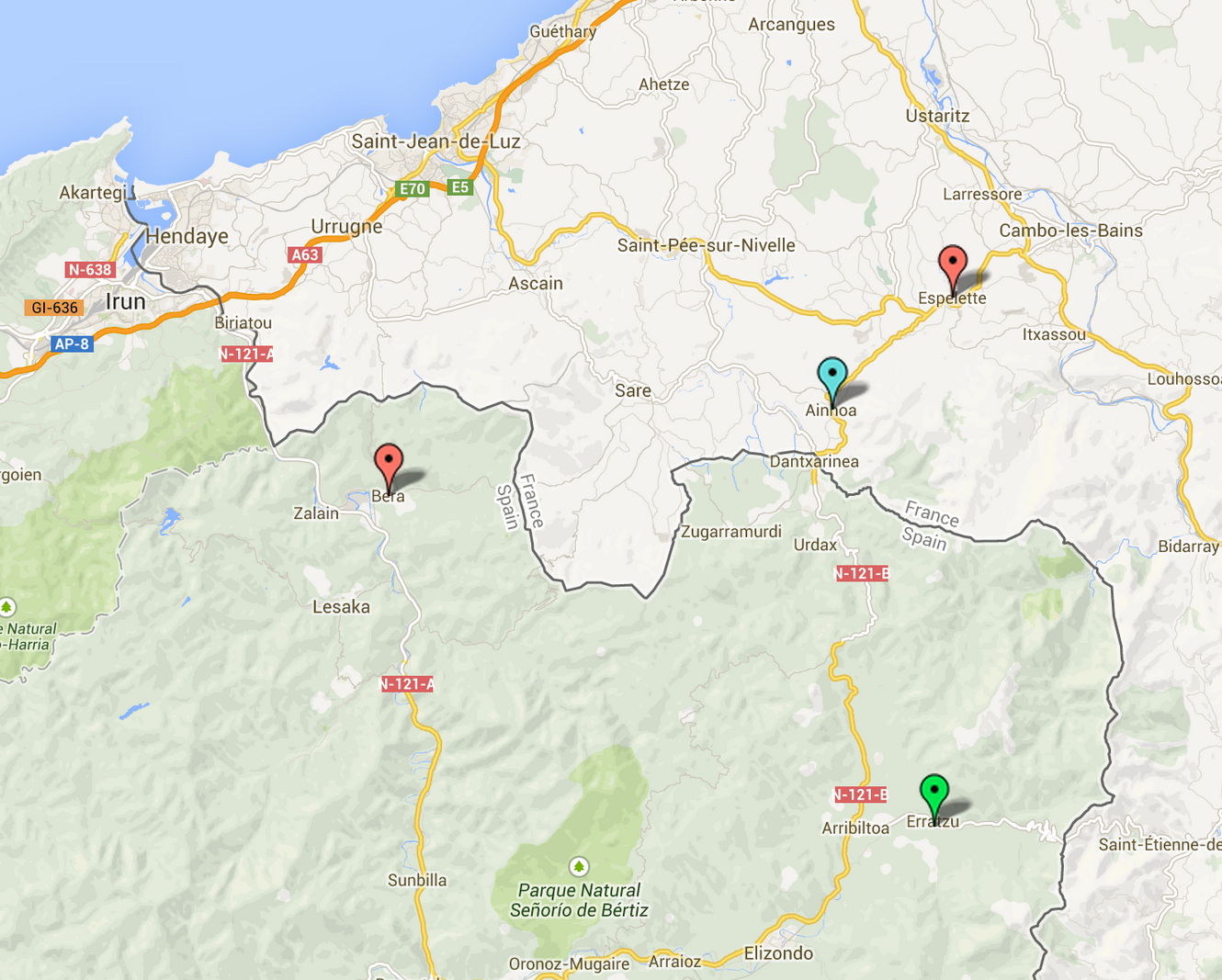
Based on the distinctive architecture, we’re obviously somewhere in Basque Country or Navarre along the Spanish – French border. The problem is though, with so little to go on, this week’s view could be in any of the hundreds of villages nestled into the foothills of the Pyrenees. So here’s a proximity guess: Bera, Spain.

Bingo on picking Basque, but two other readers shaved off a few more kilometers:

I would be very interested in knowing where this view from your window actually is, if it isn’t taken from Ainhoa, in the Basque province of Labord near the Spanish border of southwest France, an hour or less inland from the Atlantic and south of Baronne. My husband and I discovered this village in the middle of a field on a morning drive that had no ostensible destination, and although I’m a Creole from Louisiana I felt the strongest sense of deja vu, and was imbued with a deep sense of something lost and a longing.  If this guess is way off, I have appreciated the chance to remember the feeling.

Ainhoa is less than 15 km from where the photo was taken, and up until 10.47 am today it would have been the closest guess. But then an email arrived from VFYW Grand Champion Doug Chini:

“In the Basque country the land all looks very rich and green and the houses and villages look well-off and clean,” – Ernest Hemingway, The Sun Also Rises.

“You put your mind to it, you can accomplish anything,” – George McFly, Hill Valley, California

VFYW-Erratzu-Chini-Pinpoint

Well, that was easy. Or not. Some timbers, a lamp and bada bing, bada boom, this week’s view comes from the lovely little town of Erratzu, Spain, about an hour outside of Pamplona. The image looks due north from a second story rear window, most likely in room #3, of the Casa Rural Etxebeltzea. The exact coordinates of the viewer’s position are as follows: 43°10’50.26″N, 1°27’22.40″W. The architecture of the buildings in the foreground was crucial in finding the location, because both are related to the traditional baserri farmhouses of the Basques. In addition to the local sites and culture, perhaps your reader was in the region to see the recently concluded festival of San Fermin?

Attached are overhead and bird’s eye views, an exterior view of the likely window, as well as another taken from inside the hotel through the same window frame.

The photo submitter tells us the view is actually from the first floor window, but they look pretty similar:
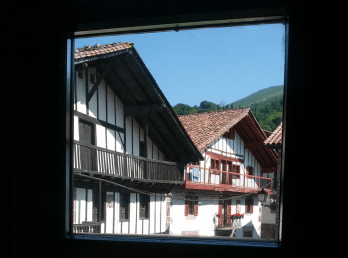
Screen Shot 2013-07-27 at 5.09.01 AMThe picture was taken from a room in the Etxebeltzea rural lodge house in Erratzu, Navarre, Spain. It is the building just to the north of this point in Google maps. There is only a fragmented view of the house from  Google street view as far as I can see in my mobile so I will give you a description of the position of the window: It is in the first floor, in the back of the building, looking north, and it would be the first window, from right to left, if you look at the building from the north. I hope that is clear enough.

He also lets us know why this place is important to him:

Erratzu is part of the Valley of Baztan, a place that my closest friend from childhood visited frequently for historical and genealogical research (in particular related to migration to the Americas). He felt in love with the place and at some point told his family that when he died, part of his ashes should be left there. Unfortunately we had to do this two years ago, since a brutal cancer took his life when he was only 45.

We left his ashes in the fields of Erratzu and family and friends come there from time to time to visit. The picture was taken on one of these occasions, when a group of long time friends (we were 13 and attended Sunday school together when we met, in the late seventies) visited Erratzu. We chose this house because it was one of his favourites in the area, and it is very close to the place where his ashes were left.

Since the guesses were so far flung this week, we mapped the overall spread:

VFYW-Guesses-201307227

This is how close our non-Grand Champion readers got:

Erratzu-Spain-VFYW-Winner-Context

Since Doug Chini has obviously won before, the prize this week goes to one of the two readers who guessed the next closest (Ainhoa, France – the blue pin in the map above) and who has also correctly guessed a difficult view in the past without yet winning:

I can’t decide what I find more frustrating; when I have absolutely no clue where a window is, or when I absolutely know the area but can’t for the life of me find the window itself.

It’s Basque, obviously. The painted wooden beams would be unforgettable even if I hadn’t driven through the Basque region just one month ago. I can’t tell if it’s the Spanish or French side, but purely on the basis of the lush green mountain I’m going to choose the French side, which is a tad more humid than the Spanish. Couldn’t find the window though, so I’m going to guess Ainhoa, because it seems to have more traditional Basque houses than almost anywhere and at least gave me something beautiful to look at during my hopeless Google Street View tour.

Congrats on what may have been our most difficult contest yet.

(Archive)

Orcas As Slaves For Entertainment

http://youtu.be/8OEjYquyjcg

While reviewing the new documentary Blackfish, which tells the story of a SeaWorld trainer killed by one of the park’s whales, Andrew O’Hehir contemplates animal rights:

While “Blackfish” largely focuses on the tragic story of SeaWorld, [trainer Dawn] Brancheau and [orca] Tilikum, the philosophical issues it raises along the way are much broader. As the experts in the film make clear, the more we learn about killer whales, the more we come to understand them as self-aware creatures possessed with high-level cognitive abilities, complex family and social structures, and distinctive forms of communication. While the word “language” remains contentious when applied to whales and dolphins – having been used too promiscuously by New Agers in the ‘70s — in recent years leading scientists have begun to talk about cetaceans possessing “culture,” as well as the psychological and emotional inner lives characteristic of “personhood.” In the film, evolutionary neurobiologist Lori Marino suggests that orca brains demonstrate a limbic system – the apparent seat of emotional life – more complicated than that found in humans.

As our awareness of the complexity of the animal world continues to evolve, and as the expanding human population puts the planet’s other inhabitants in greater danger, certain questions become irresistible. If we come to believe that orcas and other large marine mammals are conscious beings, individuals not unlike ourselves, then by what right do we arbitrarily abduct and imprison them for our entertainment? Or even, as SeaWorld would have it, for our education, for the advancement of science and for the furtherance of conservation efforts? One could argue that when Africans or Native Americans were kidnapped from their homelands and put on display in the great cities of Europe, it ultimately served to broaden human understanding. That doesn’t mean anyone would defend that practice today.

In many cases, we simply cannot know what consciousness is like for, say, an orca or a pig. We can hazard guesses from comparing their brains with ours – but, in my view, the captivity and use of any intelligent animal for entertainment will one day be seen as barbaric. It is a violation of the animals’ dignity. While that may not ascend quite to the level of human dignity, it demands that we cease treating our fellow inhabitants of earth as captive slaves. With the dominion humans have over the natural world comes great responsibility. And right now, we humans are behaving with criminal recklessness toward the planet that gave us life.

An interview with the director of Blackfish, Gabriela Cowperthwaite, is here. Earlier Dish on animal consciousness here, here, and here.

Dolan Spins Francis

Nothing the Cardinal says above is wrong exactly, but it’s classic spin from the bullshit artist who runs the New York archdiocese. The idea that Pope Benedict used the same tone toward homosexuals as Pope Francis – that there has been continuity on this – is absurd. Benedict’s move – strongly backed by Dolan – was at complete odds with Francis’ new tone. It was not to reassert the core doctrine that there is no sin in homosexuality, merely in non-procreative sex. That had definitely been the case already, and clarified in the 1975 letter that signaled the kind of openness and spirit that Francis represents. What Benedict did was deliberately to conflate the sin with the sinner eleven years later in 1986:

In the discussion which followed the publication of the [1975] Declaration, however, an overly benign interpretation was given to the homosexual condition itself, some going so far as to call it neutral, or even good. Although the particular inclination of the homosexual person is not a sin, it is a more or less strong tendency ordered toward an intrinsic moral evil; and thus the inclination itself must be seen as an objective disorder.

My italics. Not the acts – the very orientation itself is objectively disordered. Being gay was in no way, for Benedict or Dolan, even a morally neutral disposition. It was rather a form of disorder of the very heart and soul, that made gay people living refutations of God’s Creation – living crimes against nature.

This demonization of gay men was a return in Catholic teaching to medieval view of sodomites (which was chronologically linked to hatred of Jews as well, as John Boswell showed in his landmark book, Christianity, Homosexuality and Social Tolerance). Its plain meaning can be gleaned from the fact that, in an attempt to divert blame from himself for the child-rape scandal, Benedict subsequently issued an unprecedented discriminatory ruling, barring all gay men from entering the priesthood, solely because they were gay, with no distinction between their identity and their sexual acts.

Here is how he defended that anti-Christian position, as I noted yesterday:

In the end, [homosexuals’] attitude toward man and woman is somehow distorted, off center, and, in any case, is not within the direction of creation of which we have spoken.

That’s not about acts; it’s about a way of being human.

The Church does not teach that homosexuality is a choice, and so, to sustain the stigmatization of homosexuality in the face of new research and data, Benedict had to opine that gay people are intrinsically outside “the direction of creation” and our very nature is “somehow distorted.” Dolan can spin this any way he wants. But the proof of the malice was the blunt discrimination against gay priests regardless of their conduct in 2005, the absurdly brutal attacks on gay parents and gay people in the debate over civil marriage equality, and the obsessive-compulsive insistence on never hiring lay people who might conceivably be married to someone of the same gender (something never done with, say, re-married or divorced heterosexuals).

Dolan and Benedict have never, ever spoken of gay people the way Francis did. The question to be asked of Dolan is: why nit? Or is he just an apparatchik? Does Dolan still favor barring all gay seminarians solely because of their orientation? Will he stop discriminating against gay people while tolerating straight people who use contraception or are divorced or who have re-married? Does he refute the statements of the previous Pope? I wish Charlie and Gayle had been able to penetrate his bullshit. But it requires a granular theological expertise few general interest journalists have time to master.