On Comedy Podcasts

by Jessie Roberts

Marc Maron interviews Louis CK for his “WTF” podcast:

Cameron Tung explores the world of comedy podcasting:

Curiously, many comic-hosted podcasts are not shows that could be strictly defined as comedy. Instead, their salient features are often honest, uncensored, and insightful repartee between comedians. At times, podcasts function as salons where comics can gather to work out bits, exchange career advice, and engage in meaningful dialogue. The creative control that comics have over their podcasts allow them to do what they do best—talk—without restraints on time or content. The most skilled use this freedom to manufacture a unique, intimate product for a specific audience that is also a genuine reflection of the comic’s persona and artistic sensibility.

It is, perhaps, this sense of intimacy that producers and consumers of comedy podcasts find most captivating. Writing at Slate, Patton Oswalt asserted that the most remarkable quality of the standup Louis C.K.’s television series “Louie” is its ability to give “outsiders a clear and affectionate feeling for a world they might not inhabit.” This is the service that “WTF,” “You Had To Be There,” and a host of other comedy podcasts provide. Through millions of computers and smartphones, they offer audiences anywhere in the world an on-demand glimpse into a universe that’s normally curtained off from observation. And, it seems, a lot of people like what they hear.
Just There For The Articles

by Jessie Roberts

dish_playboy

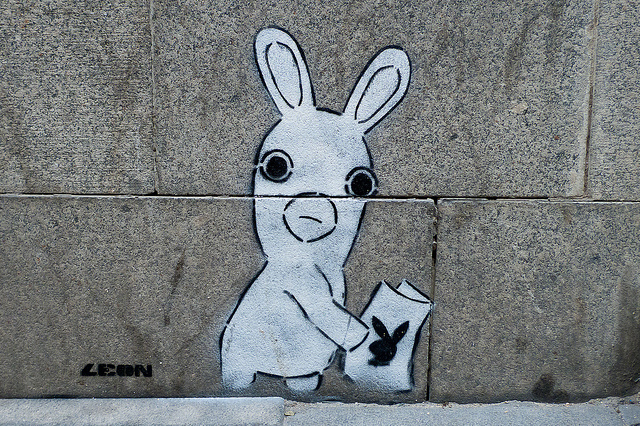
Amy Grace Loyd describes working as an editor at Playboy:

Working at Playboy does mean working alongside a parade of breasts (real or fake but always protuberant), an opera of breasts, really, but over time, in the course of my weeks and months there, I didn’t remark on them much. We worked in the New York office on Fifth Avenue, near one corner of Central Park and The Plaza. There were no photography studios on site, no auditions held for Playmates or Bunnies. So it was all the easier to believe what us editors and staff writers told ourselves: The women showcased in the magazine were carnival barkers. They got the folks into the tent, but it was the articles, the essays, the interviews and reviews, the short stories, that kept them there. I saw us as misunderstood, as an underdog.

You bet I’d drunk the Kool-Aid. It helped that my fellow editors were among the best I’d ever worked with. I expected some sexism, a run-in or two with sexual harassment, but I was disappointed in this, happily. Certainly sex was in the air, the stuff of endless humor, of puns, double-entendres. You had to be light on your feet. Usually the only woman in editorial meetings, I was especially good at providing straight lines, unwittingly, until I became better at playing along, keeping up. It was infantile but necessary to subdue all the elephants in the room, all the content we had no say over, and juxtapositions of that content, of high and low, that can still make me laugh out loud, still delight me for their irreverence and denial of this country’s determined conservative tastes, conservative everything. We worked hard, maybe harder than most monthly magazine staffs, to prove ourselves, in the hope, however slight, that readers, and the industry we were part of, might see the forest for the breasts.

Earlier Dish on the working environment at Playgirl here.

(Photo by Flickr user r2hox)

Face Of The Day

by Chris Bodenner

HONG KONG-SEX-EXPO

A man smells a sex toy at the Asia Adult Expo and Intimate Lingerie expo in Hong Kong on August 29, 2013. After failing to take place in Hong Kong over the years, the event opened in the former British colony and will run from August 29 to 31. By Philippe Lopez/AFP/Getty Images.

What’s In A Dance?

By Brendan James

Susan Shepard highlights a 2005 tax case up for appeal, centered on the whether a man’s strip club provides genuine “artistic performance”:

The origin of the case stems from a provision in New York’s tax code that exempts dramatic and musical performances from sales taxes. The Court ruled that the stage and private performances taking place inside of Nite Moves did not qualify as such. But when courts make a determination as to what is and is not art, they are not on the most solid ground. As the dissenting opinion read, “It does not matter if the dance was artistic or crude, boring or erotic. Under New York’s tax law, a dance is a dance.” After that defeat, [owner Stephen] Dick hired First Amendment expert Robert Corn-Revere, who has petitioned the Supreme Court to hear their appeal.

She interviews anthropologist and dancer Judith Lynn Hanna, who testified in the case that stripping and lap dancing qualify as a “choreographed performance”:

A choreographed performance is a performance that has some plan. And it has some specific use of time, space, effort, and of body movement and posture. Just as a dancer on stage has a routine, whether she’s going to the mirror, whether she’s going to the pole, whether she’s changing flow over the performance, it usually very much depends on the dancer’s earlier background. Some people have had ballet, some have been in dance companies, some draw on moves they had as a cheerleader or social dancing, They watch television or they just watch the dancers who are already dancing and learn like most people learn, which is by watching or being coached.

So the issue was can you have improvisation? Well, of course. Even in a very choreographed ballet performance there can be interpretation by the specific dancer. Some people just think that you don’t dance when you are an exotic dancer or doing striptease, that all you do is get up and shake your booty.

Colbert covered the story here.

Beer Goggles In The Lab

by Brendan James

https://www.youtube.com/watch?v=JtS2PGXPUTs

To explain the effect of booze on perception, researches ran an experiment that found “acute alcohol consumption decreases ability to detect asymmetry in faces”:

Twenty images of a pair of faces and then 20 images of a single face were displayed on a computer, one at a time. Participants were instructed to state which face of each of the face pairs displayed was most attractive and then whether the single face being displayed was symmetrical or not. Data were collected near campus bars at Roehampton University. Sixty-four self-selecting students who undertook the study were classified as either sober (control) or intoxicated with alcohol. For each face pair or single face displayed, participant response was recorded and details of the alcohol consumption of participants that day were also obtained. Sober participants had a greater preference for symmetrical faces and were better at detecting whether a face was symmetrical or otherwise, supporting the hypotheses.

The Art Of Ink

by Jessie Roberts

Margot Mifflin reviews Ed Hardy’s memoir, Wear Your Dreams: My Life in Tattoos:

[Hardy] opened Realistic Tattoo in San Francisco, the first appointment-only shop devoted to custom designs. Realistic is the reason tattoo shops today are more like art dish_tattoo2 studios, galleries, or hair salons; the reason name tattooists have waiting lists stretching sometimes years into the future; the reason more people plan out their tattoo collections and research the best artist for a particular job; the reason so many art school graduates are pushing ink; and the reason that despite the ocean of bad skin art sloshing around the globe, the best work is increasingly excellent. Do an online search, for instance, of Duke Riley (Brooklyn), Roxx TwoSpirit (San Francisco), Colin Dale (Copenhagen), Saira Hunjan (London), or Yann Black (Montreal), then sit back and allow your brain to quake.

Hardy’s ambition has always been to bridge the worlds of fine art and tattooing. “I wanted to elevate the art form,” he writes:

Having graduated from art school, I brought […] a sense of art history, a fierce dedication to the medium, and something of a chip on my shoulder toward the rest of the world that failed to hold the art of tattoo in the same regard I did.

Until recently, that was a failed mission. The establishment art world has shown little interest in tattoo as design, fine art, street art, or fashion, for reasons involving money, class bias, and the difficulty of exhibiting human bodies. But the first stirrings of change are evident: last year, the Honolulu Museum of Art mounted a show of ten contemporary Hawaiian tattooists. The Milwaukee Art Museum just opened an exhibit of the work of Amund Dietzel, a legendary Old School Milwaukee tattooist. And this year, museums in Germany (The Museum Villa Rot) and Switzerland (the Gewerbemuseum) have organized tattoo exhibitions.

Recent Dish on tattoos here and here.

(Photo of work by Amund Dietzel at the Milwaukee Art Museum by PunkToad)

What’s Wrong With Office Romance?

by Patrick Appel

Why Ann Friedman doesn’t date co-workers:

In many workplaces, young women still have to work hard to prove they’re professionals and not coffee-fetching interns or office eye candy, and it seems like office romance would undercut their efforts to be taken seriously. Despite the increasing general acceptance of intra-office romance, research shows women who date a co-worker are more likely than men to be seen as using the relationship to get ahead at work. Then there are classic concerns about weathering a breakup with someone in the next cubicle over. “Every time I’ve been heartbroken, I would not have been able to deal with that at work,” says a friend of mine who shares my no-co-workers rule.

Picasso As Playwright

by Jessie Roberts

Jerome Rothenberg is translating The Four Little Girls, the second of two plays Picasso wrote in the 1940s:

While there may be less razzle-dazzle here than in the better known Desire Trapped by the Tail, there was a pop, almost juvenile quality in the language, or in how I perceived the language, that I wanted to emulate in the version I was starting to transcreate. My sense of Picasso poète then & now, contrary to Gertrude Stein’s dismissal of him, was that what he offered was the real goods which his awesome reputation as an artist only tended to obscure.

An excerpt from a scene that takes place in a vegetable garden:

little girl i – singing – we’re not gonna go to the woods no more the laurel trees are down on the floor & the beautiful babe hey (she shouts) hey hey hey cause the cat has taken a dish_houseinagarden bird from the nest in his mouth & he’s choking it now with his claws & dragging it back of the lemony cloud dipped in butter that melts on the edge of a wall that’s all bunged up with earth & a sun that’s covered with ash.

little girl iii – oh that’s just too dumb

little girl iv – go take your places down by the flowers the knitting yarn trailing all over the garden & hanging its rosary beads up like eyes & the full cups of wine in fine crystal the organs we listen to short little arms pitterpatting the cotton wool sky from somewhere in back of the big rhubarb leaves.

little girl i – go take your places your places life’s wrapping me up my passion’s like chalk on my coat it’s in tatters & full of black ink stains that flow down my throat from the blind hands that seek out the mouth of the wound.

little girl iii (hidden in back of the well) that’s it yes that’s it yes that’s it.

little girls i – ii – iv – dumb dumb – you’re so dumb – you’re two times as visible there – yeah yeah everyone sees you – you’re totally naked & covered with rainbows. Go fix up your hair it’s on fire it’s starting to burn up the string of bows scraped on the tangled-up hairdo of bells licked clean by the mistral.

little girl iii – that’s it – yes that’s it – that’s just it you can’t catch me alive & can’t see me – I’m dead.

little girl iv – don’t be such a jerk

(Image: House in a Garden, by Picasso, via Flickr user jmussuto)