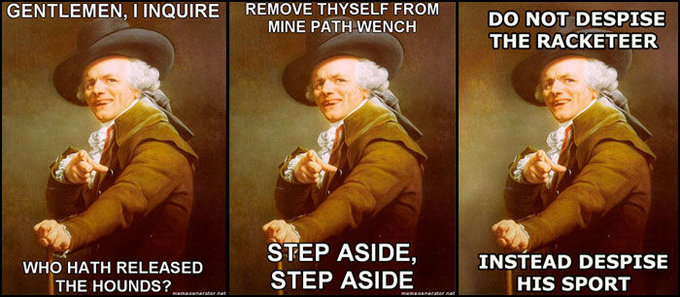
Jessica Love deconstructs the image macro, or the captioned images that pervade the Internet:
As with most games, there are rules. Some image macros—those built around the sarcastic catchphrase Cool Story, Bro come immediately to mind—should only be posted in specific contexts, such as in response to a previous contribution that was overly long and personal.
Captions, on the other hand, tend to be generated according to templates that dictate how words are spelled (the vs. teh vs. th), how they are pronounced (Oh my God vs. O.M.G. vs. ermahgerd), and how they are strung together. Consider, for instance, one image macro series built around the self-portrait of 18th-century painter Joseph Ducreux. Here, captions are composed of modern-day rap lyrics translated into faux-formal, old-timey English (Gentlemen, I inquire: Who hath released the hounds?).
She notes that memes are “creeping offline”:
The Internet slang phrase “nom nom nom” can now be heard around the technophobe’s dinner table; what will be next to make the jump? Perhaps the use of –fag as a suffix? Brennan explains that the suffix was coined on the image-posting board 4chan in 2007 as an equal-opportunity descriptor: there were newfags who were new to the forum (and thus looked down upon), but also oldfags and musicfags and artfags. “Despite the homophobia and hate associated with the suffix, it’s been adopted and used as an identifier within some communities,” she tells me.
(Image from Know Your Meme)
 The Dish