It’s ugly:
The new report from Bureau of Labor Statistics shows the U.S. economy added only 74,000 jobs in December, far below economists’ expectations. The unemployment rate dropped to 6.7% – its lowest point since October 2008 – but that appears largely to be the result of people dropping out of the workforce.
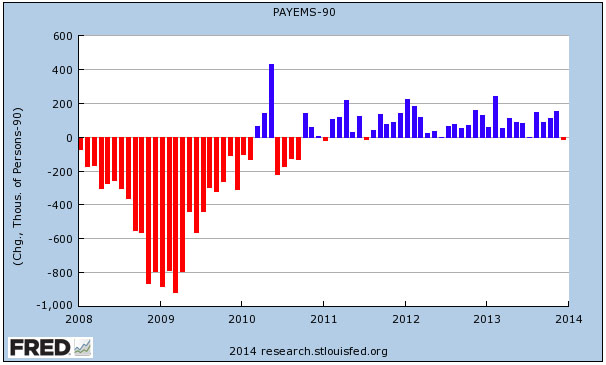
Drum created the above chart, which shows net job growth:
The American economy added 74,000 new jobs in December, but about 90,000 of those jobs were needed just to keep up with population growth, so net job growth clocked in at minus 16,000. There’s no way to sugar coat this: it’s pretty dismal news.
Matt Phillips suspects it was a fluke:
[S]omething doesn’t smell right about this report. For one thing, it jibes with hardly any of the other data we’ve been getting about the US labor market lately. … US stock futures are still in positive territory. And while there has been a bit of money flowing into US Treasurys, it’s not as if there’s a huge rush to safety driven by deep concerns about the economy. The market believes that this is a blip that’s better ignored. And for once, we’re going to say the market is right.
Felix Salmon blames the weather:
Once you take into account the weather … the December report wasn’t that bad.
A whopping 273,000 people were counted as “Employed – Nonagriculture industries, Bad weather, With a job not at work”, which is to say that they did not get counted in the payrolls figures even though they’re employed. Most of the time, that number is in the 25,000 to 50,000 range, and although it always spikes in the winter, this was the worst December for weather-related absence from work since 1977.
Greg Ip focuses on the bigger picture:
The more fundamental reason to worry is the ostensibly good news that unemployment had fallen to its lowest since late 2008. This was not principally due to the rise in employment but the fact that the number of people in the labour force (i.e. either working, or looking for work), tumbled 347,000 – even as the population grew 178,000. As a result, the labour force participation rate plunged to 62.8%, tying November’s figure for the lowest since 1978. The number of people who are not in the labour force but want a job – so called discouraged workers – jumped 332,000.
This is not a fluke. The labour force participation rate has been trending lower since before the recession. This remains by far the most vexing puzzle of the labour market.
Neil Irwin weighs in:
[T]he usual caveats around the jobs numbers — it is one month’s number, with a big range of error around it –apply more than usual in this one. Still, one doesn’t envy the policymakers who have to decide what to do based on this shaky data. The Federal Reserve’s policy committee meets at the end of the month and will have to decide whether to continue “tapering” their bond-buying program.
Kevin Roose adds:
The numbers are almost certainly going to be revised next month. But the initial signal is that we’ve been too hasty in calling this a healthy economy. The labor force participation rate fell by .8 percent, meaning that more people stopped looking for work altogether. And several key industries — construction and health care among them — lost jobs for the first time in months…. today’s report is a sign that we’re still dealing with a fragile economy, made more fragile on the policy side by threats of extending sequestration and letting unemployment insurance lapse.
 The Dish