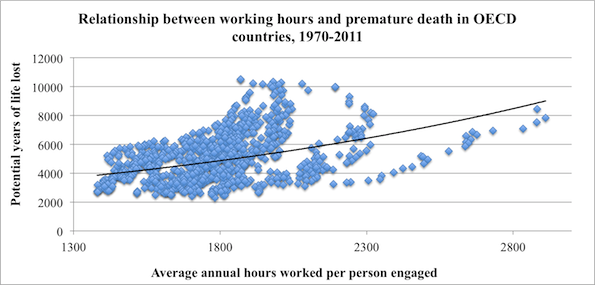
The graph … shows the relationship between working hours and “potential years of life lost” (PYLL), both of which were taken from the OECD. PYLL is a measure of premature mortality, which estimates the average number of years a person would have lived if they had not died prematurely. It gives more weight to deaths among younger people and may therefore be a better measure of mortality. The higher the value of PYLL, the worse. …
Longer working hours seem to lead to higher premature mortality. (For stats nerds: the strength of the relationship is significant, with an r-squared of 0.2). The implication that over-work is bad for you chimes with lots of research (such as here, here and here) which links long working hours with poor health. Stress, for example, can contribute to range of problems like heart disease and depression. That was, indeed, what the philosopher Bertrand Russell argued back in the 1930s. Overwork, said Russell, led to “frayed nerves, weariness, and dyspepsia”.
 The Dish