James Bruno laments that the US still hands out ambassadorial appointments as political prizes:
When hotel magnate George Tsunis, Obama’s nominee for Oslo, met with the Senate last month, he made clear that he didn’t know that Norway was a constitutional monarchy and wrongly stated that one of the ruling coalition political parties was a hate-spewing “fringe element.” Another of the president’s picks, Colleen Bell, who is headed to Budapest, could not answer questions about the United States’ strategic interests in Hungary. But could the president really expect that she’d be an expert on the region? Her previous gig was as a producer for the TV soap opera The Bold and the Beautiful. She stumbled through responses to Senator John McCain (R-Ariz.) like, well, a soap opera star, expounding on world peace. When the whole awkward exchange concluded, the senator grinned. “I have no more questions for this incredibly highly qualified group of nominees,” McCain said sarcastically. …
The reason a hotelier and a television producer, for instance, might be appealing choices is blindingly obvious: money. Bell raised $2,101,635 for President Obama’s re-election efforts. Tsunis, who flipped his affiliation from Republican to Democrat in 2009, embraced his new party with gusto, raising $988,550 for the president’s 2012 bid.
Henri J. Barkey takes Obama to task for what he calls “a disservice to diplomacy”:
The Obama administration’s appointments suggest that the president isn’t being honest when he says that diplomacy is important to him. Yet the administration clearly values diplomacy — officials, including the president, have emphasized that the ongoing negotiations with Iran are the way to resolve the nuclear impasse. Would Obama consider making Tsunis our negotiator? Of course not. Yet it’s illogical, and insulting, to presume that Norwegians are such wonderful and civilized people — and hence unlikely to cause any problems with Washington — that we can afford to send someone on a taxpayer-funded three-year junket to enjoy the fjords.
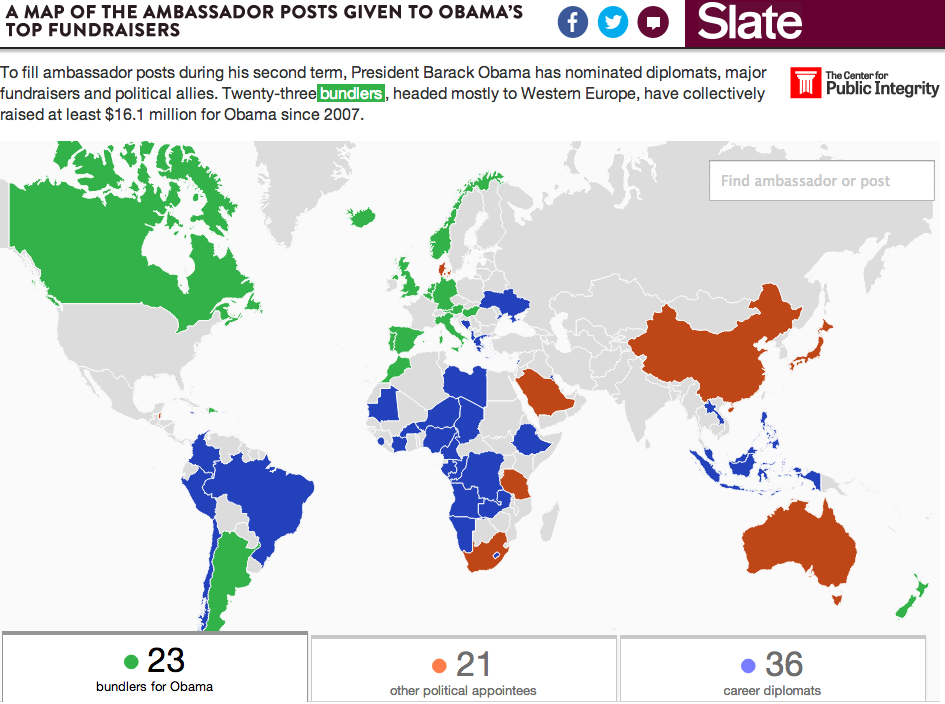
But Fisher, who passes along the above map from Slate, sees a silver lining:
There may be an upshot to all this. Career diplomats are probably, in most circumstances, also going to be the best diplomats. They’re competing against campaign bundlers for assignments, though, and they seem to lose out for assignments like Belgium or Italy. Countries like Egypt and Russia are probably important enough that no administration would send a bundler there. But there’s a category of countries that are not Egypt-level difficult to demand a technocratic assignment, nor Portugal-level fun that a campaign bundler gets it.
You have to wonder if some number of really talented diplomats, who in a universe without campaign bundlers would get sent to Austria or Italy, are instead getting sent to countries like Malaysia or Peru. Countries they would otherwise be too experienced or talented to be sent to. And maybe, as a result, the United States has unusually good diplomatic representation in a lot of the blue countries in this map. That could maybe have helped a little bit in sub-Saharan Africa, where, as G. Pascal Zachary argued in The Atlantic, the United States has seen significant diplomatic gains.
 The Dish