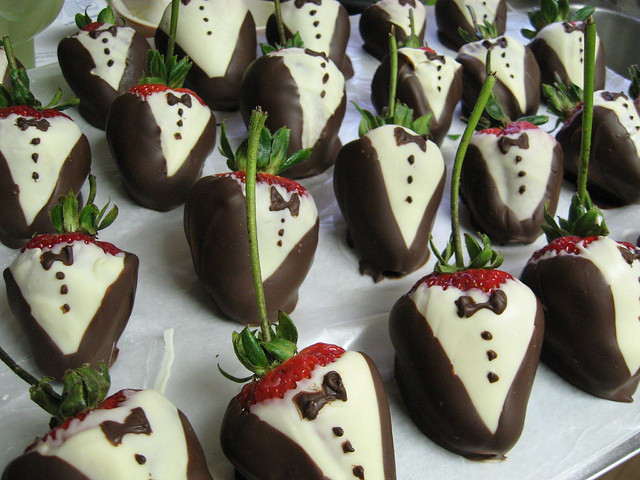
Sadie Stein investigates the practice of dipping strawberries into layers of white and milk chocolate, or the “art of dressing strawberries in tuxedos”:
As we know, chocolate-dipped strawberries have long held a cherished place in the echelons of Romantic Signifiers. Apocryphal sources from around the Internet claim that a woman named Lorraine Lorusso invented them in the sixties, when she was a candy buyer for Stop & Shop in Chicago—she used to demonstrate new products at the front of the store, and as looked at the strawberries one day, it occurred to her that they ought to be dipped, immediately, in chocolate. But who was the genius who decided to dress the strawberry in formal wear? Google yields no results, although one suspects the eighties. Like the large martini glass filled with mashed potatoes, or the bed strewn with rose petals, its origins are lost in the mists of time. Like love itself, it simply Is. In the immortal words of James Baldwin, “Love is a battle, love is a war; love is a growing up.” Love is a strawberry dressed in a chocolate tuxedo.
Meanwhile, Meg Favreau notes that “from the time Spanish explorers brought chocolate to Europe all the way until the 1900s, chocolate was considered to be more medicine and less treat”:
Even when the humoral theory of medicine faded out of fashion, people remained convinced of chocolate’s cure-all properties. In an 1845 issue of The Magazine of Science, and Schools of Art, there’s this note:
Chocolate is a very important article of diet, as it may be literally termed meat and drink; and were our half-starved artisans, over-wrought factory children, and rickety millinery girls induced to drink it instead of the innutritious and beverage called tea, its nutritive qualities would soon develop themselves in their improved and more robust constitutions.
And of course, in the 1800s and early 1900s, there were chocolate tonics to cure all ills, some more legit than others – Dr. Day’s Chocolate Tonic Laxative and Hauswaldt Vigor Chocolate, among others.
Throughout all of this, people did also consume chocolate solely for pleasure – although not nearly to the extent that they do today. By some accounts, the wives of Spanish colonists were obsessed with drinking chocolate, and in The True History of Chocolate, writers Sophie D. Coe and Michael D. Coe state that, “There is a misconception among some food writers that solid chocolate confectionery is a fairly modern invention… Yet there is evidence that such sweets were being manufactured early on in Mexico… [and] They almost certainly graced many a banquet table in Baroque Europe.” But despite all of this eating of chocolate as sweet, it wasn’t until the 1950s that chocolate was solely marketed for pleasure, no medical claims attached.
(Photo from Flickr user kimberlykv)
 The Dish