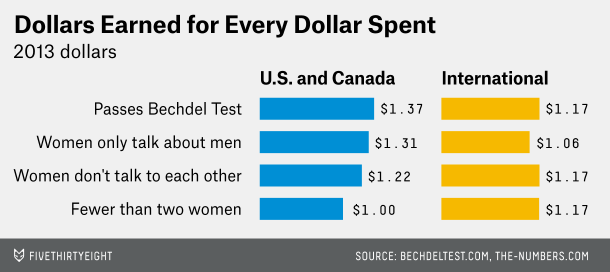
Walt Hickey employs the Bechdel test to argue that Hollywood’s exclusion of women makes no economic sense:
[T]here’s a wide-ranging perception in Hollywood that audiences — in the U.S. and abroad — simply don’t care for women in leading roles and that movies for and about men are more likely to have better cross-market appeal than movies about women. The theory is that “women will go to a ‘guy’s movie’ more easily than guys will go to a ‘woman’s movie,’” said Michael Shamberg, who produced “Pulp Fiction” (1994), “Django Unchained”(2012) and “Garden State” (2004).
This assumption is up for debate; we found that films that pass the Bechdel test tend to do better dollar for dollar than those that don’t — even internationally. …
The total median gross return on investment for a film that passed the Bechdel test was $2.68 for each dollar spent. The total median gross return on investment for films that failed was only $2.45 for each dollar spent. And while this might be a side effect of films with lower budgets tending to have higher returns on investment than films with higher budgets, it’s still a strong indicator that films with women in somewhat prominent roles are performing well.
Alyssa applauds:
This is exactly the kind of analysis that I suggested data-driven journalists could profitably contribute to entertainment reporting back when FiveThirtyEight.com launched. And it is exactly the sort of data that backs up the anecdotal evidence that those of us who would like to see more female characters, and more kinds of stories about women, have been brandishing at Hollywood for years. If skeptics of women-centered stories are able to brush off examples like the billion-dollar box office for “Frozen” as some sort of fluke, maybe long-range data like Hickey presents here, and that which [journalism professor Stacy] Smith is assembling, can start to turn this titantically misguided assumption around.
 The Dish