Over The Hill At 24, Ctd

A reader doesn’t quite buy the notion that cognitive performance peaks in one’s mid-20s:

Yeah, bite me. Gabriel Garcia Marquez was 40 when he published his most popular and most seminal work, One Hundred Years of Solitude. You hear that? One hundred years. What, are the next 76 going to be in spent in obsolescence? His characters lived a hell of a lot longer than 24, and they were lively and smart to the very end. In the real world – Newton, Dickens, Springsteen. Sure, you can say “But they’re geniuses,” but billions of regular folk get sharper and better with age.

These kinds of studies just reinforce the concept of life as a rat race – a minute-by-minute, day-by-day competition to win at the game of life instead of lose. That’s not healthy. Life is amazing, as Carl Sagan said. It’s not a battle. There are no winners and losers. What makes true happiness? I would posit an answer of living a content life, free from anxiety and worry – including the worries about studies that say you’re over the hill when you’re still young enough to be carded at restaurants.

A 27-year-old reader:

I’ve got to question the reasoning behind seeing a lag in “seeing and doing” between a 24-year-old and a 39-year-old. Can we not chalk that up to a penchant for slightly more forethought and planning as we age? No doubt there is a bit of pruning that goes on following adolescence. (I know because the Dish told me so.) Brains shrink. Synapses slow. In the context of judgment calls, I would argue the ability to plot strategy – chess vs. checkers – increases over time.

Mostly though, I know I’m on the downhill slide. Don’t rub it in.

But maybe he isn’t; another reader points to a recent article in New Scientist in which computational linguists Michael Ramscar and Harald Baayen argue that “our brains work better with age”:

Contrary to popular belief, neuronal loss does not play a significant role in age-related changes in brain structure. Rather, consistent with our findings, most of the changes that occur as healthy brains age are difficult to distinguish from those that occur as we learn. Thus, understanding the costs and benefits of learning is critical if we are to establish the facts of cognitive aging.

For example, memory experiments show that, as we age, we “encode” less contextual information, such as what we were wearing when we learned a new fact. This makes the fact harder to recall, and is seen as a sign of cognitive decline. Yet everything we know about the way our brains learn indicates that people must inevitably become insensitive to many background details as life experience grows. This is simply because detuning our attention to irrelevant information is integral to the process we call “learning”. …

We are not arguing that the functionality of our brains stays the same as we grow older, or that cognitive decline never happens, even in healthy aging. What we do know is the changes in performance seen on tests such as the PAL task are not evidence of cognitive or physiological decline in aging brains. Instead, they are evidence of continued learning and increased knowledge. This point is critical when it comes to older people’s beliefs about their cognitive abilities. People who believe their abilities can improve with work have been shown to learn far better than those who believe abilities are fixed.

The aforementioned reader adds, “I know I would rather have a 24-year-old as a fighter pilot, but a 50-year-old as an airline pilot.” He’s not the only one: a historically-minded reader notes that “in the Second World War, the Royal Air Force limited fighter combat to pilots who were younger than 26. Their estimate was that the reflexes began to slow enough to make it a fatal risk.” Update from a reader:

First of all: as a 28-year-old gamer-scientist who plays both StarCraft 1 (SC1) and StarCraft 2 (SC2) – and both since launch – I’ve been playing SC1 for just over 16 years now! – this journal article is fucking infuriating. So much bad science, so much bad gaming reporting. First of all: the base data (Ref. 1 in the PLoS article, which you can find here), only looks at a few characteristics as to what makes a “better” gamer in SC2. It turns out: being a faster neurotic (higher APM), using high tech unit / spell casters more often and wisely. The follow-up looks at how players across different ages compare to these “characteristics” and what their league level is.

Ok, here’s my scientist part: what is their control game? So far all I’ve seen is data that shows older SC2 players do worse according to their definitions of a good SC2 player compared to younger players.

As a gamer: SC1 and SC2 are different games with almost the same base. Older players who played a lot of SC1 just do NOT play SC2 the same way because we have over a decade of training to play it differently. SC1 rewards: high APM, high macro, high tech / low spell units. And if you look at the data in the cited PLoS article, it turns out the data seems to say: hey, lower skill players are all over the place (fig 3(a) in ref), but high skill players are all concentrated in the young groups (fig 3(f) in ref).

As a scientist: do other games of similar skill/age profiles show the same age-histograms? Could it be that older people have less time to play these types of games and therefore make up less of the % of leagues?

As a gamer, on pg 6 they directly mention that older gamers do better than younger players on a direct skill that was highly rewarded in SC1. As an “older” SC1/2 gamers, this fits my first point – SC1 players who transitioned to SC2 just play differently. It’s a mechanics issue where the new rules are directly fighting against 10+ years of trained playing.

Finally: we have seen over multiple reports recently that there has been a giant uptick in cognitive ability that might be directly related to lead exposure (see all the reporting by Kevin Drum at Mother Jones, but I have heard sociologists talking about this since at least 2005). You are looking at a report that compares people from ages 16-44 (those born between 1997 – 1969). So whats the baseline cognitive ability? Yes, there could be one, but there is no control.

A Latta Discrimination

A reader writes:

I know you’re not the biggest fan of pushes for laws such as ENDA, but thought I would share this with you anyway. Crystal Moore has been with the police force of sleepy Latta, South Carolina for more than 20 years, capping her career serving as the town’s police chief. She’s an out lesbian. On April 15, she was fired by the mayor, her pristine service record being marred by the SEVEN disciplinary letters he handed to her that very afternoon. After refusing to sign without having an attorney check them out, he dismissed her. These letters were the result of the police chief investigating a recent hire of the mayor’s for whom the mayor did not do his due diligence, and who was supposedly driving a city vehicle with a suspended license. Now, all of a sudden he’s not answering questions regarding the firing but was recorded in conversation with a fellow council member saying the following (audio here):

I would much rather have.. and I will say this to anybody’s face… somebody who drank and drank too much taking care of my child than I had somebody whose lifestyle is questionable around children.

Because that ain’t the damn way it’s supposed to be. You know.. you got people out there – I’m telling you buddy – I don’t agree with some of the lifestyles that I see portrayed and I don’t say anything because that is the way they want to live, but I am not going to let my child be around. I’m not going to let two women stand up there and hold hands and let my child be aware of it. And I’m not going to see them do it with two men neither. I’m not going to do it. Because that ain’t the way the world works.

Now, all these people showering down and saying “Oh it’s a different lifestyle they can have it.” Ok, fine and dandy, but I don’t have to look at it and I don’t want my child around it.

Pure bigotry. Disgusting. But the silver lining to this is the amount of outcry from within the small, rural community of all ages and races have been rallying to her cause. She was a good, competent police chief. She was well regarded in the community, and they see what Mayor Bullard did and recognize it for exactly what it is – animus. Local reports have said that in excess of 100 people filled council chambers and out into the hallways, despite the mayor’s best efforts to quash debate, even going so far as to forbid entry to the public meeting to nonresidents of the town (illegal).

I’m from this region of South Carolina, and I couldn’t be more proud of all the folks for standing up for what’s right. I’m hoping the council is able to reinstate Chief Moore. Unfortunately in SC, by law there’s no way to impeach a mayor; only the governor can remove them from office for committing crimes. I have my doubts that Gov. Haley will remove the mayor despite what may prove to be several illegal actions by the mayor.

Update from a reader:

I finally know enough about something to write in because am originally from the tiny town of Latta and personally know many of the people involved.

One aspect of the case that the previous reader left out is that prior to Ms. Moore’s firing, the town’s recreation department head, who also happens to be openly gay, abruptly resigned and took another job in a nearby town shortly after the town’s new mayor took over last December. She was also a well-respected member of the community and by all accounts had also done a fantastic job in running her department. So we have two high-profile gay citizens with exemplary records and many years on the job who are both now gone (one resigned, one terminated) within a few months of an unabashedly anti-gay mayor coming into office. On the surface, it appears to be an open and shut case of discrimination on the basis of sexual orientation.

The problem here is that quite often in small towns, it is very difficult to get to the truth in matters such as this. Although I have been very proud to see a community that is very conservative and Christian rising up to support the former police chief, the charges of anti-gay animus have somewhat overwhelmed the facts in the case – namely, the seven reprimands that the mayor drew up in short order against Ms. Moore. Very few people know exactly what has transpired in the police department, yet the protesting citizens of the town have decided that they know the real reason for the firing and are out to reconcile the situation via public pressure.

We will most likely see this play out in the courts. I do hope that that process reveals the truth in the case. In the meantime, my tiny hometown will have to serve as a flashpoint in the very complicated arena of equal rights.

A Blow To Race-Based Admissions

This morning the Supreme Court issued a 6-2 ruling (pdf) upholding a Michigan referendum banning affirmative action in college admissions, reversing a 6th Circuit decision:

Justice Kennedy penned the plurality opinion for the court, joined by Justices Alito and Chief Justice Roberts, arguing that neither the Constitution nor previous court precedent gives the courts the authority to overturn a voter-approved prohibition on race-conscious admissions policies. Justices Breyer, Scalia, and Thomas filed concurring opinions, while Sotomayor wrote the dissenting opinion. Justice Ginsburg joined in the dissent, while Justice Kagan was recused from the case and did not vote.

“It is important to note what this case is not about,” Kennedy wrote in his opinion. “It is not about the constitutionality, or the merits, of race-conscious admissions policies in higher education.” The Coalition to Defend Affirmative Action had challenged the state ban on constitutional grounds, arguing that the voter ban violated the equal protection clause of the Fourteenth Amendment.

Nora Caplan-Bricker explains the likely repercussions of the ruling:

[I]ts most immediate impact will be in the six other states that, like Michigan, have passed ballot initiatives banning affirmative action: Arizona, Florida, Nebraska, New Hampshire, Oklahoma and Washington.

Any attempt to challenge those bans is now “futile,” Robert M. O’Neil of The University of Virginia School of Law wrote in an e-mail. The ruling could also inspire other states to hold ballot initiatives—or could spur out-of state activists to look for places propose them, said Michael A. Olivas of the University of Houston Law Center.

The opening for activists could stretch beyond racial preference in admissions. Barbara A. Lee, an attorney who teaches at Rutgers’ School of Management and Labor Relations, predicted the ruling would “encourage those who oppose any form of preference (possibly even those related to social class, income, geography, etc.) to organize a grassroots movement to eradicate by ballot initiative the policies that educators have developed to broaden the scope of educational opportunity for groups traditionally excluded from access to public higher education, either by law or by poverty.”

When the Supremes took up the case last year, Bazelon called it “a case that liberals will lose, and probably deserve to lose”:

It’s about whether states may ban schools from using affirmative action. That’s what Michigan did by passing a ballot initiative in 2003 called Proposal 2. I wouldn’t have voted for it. But should the Supreme Court say that when voters decide to restrict the use of affirmative action, they have violated the Constitution? There is no way that the conservative majority of the Supreme Court will answer yes. And that is probably the correct outcome in terms of policy. To say so deviates from the usual liberal line on affirmative action, laid out today in a New York Times editorial.

And yet: The current huge fairness problem in university admissions isn’t race-based. It’s class-based. And it is at the schools of the 10 states across the country that have banned affirmative action where the most interesting socioeconomic alternatives are unfolding. The Supreme Court won’t stand in the way of those experiments. And it shouldn’t.

David Plouffe On Becker’s Book: “Decidedly Inaccurate”

The account Jo Becker gives of the Obama administration’s response to the issue of marriage equality is one of the few parts of the book that has not been demolished since it was published. Since her account did not square with my own memory, I asked David Plouffe to address some of the claims in the book and he was eager to do so. Plouffe ran Obama’s 2008 campaign and during the time in question was Senior Adviser To The President.

Below is a Q and A I had with Plouffe today on the events Becker purports to report. My questions are in italics. Plouffe’s answers follow:

AS:  Becker’s book argues that the president’s position seemed stalled on marriage equality in 2011 and 2012 and that he likely did not intend to evolve any further on marriage before his second term. Do you agree?

DP: Absolutely not. The President made a decision that he was ready to “fully evolve” and announce his support for marriage equality. As he put it, “If I get asked if I was still a state legislator in Illinois would I vote to recognize same sex marriages as New York State did, the answer will be yes.” So the only question was when and how to announce in 2012 he would be the first President to support marriage equality, not whether to.

AS: What were the major and minor influences that caused the president to embrace marriage equality when he did?

DP: His evolution was not contrived as some suggest, but real. He spoke powerfully to some of his reasons in the Robin Roberts interview, but also the decision not to defend DOMA was instrumental, as well as the increasing number of states that were recognizing marriage. However, his family and friends and the discussions they had were likely the single greatest influence. His ultimate support for marriage equality was arrived at in a way that while public, was not too dissimilar to the journey many of us in the country took. Also, the President believed his support for marriage equality could change the opinions of some in his electoral coalition – witness the striking change in support in the African-American community which was illustrated in the Maryland ballot initiative results in 2012.

Given the Democratic convention and the Debates, where this issue was sure to come up, and that he had personally decided to support marriage equality, the plan was to make sure the announcement was made by June.

AS: Did Biden force your hand on substance? Or just the timing? What was the president’s personal response to Biden’s public statement?

DP: Not even the timing really. We were planning to do so within a week or two. So it might have sped it up by a matter of days, if that. He was very calm about it. He understood that this would be a historic moment and years from now, if not months (which turned out to be the case for most) all that mattered would be the words he spoke, not the process to get there. I will confess to being exercised because this was a historic moment and I wanted that to be the focus, not why we were doing it or how the timing was forced. He was right, I was wrong.

AS: David Brooks argues today that judging from Becker’s book, this was a decision dominated by elite political strategists. Is that your recollection?

DP: Not all all.

DP: Once he made the decisions, it was a settled debate. All we did was help think thru the timing and some of the questions that would arise from his statement. I understand the Becker book may give people that sense. It is decidedly inaccurate. I sat beside him from his decision not to defend DOMA in early 2011 to his embrace of marriage equality on May 9, 2012. It was his call. And from my unique perch at the time, I can assure you there were no guarantees this would not cost us votes in some of the battleground states. It was one of my favorite days in the whole Obama experience. Doing something historic and right that had risk associated with it – I’m certain that’s how history will capture it, not some of the BS out there now.

AS: Was the president’s reluctance to embrace a federal right to marry a function of his caution or of his understanding that civil marriage has been a state issue in the US?

DP: The latter, exactly. Though I think he believes that ultimately the Courts and the states will move almost universally in the right direction and we certainly have seen progress on both fronts since his announcement. There really hasn’t been an issue at least in modern times that has seen this rapid support growth, and given support levels for marriage equality across the ideological spectrum of those under 35, the path is clear.

AS: Over the first term, the administration had successively endorsed the notion of heightened scrutiny for gay rights cases, had bowed out of defending DOMA in the courts and had ended DADT. How did these events change the debate about marriage equality within the administration? Or were they irrelevant?

DP: I believe that while you had to look at each individually and make decisions based on the unique core facts at hand – and any administration must – there is no doubt that each was a barrier that was overcome and the result of each pointed in the same direction towards progress. Surely some will disagree with this this, but I think the gradual progression on the issues you mention in the first three years leading up to his marriage equality statement helped ultimately build support broadly for the equality case. Some may get frustrated by this, but the President has always had a very good sense of timing, even when it seems slow or not how they would do it on The West Wing TV show. I think in this case, we will look back and understand that each chapter unfolding as it did was the right path for the overall cause.

AS: Was there a sell-by date by which time the administration believed it had to endorse marriage equality before the election?

DP: Yes – our internal clock was June. There was platform language for the convention that had to be agreed to and the debates looming and he would start doing a lot of local interviews as well as national. It would be impossible to imagine not getting the question – directly  (Are you still evolving?) or hypothetically (would you vote for it in the Illinois legislature?) We were actively working thru dates and options in the very near term when the VP made his statements on MTP.

When you read the book, you get the impression that Chad Griffin did almost all of this himself. Think about that claim for a moment. And what it says about his vision of the marriage equality movement and its hundreds of thousands of participants, gay and straight, over the last two and a half decades.

“The Original Cubicle Was About Liberation”

So says Nikil Saval, author of the new book, Cubed: A Secret History of the Workplace:

The original designs for the cubicle came out of a very 1960s moment; the intention was to free office office-space-cubicle-oworkers from uninspired, even domineering workplace settings. The designer, Robert Propst, was a kind of manically inventive figure – really brilliant in many ways – with no particular training in design, but an intense interest in how people work. His original concept was called the Action Office, and it was meant to be a flexible three-walled structure that could accommodate a variety of ways of working – his idea was that people were increasingly performing “knowledge work” (a new term in the 1960s), and that they needed autonomy and independence in order to perform it. In other words, the original cubicle was about liberation.

His concept proved enormously successful, and resulted in several copies – chiefly because businesses found it incredibly useful for cramming people into smaller spaces, while upper-level management still enjoyed windowed offices on the perimeter of the building. In that sense, the design was intended to increase the power of ordinary workers; in practice it came to do something quite different, or at least that’s how it felt to many people.

Juliet Lapidos calls the book an “impressive debut”:

Saval is of course aware that he’s telling the story of the office at a moment when it’s in flux. Personal computing and the Internet have made telecommuting feasible and the freelance economy is growing, so that many people who would have labored in a cubicle a generation ago now do their jobs at home or in coffee shops. Careful not to glorify contract labor, Saval concedes that many freelancers have not chosen to leave the permanent workforce: They’ve been pushed out. They don’t have benefits and may struggle for cash.

Still he accepts the precarious life of the freelancer as preferable to that of the old-fashioned cube-dweller. He criticizes “organizations that insist on hierarchy” and praises “the willingness of workers to discard status privileges like desks and offices.”

Previous Dish on office space here, here, here, and here.

The “Quality Of Life” In New Jersey

Chris Christie explains:

For the people who are enamored with the idea with the income, the tax revenue from [legalized marijuana], go to Colorado and see if you want to live there. See if you want to live in a major city in Colorado where there’s head shops popping up on every corner and people flying into your airport just to come and get high. To me, it’s just not the quality of life we want to have here in the state of New Jersey and there’s no tax revenue that’s worth that.

What you have here is not an argument, but a prejudice. Why is a head-shop somehow bad for a neighborhood? Why is tourism for casinos fine but for smoking a joint such a terrible thing? Why is legal pot worse for New Jersey’s reputation than the popularity of Jersey Shore and The Real Housewives of New Jersey?

And why, pray, is it a better quality of life to have less personal freedom rather than more?

“Nothing Could Be Further From The Truth”

Nathaniel Frank is the latest writer, journalist and activist to be appalled by the shoddy, shallow, dishonest journalism of Jo Becker. You will learn more about the history of the marriage equality movement in his single piece than you will in the entire 400-plus pages of Becker’s p.r. material for Chad Griffin. How Becker’s book came to be written, let alone published, remains “a major mystery that some intrepid reporter may one day unravel.”

Even Strong Black Women Get Suicidal

Following the suicide of a 22-year-old activist who founded a movement “to uplift and empower” African-American women, Josie Pickens considers the unique challenges they face when confronting depression:

It is appropriate that [Karyn] Washington’s suicide is stimulating conversation around race and mental illness. … I honestly believe we’re so accustomed to delivering the strong Black woman speech to ourselves and everyone else that we lose our ability to connect to our humanness, and thus our frailty. We become afraid to admit that we are hurting and struggling, because we fear that we will be seen as weak. And we can’t be weak. We’ve spent our lives witnessing our mothers and their mothers be strong and sturdy, like rocks. We want to be rocks. Somehow realizing I wasn’t a rock (and that I had honestly never been one), I fought my way out of bed and onto my therapist’s couch. I became exhausted with carrying all of the masks and the capes. And I knew if I didn’t get help quickly, I wasn’t going to survive.

The long-running thread “Suicide Leaves Behind Nothing” is here.

A Global Tax On The Super Rich? Ctd

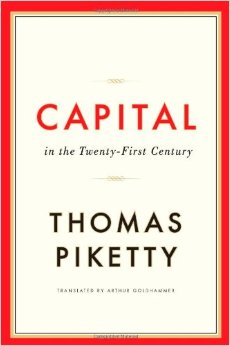
Here’s a good six-minute primer on Piketty’s new book and the progressive praise for it:

The full transcript of Krugman’s interview is here. Ryan Avent, also a fan of the book, fisks Clive Crook’s critique of Capital in the Twenty-First Century. His broader view:

Why do we care about inequality? We care about it because we are human, and we can’t help but be concerned about matters of fairness, however much economists might wish that were not the case. But what Mr Crook seems not to understand is that we also care about it because we care about living standards.

Mr Piketty’s book does an able job showing that high levels and concentrations of capital have not been a necessary or sufficient condition for rapid growth in the past, though they have often sowed the seeds for political backlash that is detrimental to long-run growth. His argument is that the living standards of many people around the rich world are now unnecessarily low, because of the nonchalance with which elites have approached distributional issues over the past generation, and that continued heedlessness of this sort will ultimately undermine the growth-boosting institutions of capitalism.

Dean Baker shares Piketty’s perspective on inequality but suggests that his global wealth tax isn’t necessary:

In Piketty’s terminology cutting back these rents means reducing r, the rate of return on wealth. Fortunately, we have a full bag of policy tools to accomplish precisely this task.

The best place to start is the financial industry, primarily since this sector is so obviously a ward of the state and in many ways a drain on the productive economy. A new I.M.F. analysis found the value of the implicit government insurance provided to too big to fail banks was $50 billion a year in the United States and $300 billion a year in the euro zone. The euro zone figure is more than 20 percent of after-tax corporate profits in the area. Much of this subsidy ends up as corporate profits or income to top banking executives.

In addition to this subsidy we also have the fact that finance is hugely under-taxed, a view shared by the I.M.F. It recommends a modest value-added tax of 0.2 percent of GDP (at $35 billion a year). We could also do a more robust financial transactions tax like Japan had in place in its boom years which raised more than 1.0 percent of GDP ($170 billion a year).

In this vein, serious progressives should be trying to stop plans to privatize Fannie and Freddie and replace them with a government subsidized private system. Undoubtedly we will see many Washington types praising Piketty as they watch Congress pass this giant new handout to the one percent.

Jeff Faux, writing in The Nation, nevertheless shrugs at the idea of a global wealth tax:

[H]e argues that the tax is technically feasible and could be gradually adopted region-by-region. Here Piketty seems out of his political depth. In order to avoid Marx’s apocalyptic conclusion, he skips around a central implication of his own analysis: that the upward redistribution of wealth also generates an upward distribution of political power that perpetuates inequality. An enforceable global tax on capital ownership would require dramatic political shifts to the left within the major economies—at least the United States, Europe, China, Japan—and unprecedented cooperation among these economic rivals to face down transnational capital and force the rest of the world to accept it. Eyes will roll.

Still, Piketty’s proposal sets a realistic marker for the level and scope of radical change necessary to deal with the grim conclusion of his quite credible economic analysis. The analysis makes hash of the conservative claim that there are “market solutions” to inequality, as well as the liberal hope that small-bore reforms will eventually achieve social justice on the cheap.

From James K. Galbraith’s lengthy review of the book:

In any case, as Piketty admits, this proposal is “utopian.” To begin with, in a world where only a few countries accurately measure high incomes, it would require an entirely new tax base, a worldwide Domesday Book recording an annual measure of everyone’s personal net worth. That is beyond the abilities of even the NSA. And if the proposal is utopian, which is a synonym for futile, then why make it? Why spend an entire chapter on it—unless perhaps to incite the naive?

Piketty’s further policy views come in two chapters to which the reader is bound to arrive, after almost41ASis1P3hL._SY344_BO1,204,203,200_ five hundred pages, a bit worn out. These reveal him to be neither radical nor neoliberal, nor even distinctively European. Despite having made some disparaging remarks early on about the savagery of the United States, it turns out that Thomas Piketty is a garden-variety social welfare democrat in the mold, largely, of the American New Deal. …

Piketty devotes only a few pages to the welfare state. He says very little about public goods. His focus remains taxes. For the United States, he urges a return to top national rates of 80 percent on annual incomes over $500,000 or $1,000,000. This may be his most popular idea in U.S. liberal circles nostalgic for the glory years. And to be sure, the old system of high marginal tax rates was effective in its time. But would it work to go back to that system now? Alas, it would not. By the 1960s and ’70s, those top marginal tax rates were loophole-ridden. Corporate chiefs could compensate for low salaries with big perks..

In sum, Capital in the Twenty-First Century is a weighty book, replete with good information on the flows of income, transfers of wealth, and the distribution of financial resources in some of the world’s wealthiest countries. Piketty rightly argues, from the beginning, that good economics must begin—or at least include—a meticulous examination of the facts. Yet he does not provide a very sound guide to policy. And despite its great ambitions, his book is not the accomplished work of high theory that its title, length, and reception (so far) suggest.

Check out the book for yourself here.