
Sarah Palin: Anti-Christian

Annual Conservative Political Action Conference (CPAC) Held In D.C.

If you want a classic example of political Christianism – and its active hostility to spiritual Christianity – it’s hard to beat Sarah Palin’s remarks yesterday. I offered a brief response last night, but this obscenity needs to be unpacked some more. And the first thing to say is that a former US vice-presidential candidate did not just endorse a war crime; she endorsed it as routine for every human being suspected of terrorism. And she seems to endorse it as an introduction to captivity. “Waterboarding is how we baptize terrorists” is a glib statement but a revealing one. Screen Shot 2014-04-28 at 12.32.19 PMBaptism is the beginning of something, an introduction. And so torturing prisoners accused of terrorism is a signature of the America Palin believes in. It’s how we welcome them to our prison camps.
Now look how far we have come from the original notion – pioneered by Charles Krauthammer and popularized by “24” – that torture should only be used in the hypothetical ticking time-bomb case. That argument – only ever hypothetical – nonetheless assumes that torture is evil and should only be used in extremis to prevent imminent catastrophe. Palin, in contrast, like her party, has long since blown past such niceties. She believes that torture should be the first resort – a sign of how America treats its foes, a badge of honor.

What can one say but that this is a bona fide fascistic sentiment. It revels in violence against individuals tied down by their hands and feet Screen Shot 2014-04-28 at 12.33.10 PMand strapped to a terrifying board in order to be suffocated hundreds of times to near-death. It is the kind of statement you might expect from the Khmer Rouge, or from the Chinese Communists who perfected “stress positions”, or from the Nazis, whose Gestapo pioneered “enhanced interrogation”, i.e. brutal torture that would leave no physical traces. Except it’s worse than that. Even totalitarian regimes have publicly denied their torture. Their reticence and lies are some small concession of vice to the appearance of virtue. Not Palin – who wants to celebrate brutal torture as the American way.

And then she manages to go one step further. She invokes torture in the context of a Christian sacrament. Not since the Nazis’ Deutsche Christen have we seen something so disgusting and blasphemous in the morphing of Christianity into its polar opposite. Mercifully, some Christians on the right have managed to say something. Dreher rightly calls it sacrilege:

Not only is this woman, putatively a Christian, praising torture, but she is comparing it to a holy sacrament of the Christian faith. It’s disgusting — but even more disgusting, those NRA members, many of whom are no doubt Christians, cheered wildly for her … What does it say about the character of a person that they could make that joking comparison, and that so many people would cheer for it.

It says something quite clear to me.

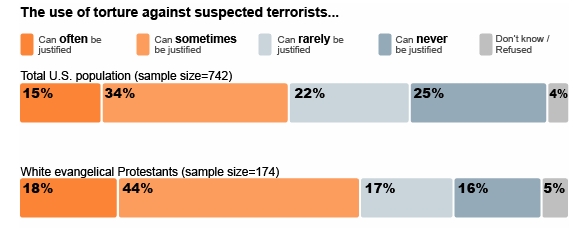
It reveals that vast swathes of American Christianity are objectively anti-Christian, even pagan, in their support for this barbarism. Rod should know this by now. In the best recent polling on the question, 62 percent of white evangelical “Christians” back torture as often or sometimes justified, with only 16 percent holding the orthodox position that it is never justified. Now compare those numbers with Americans who are unaffiliated with any religion: the number in that demographic is 40 percent in favor in some or many cases, and 26 percent against it in all circumstances. Is this a function of wayward and uncommitted Christians? Nope. Support for torture is highest among those who attend church at least weekly and lowest for those who rarely or never go to church. In America, torture is a Christian value. And some people wonder why I prefer to term “Christianist” to describe these people.

Joe Carter gets it right:

The truly Christian position is to never forget that evil comes not just from the actions of “terrorists” or “enemies” but from the heart of a fallen, sacred yet degraded, human beings. If we are to preserve our own humanity we must not forget that our enemy differs from us in degree, not in kind. Like us, our enemies need to accept Jesus and to be baptized by water and the Spirit. That is the Christian way, not as Palin would have it, to have our enemies fear a pagan god and have their spirit broken by water.

It seems to me, moreover, that torture is a far graver evil, even for orthodox theologians, than non-procreative or non-marital sex. And yet today’s Christianists are obsessed about the latter and not just indifferent to the former, but actually in favor of it. It’s this twisted set of priorities, this exquisitely misplaced set of fears, and this utter ignorance of even basic Christian teaching that reveals all that’s so terribly wrong with American Christianity. It has become its own nemesis.

(Photo: T.J. Kirkpatrick/Getty Images)

The Democrats’ 2014 Strategy

Sasha Issenberg’s new TNR cover-story goes over it in extreme detail. One of his main arguments:

If Democrats fail to see midterms as sufficiently sexy, the problem may lie not with the party’s rank-and-file but with its donors and activists. The strategists engineering the party’s campaigns now have at their disposal databases containing the names of every Unreliable voter in the country, as well as guidance on where, how, and when they can be reached. (Democratic analysts have developed predictive models to anticipate which voters are most likely to actually open and read their mail.) Volunteers who live near those passive sympathizers can be dispatched; when in-person contact is unfeasible, carefully crafted letters can be sent instead.

But all of these increasingly powerful tools also require money and manpower. This is why it’s not intensity scores on polls but rather the bustle of field offices and the sums on fund-raising reports that are the best guide to the Democrats’ midterm prospects. When those indicators sag, says Mike Podhorzer, the AFL-CIO’s political director and chair of the Analyst Institute’s board, “the effects are cascading.” For a party populated with Unreliable voters, the midterm imperative is clear: Raise the dollars and secure the volunteer commitments. Then go and turn out those who are already on your side but won’t show up without a friendly nudge.

In an accompanying piece, TNR charts out some voters Democrats will need to capitalize on. One group: “non-electorial college college students”:

Most of this year’s big Senate races are in states, like Georgia, that never got worked over by Obama’s field team. Their Democratic turnout targets will include not only Unreliables but also non-voters who weren’t even mobilized in 2012, many of them young whites. (A majority of this year’s Senate races are also in states whose African American population is smaller than the national share.)

Our Planet-Hunting Skills

They’ve improved:

Planets

Joseph Stromberg passes along the above GIF on the 736 planets we’ve identified so far this year:

That fact alone is remarkable. But it’s even more amazing when you consider that we didn’t find a single one of these exoplanets until 1989, and only found 1045 of them in total in the 23 years following that. … The Kepler space telescope — which orbits the sun, taking high-resolution images of distant stars so scientists can look for planets surrounding them — was responsible for these 715 planets [announced at once], along with 246 planets announced at other times, including the potentially Earth-like planet announced last week.

Unfortunately, the Kepler telescope was shut down in May 2013, because of an equipment failure. It’s not collecting any more data, so we probably can’t look forward to such ginormous hauls of new planets in the next few years.

Megan Garber has more:

A couple of years ago, I talked with Geoff Marcy, the astronomer whose work identifying habitable-zone exoplanets has earned him the nickname of “the planet hunter.” When he started searching for exoplanets in the 1990s, Marcy told me, that search had the air of the quixotic about it. The Times, at the time, noted that “a few skeptics still question whether these objects, called exoplanets, qualify as true planets.”

Marcy put it more bluntly: “Everybody,” he said, “said I was crazy.”

Update from a reader, who quotes Stromberg:

Unfortunately, the Kepler telescope was shut down in May 2013, because of an equipment failure. It’s not collecting any more data, so we probably can’t look forward to such ginormous hauls of new planets in the next few years.

This is incorrect on a few points. The telescope was not shut down; it continues to take data! The equipment failure ended its nominal mission because it could no longer reliably point at its appointed targets, but it is now looking at different stars, and will continue to do so if NASA decides to keep funding it (fingers crossed).

There actually may be similarly ginormous hauls of planets in the near future for another reason, as well: Of the more than 4,000 planet candidates Kepler has already discovered, some 3,700 remain to be validated in addition to the 736 that created tat big spike in your animated GIF. We’re still working on the rest!

Sanctions Redux

The US imposed new sanctions against Russia this morning, targeting seven cronies of Putin and 17 Russian firms:

Among those sanctioned were Igor Sechin, head of state energy firm Rosneft, and Deputy Prime Minister Dmitry Kozak. A Russian deputy foreign minister was quoted as expressing “disgust” at the White House announcement. The European Union, with more to lose than Washington from sanctions against Russia, a major energy supplier and trading partner for the EU, is also expected to announce new penalties after member governments reached a deal, diplomats said.

The United States will deny export licenses for any high-technology items that could contribute to Russian military capabilities and will revoke any existing export licenses that meet these conditions, the White House said. It was the third round of sanctions that the United States has imposed over Crime and troop build-up on the border. All the sanctions have been aimed at individuals and businesses.

Max Boot sums up the emerging criticism from the right, that only sanctions on Putin himself will have any effect:

If you want to know why Putin is able to get away with his brazen aggression, here it is in a nutshell: a fundamental failure of will on the part of the U.S. and its European allies. Obviously nobody favors nuclear or even conventional military retaliation–we are not going to war with Russia unless it crosses some future line. But surely Putin has already crossed enough lines to justify the most severe possible economic sanctions we can inflict–including doing everything possible to deny him and his cronies the use of their illicitly acquired fortunes. The fact that we are willing to impose limited sanctions on some Putin pals but not on the master of the Kremlin himself says volumes about how fecklessly we are acting in the face of continuing and escalating aggression.

Considering Putin’s grand strategy, Posner doubts there’s much we can do to stop him meddling in Ukraine:

Putin is not interested in conquering his neighbors, which would be difficult to rule. He just wants them to be in Russia’s orbit. … This strategy is a less ambitious version of the Soviet Union’s strategy, and also not much different from what the United States did during the cold war, in places like Cuba and Nicaragua. It’s perfectly logical, and also likely to succeed because a big country cares more about its neighbors than other countries do, and can exert influence over them more easily than other countries can.

The implications for the West are also clear. It needs to decide whether the benefits of attracting Russia’s neighbors into the Western orbit are worth the risks of disorder that result from Russia’s retaliation.

But if Putin isn’t trying to conquer Ukraine, Andrew Foxall and Ola Cichowlas point out, he’s doing a terrible job of showing it:

Over recent weeks, Ukraine’s security agency has detained over a dozen individuals suspected of collecting intelligence for Moscow. Some were Ukrainian nationals, while others are suspected of being Russian “war tourists.” At least one was a Russian “spy” (albeit one apparently unaware that posting a photograph of herself holding an automatic rifle to VKontakte, Russia’s equivalent of Facebook, is not a usual part of espionage). Kiev has begun to limit the access of such individuals to Ukraine; it has ended unrestricted travel for Russians to the country and begun to turn away Russian journalists at the border. The rather farcical way Ukraine has gone about this, however, illustrates just how hard it will be for Kiev to find a workable approach. …

Russian tanks may not yet have crossed the Ukrainian border, but the Kremlin has already begun to invade eastern Ukraine. Moscow has infiltrated the Donetsk region with weapons more effective than Kalashnikovs: a new generation of Russian “liberators.” These men — convinced that Russia is surrounded by enemies and that only they understand what is needed to save it — are working overtime to restore “stolen” lands to the Kremlin. And they will not stop at Ukraine.

Meanwhile, Jamie Dettmer provides a reality check, recapping what has transpired since a deal to end the violence was signed last week:

Since the signing of the accord pro-Russian separatists in Slovyansk led by the thuggish former Soviet soldier Vyacheslav Ponomaryov have kidnapped more than two dozen people – including the town’s mayor; American reporter Simon Ostrovsky, roughing him up and holding him captive for two days; two Maidan activists; and five members of an official military mission from the OSCE, along with five Ukrainian military personnel accompanying them. Ponomaryov claimed responsibility for a successful grenade attack Friday on a military helicopter, injuring the pilot, in a nearby town.

In Kramatorsk, the police chief was kidnapped and the deputy mayor is languishing in hospital reportedly after being beaten up by pro-Russian militants for refusing to go along with a takeover last weekend of the town’s municipal building. There have been other reports of abductions across eastern Ukraine.

The most egregious separatist violence came early last week when the tortured bodies of Volodymyr Rybak, a local pro-Kiev politician, turned up along with the corpse of an unknown man. Ukrainian authorities blame Ponomaryov and Russian military intelligence officers they name as Ihor Strielkov and Ihor Bezlier for the murders. Ukrainian SBU officials say the Russians decided to kill the politician after he tried to raise the national flag on the municipal building in the town of Horlivska and he was transported to Slovyansk, they claim, where he was tortured and  Ponomaryov was ordered to dump the body.

Recent Dish on Ukraine here, here, and here.

Donald Sterling’s Personal Foul

The seriously, surreally racist remarks allegedly made by Clippers owner Donald Sterling:

Josh Marshall weighs in:

Race and racism are complex. White families who were the linchpins of white supremacy in the Jim Crow South and in the days of slavery could still have deep and intimate relationships with African-Americans. And I’m not just talking about the well-known and often brutally exploitative sexual relationships. (After all, remember that Strom Thurmond had a mixed race daughter.) Obviously, in this day and age you can work with, have civil relationships with black people, even employ African-Americans and still be totally racist. But in this day and age it’s a little hard to figure how you can have such visceral racism (as opposed to just having a low opinion of black people) and manage to operate in the pretty black world of the NBA.

Jazz Shaw compares Sterling to last week’s racist, Cliven Bundy:

What do Bundy and Sterling have in common? First of all – aside from the obvious fact that they are white – they are old. And I don’t mean old like me… we’re talking really old. And second, each in their own way are old men who live in a form of isolation. Bundy lives in a geographically isolated, rural region. Sterling lives in the rather insular world of the very wealthy. They also come from a different generation, growing up among attitudes which were common beyond notice in their day but which would probably shock many people today. Without going into graphic detail, I’ll just say that I can relate to that, being raised by a member of that same generation in a rural, farming area.

Matt K. Lewis also considers the age factor:

Bundy is 67 and Sterling is 80. In a way, the age disparity makes sense; you could argue that an urban (and rich) 80 equates to a rural 67. So age does seem to be a common denominator — and if one accepts this theory, it is a bit of good news, inasmuch as it implies a lot of this stuff will be resolved through attrition.

Chotiner argues that the story “shines a light on an uncomfortable fact: society reacts much more forcefully to lone outbursts like Sterling’s than larger, institutional racial problems”

Sterling was accused of two of the most institutionally harmful forms of racism in our society: hiring/firing discrimination and housing discrimination. And yet’s it’s fair to say that the housing discrimination case, no matter how it had played out in court, would not have caused the stir that these comments did.

This is partially because there is audio of his recent remarks, and they are thus easier to react against. But it also shows how much more at ease people are responding to something so easy to grasp, and so unthreatening to the status quo. Institutional racism is just too daunting and widespread. A lot of people who don’t consider themselves racists nevertheless don’t particularly want to live in minority neighborhoods, or send their kids to overwhelmingly non-white schools. And they may hold certain stereotypes about minorities. Confronting all this is complex and fraught. Sterling’s alleged comments are just so…simple.

Ambinder focuses on Sterling’s enablers:

An article about Sterling in ESPN’s magazine called his life “uncontested.” That’s an apt description. The reporter followed Sterling to an NAACP gathering, where he proceeded to brag about how easy it was to pull the wool over the eyes of the organization. Referring to the reporters tailing him, he asked other attendees, “Do you know why they’re here? They want to know why the NAACP would give an award to someone with my track record.”

Yeah. Good question.

The answer is apparently that he gave the organization money. In fact, he gave a lot to organizations devoted to the poor and to helping minority groups.

Peter Dreier expands upon the NAACP’s money-grubbing culpability:

Of course, many nonprofit groups rely on charitable donations from wealthy donors and corporations. Often their philanthropy is altruistic and heartfelt, but sometimes their gifts are self-serving, designed to help a company or a billionaire cleanse a soiled reputation or peddle influence with politicians. Many donors expect to see their names on buildings or to be rewarded with public celebrations of their philanthropy, including receiving awards. The NAACP-Sterling relationship raises the larger question of whether nonprofit organizations should have any standards for bestowing honors on their donors. When is a donor such a disreputable person or corporation that its donation — and the strings attached to it — soils the reputation and moral standing of the nonprofit group, despite its many good deeds?

Marc Tracy zooms out:

As the league begins to move against its longest-tenured owner, the moment feels positively catalytic. The National Basketball Association is the sports world’s most progressive league. Its 30 teams are 30 businesses out to make money, but they do it in a game that finds its greatest popularity among the lower and middle classes and as a league with the second-highest proportion of Democratic fans. More specifically, the NBA is society’s cutting edge as far as race is concerned—it’s the league that birthed the first black head coach (Bill Russell, with due respect to football’s Fritz Pollard); first black superstar (Wilt Chamberlain); first black sneaker brand (Air Jordan); first black general manager (Wayne Embry); and only black owners (the Charlotte Bobcats were owned by Bob Johnson and are now owned by Michael Jordan). Its recent surge in popularity and value has been due primarily to an unusually talented and charismatic inventory of superstars who are overwhelmingly young black men.

Over the past several years, NBA players have seized the athletic and cultural zeitgeist, in the process making a ton of money for themselves but even more for ownership, who have seen their properties appreciate at rates not normally experienced outside the top echelons of Silicon Valley and Wall Street—according to Forbes, franchise values have increased 25 percent just in the past year. This imbalance—between who is responsible for the profit and who reaps the profit—makes less sense with each passing year, and incidents like Sterling’s make it seem absurd. So this is a moment of reckoning for the league, and, since the league has always seemed to represent more than just itself on matters of race and of labor, it’s a moment of reckoning for everyone. Will Sterling be allowed to stick around just because he’s the guy who owns the team? Or will the laborers responsible for Sterling’s success get their way? To put it more bluntly: Will the moribund old white guys win another round, or will the young wealth-creators triumph?

Flights Of Fancy

David Owen chronicles the evolution of luxury air travel:

In the early nineties, the best seats on airplanes were still just seats, even if they reclined almost all the way back. Then, in 1995, in first class on some long flights, British Airways introduced seats that turned into fully flat beds, and within a relatively short period airborne sleeping became a potent competitive weapon. The carriers that fly the wealthiest passengers on the longest routes have been especially aggressive about adding comforts, in both first and business (while also often shrinking the seats in economy and squeezing them closer together). A first-class passenger on the upper deck of some Lufthansa 747s gets to hop back and forth between a reclining seat and an adjacent full-length bed. On some of Singapore Airlines’ A380s, a couple travelling in first can combine two “suites” to create an enclosed private room with a double bed and sliding doors. On some flights on Emirates, first-class passengers who make a mess of the treats in their personal minibar can tidy up with a shower before they land.

But the real money is in business class:

Premium cabins contribute disproportionately to an airline’s economic performance—both directly, through higher ticket prices, and indirectly, by solidifying relationships with big-budget customers who fly all the time. Business class is especially valuable; first class can be problematic, because first-class ticket holders require extra pampering and won’t tolerate overbooking. Web sites like SeatGuru enable picky fliers to compare seats on many routes, and keeping such fliers loyal is expensive: new first-class seating units can cost more than half a million dollars each. Jami Counter, a senior director at TripAdvisor, which owns SeatGuru, told me, “The true international first-class cabin actually keeps shrinking, because the international business-class cabin has become such a great product, to the point where you’re differentiating more on things like food and service.”

Creepy Ad Watch

A trippy and hathos-filled video for UNICEF’s Poo2Loo campaign, which aims to bring awareness to the 620 million people in India who defecate publicly each day:

Scaachi Koul criticizes the campaign for missing its target:

UNICEF seems to think lack of awareness is the issue, that Indian Wii characters just need to buckle down and take their poops to the giant, bedazzled toilet in the middle of Delhi and everything will be okay. But with the exception of, say, very rude children and animals, everyone in India knows they’re not supposed to poop in the streets. The problem of public waste in India isn’t complacency or stupidity or backwards values. Poo2Loo zeros in on a gross (and therefore, rarely discussed) problem in India, but focuses on the wrong issue: not awareness, but resources. …

Usually the people defecating in public are poor. On their list of priorities is eating, finding clean water, and not dying. I’m guessing that finding a nice, clean toilet isn’t in the top five. It’s not that India’s poor don’t know how to use a toilet, or that they should be using it, it’s that they literally can’t. The Poo2Loo website even admits that there is some stigma to defecating in public, particularly if you’re female. Girls and women often have to wait until night before they can relieve themselves, in order to avoid bringing shame onto their families.

It’s embarrassing for UNICEF that they seem unable to see the difference. The Poo2Loo site is largely focused on awareness of the issue, but no specific initiatives are mentioned. You can donate to UNICEF to “overcome this problem,” but where does your money even go?

The Bee’s Beginnings

In an excerpt from A Sting in the Tale: My Adventures with Bumblebees, Dave Goulson describes their gory genesis:

The first bees evolved from wasps, which were and remain predators today. The word ‘wasp’ conjures up an image of the yellow-and-black insects that often build large dish_bee nests in lofts and garden sheds and which can be exceedingly annoying in late summer when their booming populations and declining food supplies force them into houses and on to our picnic tables. Actually, there are enormous numbers of wasp species, most of whom are nothing like this. A great many are parasitoids, with a gruesome lifestyle from which the sci-fi film Alien surely took its inspiration. The female of these wasps lays her eggs inside other insects, injecting them through a sharply pointed egg-laying tube. Once hatched, the grubs consume their hosts from the inside out, eventually bursting out of the dying bodies to form their pupae. Other wasp species catch prey and feed them to their grubs in small nests, and it is from one such wasp family, the Sphecidae, that bees evolved.

In the Sphecidae the female wasps stock a nest, usually an underground burrow, with the corpses, or the paralysed but still living bodies, of their preferred prey. They attack a broad range of insects and spiders, with different wasp species preferring aphids, grasshoppers or beetles. At some point a species of sphecid wasp experimented with stocking its nest with pollen instead of dead insects. This could have been a gradual process, with the wasp initially adding just a little pollen to the nest provisions. As pollen is rich in protein, it would have provided a good nutritional supplement, particularly at times when prey was scarce. When the wasp eventually evolved to feed its offspring purely on pollen, it had become the first bee.

Update from a reader:

Check out the Cicada Killer Wasps. These beauties are so large they can be mistaken for hummingbirds. I had an infestation for several years and tried to use a tennis racket against them. It worked well when you actually hit them, but I became embarrassed about my antics being watched by neighbors. To watch these bees carrying a big, green cicadas back to their nest was to watch something that seemed to be physically impossible to do. I finally took care of the problem by simply pouring boiling water into each burrow.

Video of a wasp viciously attacking a cicada after the jump:

Another reader:

The guy killing the wasps with boiling water is foolishly panic stricken. Sure they’re huge, but the males, who are bigger than the females, don’t even have a stinger. I have a 50-year-old flagstone patio in which they burrow, and when they show up usually at the end of July there’s never been a problem with them ever. They’re just huge and fun to watch.

An entomologist from the in-tray backs this up:

Precisely. Aside from a somewhat similar appearance, they aren’t the least bit like hornets (a group that includes the yellow jackets that mess with your Labor Day picnics) or paper wasps that are so vigorously defensive and aggressively hostile to even little disturbances. Cicada killers nest communally (in patches of soil that have the right characteristics for them to dig their annual nests), but each nest is one tunnel built by one female. Unlike with hornets and paper wasps, each adult female cicada killer is on her own.

In my experience, it’s the social stinging insects (or pretty much just the honey and bumblebees, ants, hornets, and paper wasps – where there is one fertile queen and an army of sterile daughter “workers” defending and caring for the eggs she lays) that are really unpleasant to deal with. The solitary stinging species are far, far less likely to sting people, even when people are near their nests. Mostly they hardly even notice you’re there.

(Photo of a Leafcutter bee by Bob Peterson)

The Importance Of Damage Control

It may be the key to immortality, according to James Vaupel, director of the Laboratory of Survival and Longevity at the Max Planck Institute for Demographic Research:

“Every day we suffer damage and don’t perfectly repair it,” explains Vaupel, “and this accumulation of unrepaired damage is what causes age-related disease.” It’s not a trait that is shared by all living organisms. Hydra for example – a group of simple, jellyfish-like creatures – are able to repair almost all the damage they suffer, and readily slough cells that are too injured to heal. In humans, it’s damaged cells like these that can give rise to cancerous tumors.

“Hydras allocate resources primarily toward repair, rather than reproduction,” says Vaupel. “Humans, by contrast, primarily direct resources toward reproduction, it’s a different survival strategy at a species level.” Humans may live fast and die young, but our prodigious fertility allows us to overcome these high mortality rates. Now that infant mortality is so low, there’s really no need to channel so many resources into reproduction, says Vaupel. “The trick is to up-regulate repair instead of diverting that energy into getting fat. In theory that should be possible, though nobody has any idea about how to do it.” If the steady accretion of damage to our cells can be arrested – so-called negligible senescence – then perhaps we won’t have an upper age limit. If that’s the case, there isn’t any reason why we should have to die at all.

Previous Dish on longevity research here.

(Photo of Hydra vulgaris by Przemysław Malkowski)

Venezuela’s Commie Core

Juan Nagel examines how the Venezuelan government is meddling in the country’s school system in an apparent effort to push socialist propaganda:

Venezuela has an extensive network of public schools, one that existed long before Hugo Chávez came to power. Due to the spotty quality of the education these schools impart, there is also a large web of private schools that has always operated with relative freedom, although under close government supervision. This peaceful coexistence, however, was shattered in 2012 when the government passed “Resolución 058.” The text, which emanated from the Ministry of Education, changed the entire governance structure for both public and private schools. Recent steps to fully implement it have set off alarm bells in the entire opposition education community.

In order to “promote participatory democracy,” the resolution states that all decisions in every school — public or private — must involve parents, teachers, students, workers, and even “the community,” represented by “communal councils.” Including communal councils in these decisions is done in order to “construct a new model of socialist society.” Many in the opposition view this as the last straw in a long line of attacks against the rights of parents to freely educate their children. While the government has talked of making schools epicenters of socialist indoctrination for years, they had not acted upon those wishes until now. Many thought the decree would never be implemented, but lately the government has started making good on its ill-favored promise, so the issue has come up again… with a vengeance.