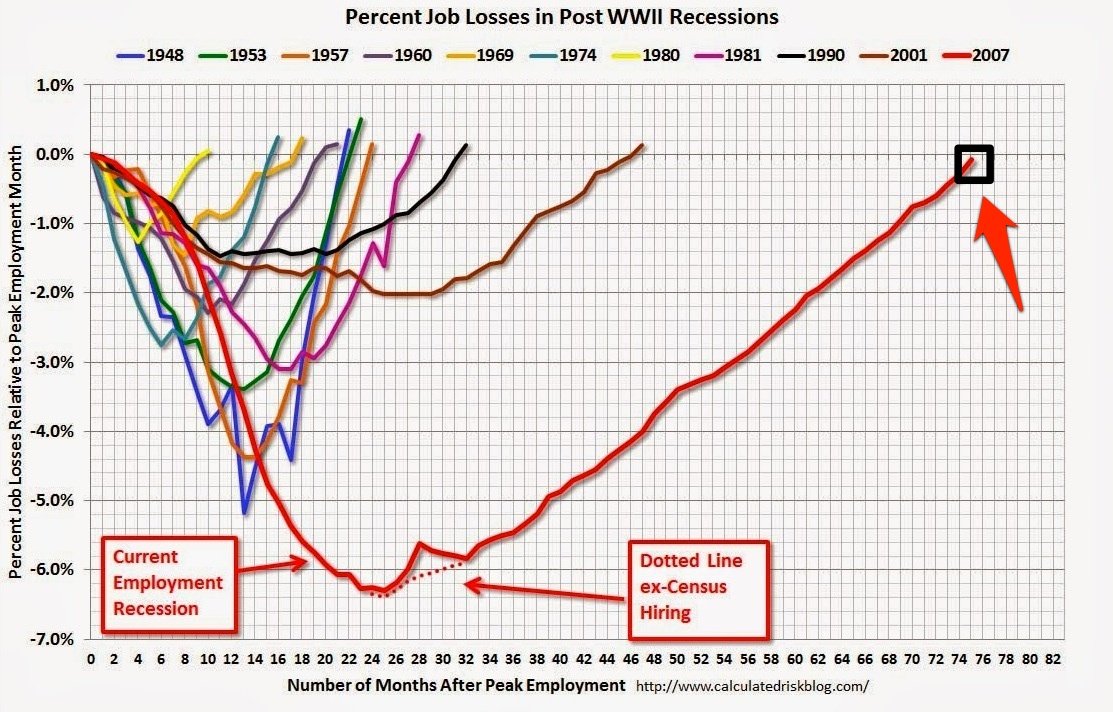
The headline number on this morning’s jobs report – 288,000 jobs added in April – looks pretty good on its face:
The hiring spree surpassed most analysts’ expectations and is the strongest showing in more than two years. Businesses added workers across a broad array of sectors, including business services, retail and construction. The unemployment rate plunged to 6.3 percent — the lowest level since 2008 — though part of that was due to workers leaving the labor force.
The upbeat report provided a convincing counterpoint to data released earlier this week that revealed economic growth was virtually flat during the first quarter. Many analysts attributed that weak reading to the unusually cold winter and argued that a spring thaw is already underway. The Labor Department also increased its estimates of hiring during the previous two months by 36,000 net jobs. Wall Street opened higher on the news.
The chart above, via Joe Weisenthal, shows that we have almost made up the job losses from the recession. But as Neil Irwin points out, there’s a huge downside:
The number of people in the labor force fell by a whopping 806,000, wiping out the February and March gains and a bit of January as well.
The labor force participation rate fell by 0.4 percentage points to 62.8 percent, returning to its December level. And the number of people reporting they were unemployed fell by 733,000, which sounds good on its surface, but paired with the similar-sized decline in the labor force points to job seekers giving up looking rather than finding new employment.
It would be irresponsible to draw any definitive conclusions from a single month’s data, but this isn’t the only area in which this report has some soft underbelly. Both hours worked and wages were unchanged. If the economy is to ever expand more robustly, it will require workers to make more money, giving them the income to buy more goods, services and houses; in April at least, there was no progress on wages.
David Leonhardt adds that the business and household surveys are extremely divergent:
The monthly survey of businesses showed that the economy added 288,000 jobs last month — and 238,000 on average over the last three months, the best such pace in more than two years. The monthly survey of households showed that the economy actually lost 73,000 jobs; the only reason the unemployment rate fell is because people dropped out of the labor force, no longer looking for work and thus not counted as officially unemployed.
It’s tempting to try to combine the two surveys into one neat package and claim that the economy added jobs, albeit not enough to bring people back into the labor force. But that’s not right. If you believe the household survey, the economy lost jobs. If you believe the business survey — which is much larger than the household survey — job growth was quite strong. They cannot both be right.
Drum advises against freaking out about the declining labor force participation rate:
[T]here are two things to keep in mind: (a) the participation rate has been shrinking steadily for a long time, and (b) it’s a pretty volatile number from month to month. The chart below shows both things. The participation rate has been steadily shrinking since 2000, and it’s been shrinking even faster ever since the end of the Great Recession. And the big drop in April? As you can see from the tail end of the chart, the participation rate hasn’t actually changed since October. It’s just been bouncing up and down.
Bottom line: Don’t take the April numbers too seriously. The long-term trends are important, but there’s so much noise in the month-to-month numbers that you can’t draw too many conclusions from them.
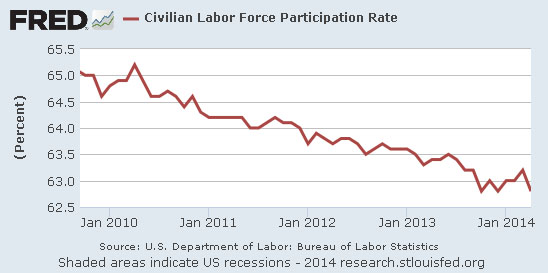
What’s to explain the decline? Patrick Brennan thinks it could be Obamacare:
If the early-February CBO report that predicted that in a few years, 2.5 million fewer Americans will be working than otherwise would because of the Affordable Care Act is right, that’s going to start showing up in a big way this year. In one sense, this is a good thing: Many people have access to affordable health insurance outside of holding a job for the first time. But when we’re worried about a secular decline in labor-force participation, this is a worrying trend.
Another explanation: We could be seeing the delayed effect of the expiration of unemployment benefits for those out of work for (about) 27 weeks or more. You might expect that to be the argument laid out by supporters of extending those benefits, though I haven’t seen much of it.
 The Dish