Pew’s latest makes it seem unlikely:
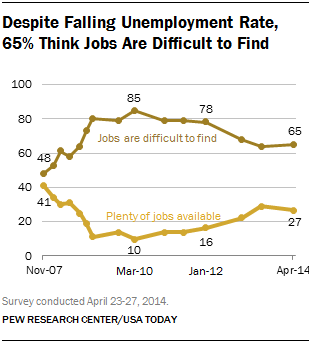
From the public’s point of view, jobs remain scarce: 65% say jobs in their community are difficult to find while 27% say there are
plenty of jobs available. Since the recession, perceptions of the job market have become less negative as the unemployment rate has declined. However, there has been virtually no change in these views since last June (64% jobs hard to find), although the jobless rate has fallen by more than a percentage point (from 7.5% to 6.3%) since then.
Moreover, there has been no increase in economic optimism. About as many say that economic conditions will be worse (24%) as better (25%) a year from now, with 49% predicting little change. Asked to describe the economic recovery, 66% say the economy is recovering but not so strongly, 26% say the economy isn’t recovering at all, while just 6% think the economy is recovering strongly.
Jonathan Bernstein is skeptical the better jobs numbers will mean much for the upcoming elections:
When Ronald Reagan’s approval turned around in 1983, for example, his strong rally still didn’t much exceed one percentage point of approval a month. And that occurred as the economy moved from a deep recession to a solid recovery, a different set of circumstances from the mild improvements that might be happening now. President Barack Obama’s approval rating is around 44 percent. A return to 50 percent by election day is a best-case scenario, and even that wouldn’t cause a dramatic tilt in the electoral playing field. Given how closely contested Senate control appears to be, a small nudge could be very important – but it’s a small nudge, nevertheless.
A far more realistic outcome is that good economic news just keeps Obama on the very mild upward path he’s been on since the Affordable Care Act exchanges were fixed.
Waldman spotlights the Democrats’ rhetorical dilemma:
Democrats have been spending a lot of time lately talking about inequality, which is not a function of what happened this month or last month, but the result of forces and trends that have evolved over the last thirty years. That’s an important discussion to have, and an argument that resonates with voters, particularly when Republicans are inclined to deny inequality exists, or that it matters if it does. But when you’ve been saying that we have a profound and deep-seated inequality problem that was three decades in the making, it’s awfully hard to turn around on the evidence of a month or two of job growth and say, “Things are going much better now!”
That doesn’t mean Democrats can’t argue, as they surely will, that the Obama administration’s policies are helping the economy pull out of the long and painful period of difficulty we’ve had since the Great Recession. And of course, they can also say that things would have been much worse had the other guys been in charge. But because they’ve begun to talk about how the system is rigged, they can’t sing “Happy Days Are Here Again.”
 The Dish