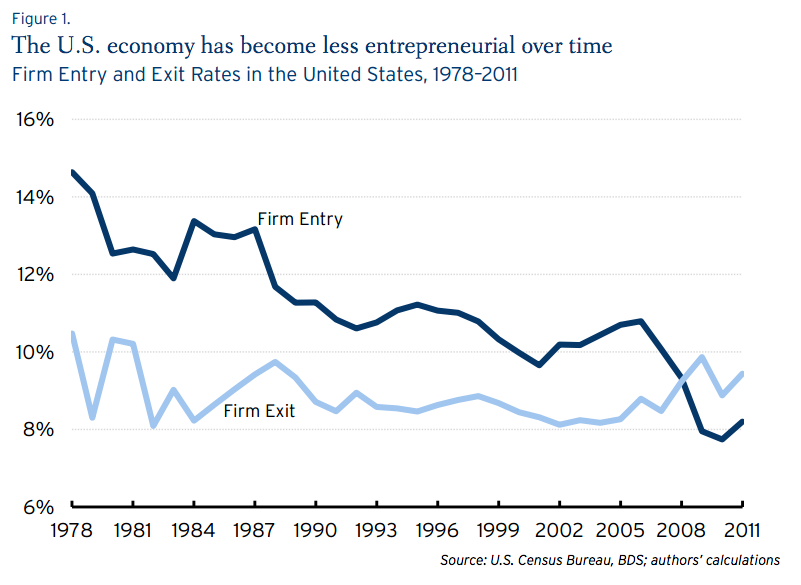
A new Brookings report warns that business dynamism and entrepreneurship are on the decline throughout the US. Danielle Kurtzleben explains why this is cause for concern:
[T]he idea at work here is the economic concept of creative destruction. New, more productive firms replace older firms, and workers get matched with better jobs over time when there’s more of this business “churn,” the authors write. A more stagnant business atmosphere, in other words, can lead to a more stagnant economy. Exactly why it’s happening, however, is more of a mystery. …
The jump in the exit rate has likely been a function of the recession, says says Robert Litan, one of the study’s co-authors and a nonresident senior fellow at Brookings, but the factors behind the falling entry rate are foggier. The fact that the trend is so long-standing, for example, suggests that it’s not one presidential administration or another that’s at fault, nor is it the recession. What’s behind it may be something less concrete are more ephemeral — an economy-wide decision to play it safe, from the richest CEOs to the plucky wannabe entrepreneurs.
Drum suspects that the proliferation of national chains is largely to blame for this trend:
I’d really like to see a breakdown of what kinds of business creation have declined. My first guess here is that the decline hasn’t been among the sort of Silicon Valley firms that drive innovation, but among more prosaic small firms: restaurants, dry cleaners, hardware stores, and so forth. The last few decades have seen an explosion among national chains and big box retailers, and it only makes sense that this has driven down the number of new entrants in these sectors. When there’s a McDonald’s and a Burger King on every corner, there’s just less room for people to open up their own lunch spots. But if there’s been a decline in the number of new small retailers, that may or may not say anything about the dynamism of the American economy. It just tells us what we already know: national chains, with their marketing efficiencies and highly efficient logistics, have taken over the retail sector. Amazon and other internet retailers are only hastening this trend.
Morrissey, however, fingers regulation for the culprit:
The reasons can’t be that unknown. Since the 1970s, the federal regulatory environment has grown exponentially, with its power amplified by the federal courts. Even short eras of regulatory reduction resulted in only moderate reversals of that decline, which quickly disappeared. Look, for instance, at the period between 1983-88 during the heyday of Reaganomics and deregulation, and the shallower gains during the George W. Bush administration.
Richard Florida notes one of the study’s main limitations:
The authors caution that their data cover the period through early 2011, so it’s possible that “these trends have reversed—or at least stabilized—since then.” The late economist Christopher Freeman, invoking Schumpeter’s “creative destruction,” long ago argued that economic crises set the stage for great bursts of innovation. Patent activity has ticked up since the crisis, and venture capital activity has surged in recent years.
But there are long lags between the onset of crises and these rebounds in innovation and entrepreneurial activity that power long-run economic growth. These Great Resets are generational events, with much longer time lines than typical business cycles.
 The Dish