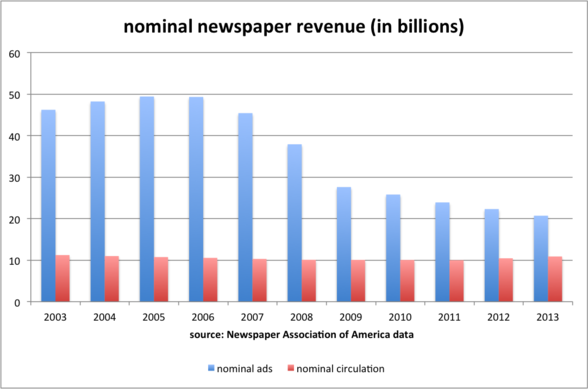
That’s the situation newspapers are facing:
Of course, more people than ever read newspapers now online than they ever did in print (although physical circulation figures don’t account for the fact that multiple people read each copy). The problem is, they spend a fraction of the time they once did on print papers. Somebody who reads a print paper 30 minutes a day is worth vastly more than one who reads the paper’s website 30 minutes a month, which is what the average unique visitor spends.
That’s why newspapers are focusing on core readers—the 5 percent or so of their heaviest users. The core appeal of the meter model is capitalizing on heavy readers while collecting bits of ad revenue from the majority of unique visitors that have little or no loyalty to your site.
Joshua Benton leafs through Mary Meeker’s annual report (pdf) on internet trends. The big picture:
Mobile is eating the world, and most news organizations make only a pittance off it.
Here’s the optimist’s spin for print: Not all forms of media are equally useful for advertising. Mobile, thus far, has been notoriously difficult to monetize through advertising; app purchases and in-app payments are the dominant ways for companies to make money on phones. Display advertising doesn’t work as well on such small screens, and search ad revenue is reduced.
If that’s true, maybe print is just mobile’s opposite: uniquely aligned with an advertising model, with big lush expanses of newsprint aching for a cell phone provider’s printed embrace.
Ryan Tate summarizes the key numbers:
According to [Meeker’s] research, the total number of internet users grew less than 10 percent last year, down from close to 20 percent in 2007 and close to 40 percent in 2002. But mobile internet use is skyrocketing, now constituting 25 percent of all internet traffic, compared with just under 1 percent in 2008. Tablets, she says, are “growing faster than PCs ever did.” Last year, according to her numbers, tablet shipments left notebook and desktop computer shipments in the dust. But it’s smartphone that really suck up our time, accounting for more “screen minutes” than any other device.
And Derek Thompson highlights the dominance of smartphones in the developing world:
The middle classes of the U.S. and Western Europe got rich in the 1950s when TV penetration was screaming past 50 percent. In the 21st century, smartphones are the new TV—the hot new glass that signals the future of attention and entertainment—and the countries that spend the most time on their phones (particularly relative to other products) are countries that only now are joining the global middle class.
 The Dish