Reality Check

Screen Shot 2014-06-24 at 12.13.38 PM

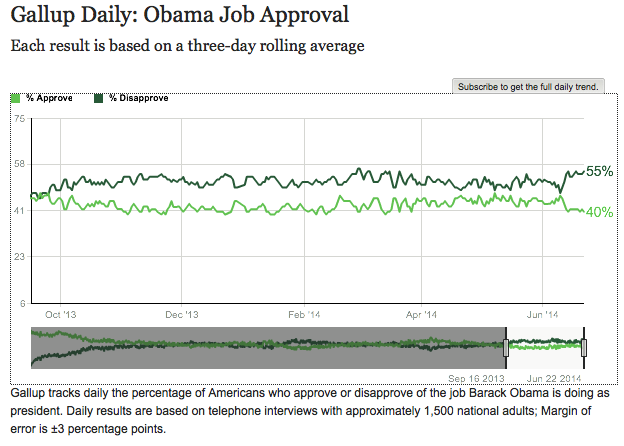
The Gallup daily tracking poll shows a sudden shift in appraisals of the president. On June 8, after a spring in which the gap between approval and disapproval was narrowing slowly, the public was evenly split – 47 – 46. Two weeks later, it’s 55 – 40. That’s one of the more sudden shifts yet in his two terms of office. It puts him close to GWB at this point in his second term:

Screen Shot 2014-06-24 at 12.16.41 PM

The light green line is Obama’s approval ratings; the darker one Bush’s. They look remarkably similar, apart from Bush’s much higher support from Democrats for a long time. That dotted line is the average of all presidents across the years since Truman. On that score, Obama is doing slightly better now than he was for much of his first term, ironically enough. The closest analogy to either of them is Truman’s approval rating (he finished out his presidency at 32 percent), which might give one some hope for a future historical assessment.

Why has this shift occurred so suddenly?

Multi-determined, as my shrink would say. But it has to be Iraq most of all. You can see a fledgling Obama recovery to an even 47-46 split until the Sunni/ISIS insurgency took off. And I think that’s understandable. One of Obama’s great and singular achievements was the withdrawal from Iraq without catastrophe. If that is now in doubt, especially if there is any chance of our getting involved again, then a core step forward looks in hindsight like a chimera. And Iraq is such a nightmare in American minds that any notion that we might be headed back there is abhorrent. Who do you blame for such a situation? The president, of course. What can he do about it? Between a metastasizing, regional sectarian war and US military intervention, it’s a pretty nasty dilemma. But my advice, such as it is, remains: stay out. Let it burn out; let’s see what emerges from the chaos; let’s concentrate on protecting our borders and improving our intelligence. If Obama could muster that message, I think it could resonate. As long as he wrings his hands, and the punditaraiat screams daily about What Must Be Done, and the State Department insists on more and more involvement, he will suffer.

Jailed For Journalism

Jesse Rosenfeld reports the news out of Egypt, where the same judge who sentenced 14 Muslim Brothers to death on flimsy-to-nonexistent evidence has handed down a harsh verdict against Al Jazeera journalists Peter Greste, Mohamed Fahmy and Baher Mohammad:

The three, who already have spent 177 days in jail, will now have to spend a total of seven years in prison. Baher Mohamed had three more years tacked onto his sentence because he had in his possession a bullet fired at a protest. Yet in this highly politicized trial the prosecution never presented any evidence to show that these journalists created “false news” or joined the banned Muslim Brotherhood as charged. Instead, prosecutors laid out a case based on broad conspiracy theories claiming that the Qatar-based Al Jazeera satellite network is responsible for Middle East regional conflicts. …

The evident aim of the prosecution was not just to convict the reporters and a handful of students on trial with them, but to drive home the idea that al-Sisi’s government has a monopoly on truth. Prosecutors described the verdict and the sentencing as a “deterrent.”

The trial reads like an Orwell-Kafka collaboration:

[It] relied heavily on evidence culled from their personal possessions, but prosecutors never made any link between the innocuous-seeming material presented and the charges against the journalists. Making matters worse, in one instance, the defense lawyers were asked to pay a “fee” of about $150,000 to view evidence. …

Because journalists were allowed into the courtroom, there is a record of what was presented as evidence. It includes:

  • A video for the melancholy Gotye song “Somebody that I used to know” that came from a cell phone that allegedly belonged to one of the journalistsBoPLnZ5IUAE5jk-
  • Video footage of a press conference in Kenya that happened in 2013
  • A picture of Greste’s parents from his flash drive.
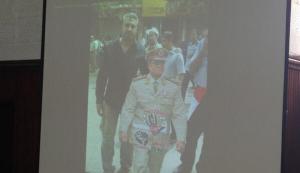
  • And this clearly manipulated picture of former armed forces chairman Mohammed Hussein Tantawi with Fahmy [seen to the right]

Journalists in Egypt have good reason to be afraid:

“It’s a warning to journalists that they could find themselves on trial and convicted for carrying out their duties,” said Mohamed Lotfy, executive director of the Egyptian Commission for Rights and Freedoms who has observed the trial for Amnesty International. Egypt’s prosecutor’s office issued a statement calling the ruling a “deterrent.” …

Most sobering for journalists, the trial also dissected the content of the Al Jazeera English team’s reporting. In his closing remarks, the prosecutor accused the journalists of selecting footage that would portray Egypt in a negative light. Among other examples of such ‘negative’ reporting, he said the three had reported on sexual harassment during demonstrations in Tahrir Square, an explosive issue that numerous foreign and local journalists have covered. In their defense, the journalists and their supporters argued: This was ordinary reporting, a journalistic portfolio similar to other top members of our profession.

Calling the verdict “a case study in all that is wrong with the Egyptian judicial system”, Bel Trew reminds us that the sorry state of press freedoms in Egypt is hardly news:

The Egyptian government has arrested over 40,000 people, according to the independent monitoring group WikiThawra, and sent thousands to trial since last summer’s military coup. Journalists haven’t been immune from this crackdown: Egypt was the third-deadliest country for journalists and among the top jailers of journalists in 2013, according to the Committee to Protect Journalists (CPJ). More than 65 journalists have been detained in Egypt since the coup, and 14 remain behind bars. …

The effect has been an unprecedented level of self-censorship by both the public and private media. “You can see many TV shows, awkwardly trying to stop their interviewees going too far in criticizing the army and the government,” Lotfy said. It was, he added, the worst press environment he had monitored in the last 30 years.

The ruling looked like a goodbye kiss for John Kerry, who had left Cairo hours earlier after announcing the US’ intent to restore military aid to the Sisi regime:

Kerry’s trip to Egypt was the clearest statement yet that President Barack Obama would rather work with al-Sisi than punish him, and his conciliatory words in Cairo before the verdict were not surprising, says Tamara Cofman Wittes, a former State Department official and Egypt expert now with the Brookings Institution. “I think the trajectory has been clear for a while.”

Keating can see why we have set aside our principles in Egypt:

It certainly seems like what’s changed here is not the policies of Abdel Fattah el-Sisi’s government but American priorities elsewhere in the Middle East. Iraq is on the verge of national collapse, Israeli-Palestinian tensions are again reaching the boiling point, and Libya is seemingly consigned to dangerous instability for the foreseeable future. Stable-ish pro-American governments with competent militaries are in short supply in the region right now.

My guess is that, with Sisi’s message now clearly sent to foreign correspondents in Egypt that they’re not immune to the government crackdown, the Al-Jazeera reporters won’t actually serve their sentences. But beyond this particular case, it’s clear that concerns about the country’s democracy have, once again, has been moved to the backburner.

Doug Bandow rightly wants to cut off the regime:

Congress should end all aid. The administration should shut up about democracy.  The Pentagon should be left to cooperate with the Egyptian military on essential tasks, including access to the Suez Canal—after all, Egypt’s generals will want to continue purchasing newer and better toys, as well as acquiring spare parts for existing weapons. There is no good answer to Egypt.  No one knows how a Morsi presidency would have turned out, but skepticism of the Brotherhood in power is understandable, given the abuses of Islamists elsewhere.

Alas, as I point out in my new article on American Spectator online, “we do know how a Sisi presidency is likely to turn out: a rerun of Mubarak’s authoritarian and corrupt reign.”  Repressive rule isn’t even likely to deliver stability, since the Egyptian people will eventually tire of yet another government which delivers arbitrary arrests, brutal torture, and summary punishment rather than economic growth.

The best Washington can do is stay out. Subsidize no one, endorse no one. Work privately to advance important interests. Leave Egyptians to settle their fate.

Is NATO Now Endangering Europe?

Arguing that NATO is obsolete and European countries should take responsibility for their own security again, Justin Logan highlights how the alliance’s post-Cold War expansion may be exacerbating the very Russian aggression it’s supposed to prevent:

The cost of surrounding Russia militarily is that Russia feels surrounded militarily. Allowing NATO to die after it achieved its mission after the Cold War would have left Moscow with a freer hand in Eastern Europe — and some current NATO member states Russian President Vladimir Putin Attends Military Exercise Near Saint Petersburgwould have faced negative consequences. Their relations with Russia would have reflected relative power and geography, and they would have had to defer to Russian prerogatives more than at present.

At the same time, other states, such as Ukraine, have arguably been worse off as a result of NATO’s persistence. Its internal politics have been more consequential to Moscow because not only of its economic orientation, but also because of the threat that it may someday become a NATO member. The downside of drawing lines across Europe, as NATO has, is that lines have two sides. And being on the non-NATO side of the line makes one a particularly appetizing target for predation, incentivizing the Kremlin to act before it’s too late. The choice facing, say, the Baltic states becomes even starker.

NATO expansion has validated the narratives of Russian nationalists and made Russian liberals look like suckers, a nuance that is lost on many in the West.

Once again, the desire to transpose a structure that made sense in the Cold War to a thoroughly different era has led to unintended consequences. The desire to spike the ball came back to haunt us, and the hubris of the neocon and liberal internationalist visions after 1989 eventually blew back, with a vengeance. We either learn this ourselves and adjust or have history teach us this more forcefully. “Creating reality” is a rather elegant term for “denying reality”. And those who in fields Elysian would dwell do but extend the boundaries of Hell.

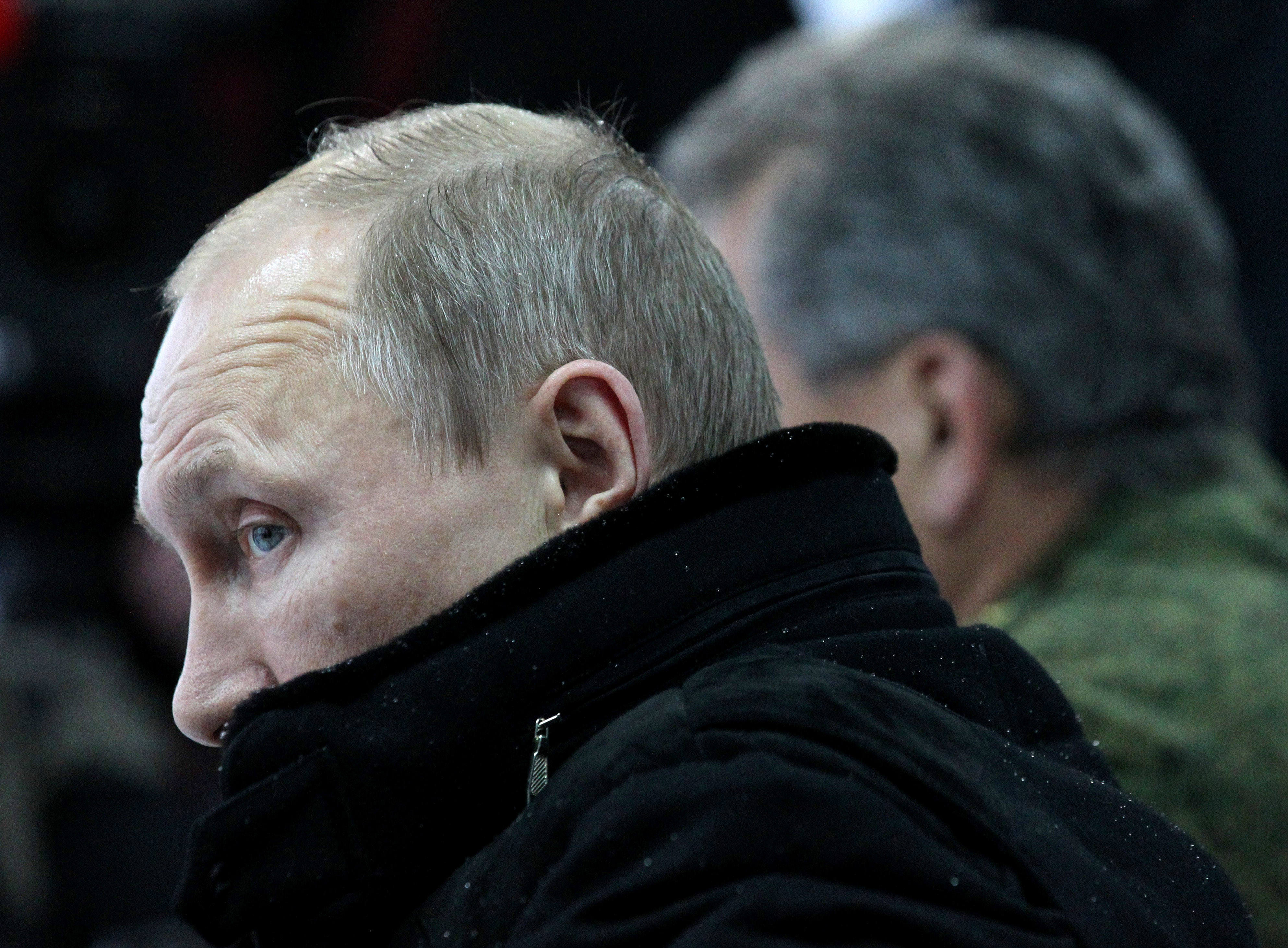
(Photo: Russian President Vladimir Putin watches a military exericises at Kamenka polygon on March 3, 2014 near Saint Petersburg, Russia. Ukrainian forces in Crimea had been issued with a deadline for surrender by the Russian military as it continued to mass equipment and personnel along the border. By Sasha Mordovets/Getty Images)

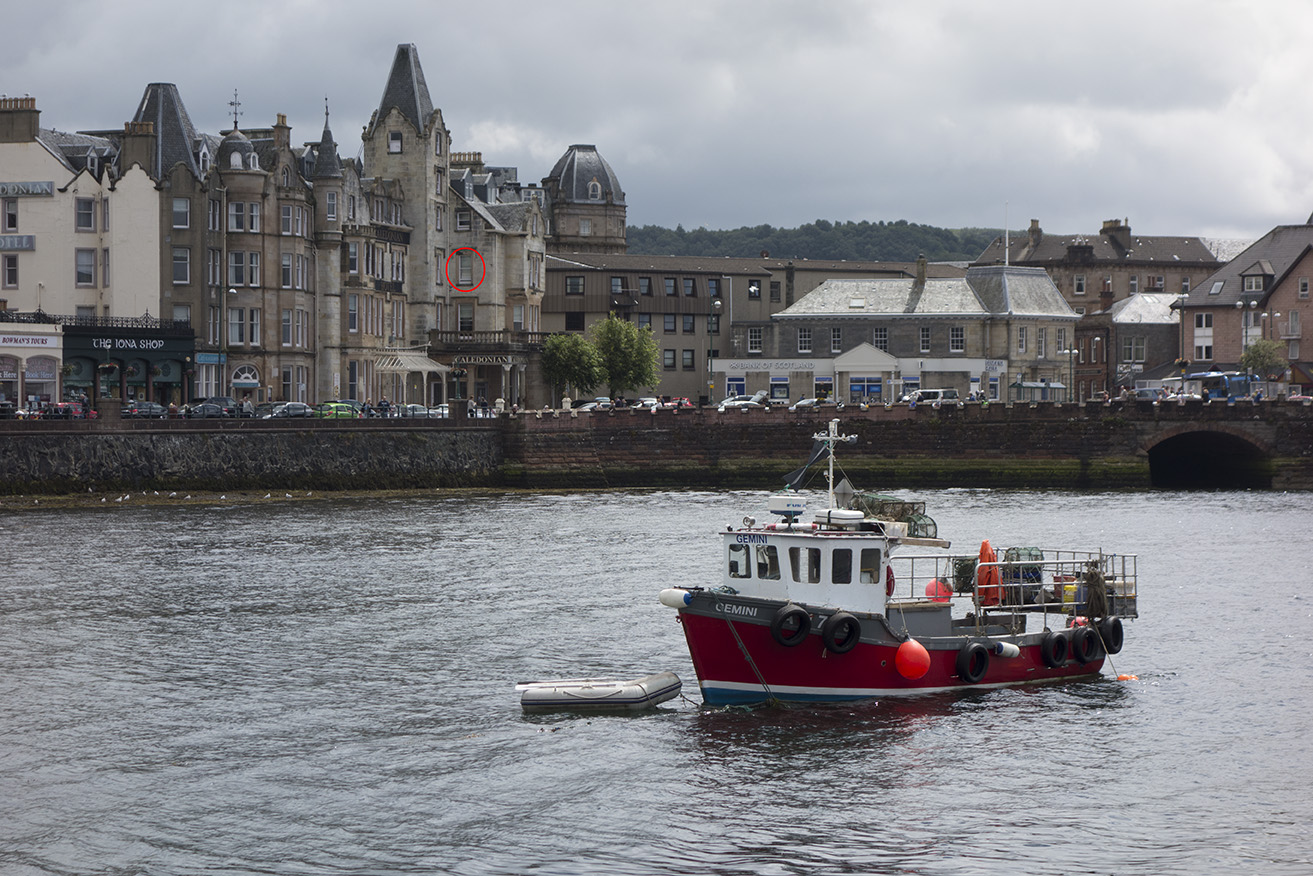
The View From Your Window Contest: Winner #210

vfywc-200

A reader ventures a guess:

Björlanda, Sweden. I believe that is the Fladen fishing store on the pier.

Another looks east:

This looks very much like the area of Hakone, Japan in which I took an excursion in 2009. Those old-time looking ships are part of the tourist industry. I’m pretty sure this is on Lake Ashi, in the Japanese Alps.

Or the Caribbean?

I’m not entirely sure of the building, but I think this is from the second floor of the DeLugo Federal Building on Veterans Drive in Charlotte Amelie, St. Thomas in the US Virgin Islands. Hassel Island is the island across the water in the foreground, and the building with the tall ship docked in front of it is next to the Legislature of the US Virgin Islands (which is out of the frame to the right). I haven’t been there since 2009, but it was raining then too! Thanks for a great window!

Another goes down under:

This contest is a pain in my ass. I went through chart after chart of tall ship logs (I finally settled on Esplanade_StrahanTasmaniaAustralia/New Zealand and environs). I can’t take it anymore. I finally Googled “Tasmania esplanade” after searching with “quay”, “inlet”, “bay”, “tall ships” and just about every permutation of “port” and “harbor” I could think of … I landed on this painting of Strahan, Tasmania.

That sure as hell looks like the VFYWC, even though I can already tell the dome is missing from the building with the orange roof. I’m out. It’s probably clear on the other side of the world, like the Isle of Man.

Another nails the right island:

I see obvious English signage, a yellow-orange number plate, and double yellow lines, cars parked facing the left side leading me to think it’s somewhere in the UK. All my searches keep pointing back to Falmouth, but I can’t find any place that would match. The surroundings remind me on the gut level more of the area around Edinburgh, but again no dice. Brighton does a Tall Ships festival, but I can’t find any tie.

After looking at thousands of photos, tracing the UK on Google Earth, and going through every company beginning with “Community” I could find, I’m no better off than I was to begin with. I’ve got no more time to give, so I’m registering a frustrated “United Kingdom” as as close as I can get, and I’m even less than certain of that at this point. Grrr. Why do I love this game?!

Because of the drama of near misses? Another reader said the view “screamed” UK because of the “rain and depressed looking tourists”. Another hits the wrong end of the island:

Alrighty, so we have another dismal-ish looking port/harbor/beach view. If I hadn’t seen the little huddle of people bundled up in cold-weather clothing, I would have immediately guessed somewhere warm. However, the vehicles being on the left side of the road, the clearly English sign on the community whatsoever building on the pier, all led me to think that this is somewhere that the British were, or at least had an influence. The numerous blurry masts in the lower left corner suggest a yachting/boating is popular. There’s a sort of castle-y looking building on the waterside to the right, it looks quite old, as in a couple of hundred years or so. The steep slope of the hill at the right leads me to believe that that it probably goes up quite a ways, maybe the hillside buildings comprise a significant part of the landscape we’re not seeing.

All of the above only serves up some rather vague ideas about where this may be. Nonetheless, I’m going to guess somewhere in the Channel Islands or along the British coast.

Another gets the correct (presently non-sovereign) country:

I don’t have any more than this guess: Ullapool, Scotland.

This reader, like most this week, identified the correct city and hotel:

OMG, I FINALLY GOT ONE!

After years of blankly staring at the view from your window photos and wondering how 3778689466_e5f3c5550e_zanyone figured these out, I decided to stop doing anything else until I figured out where this one was. After all, there were plenty of clues: European license plate on a car, UK street markings, and even words on buildings! This would be easy, right?

Um, no … it appears that an insane level of persistence is required to search every possible clue until you get that magical hit. Then you get to obsessively triangulate in on the photo’s precise point of view. But holy cow, this was fun!

The town is Oban, Scotland, and it looks like the photo was taken from a third floor window at the Oban Caledonian Hotel.

Chini chimes in:

Normally it’s a tad disappointing to get an easy view, but between travel for work and Sunday’s World Cup game I’m grateful that this was a near instant find. Plus, it’s a good photo for new players because there’s at least half a dozen different ways to find the location.

Indeed there were:

Northern seaport.
European buildings, license plate.
“Community” on building – aha! Scotland.
Google “Piazza Scotland”: “We are a family friendly pizza/pasta restaurant on a pier in beautiful Oban Bay in Scotland”

Bingo!

Or you could take a more circuitous route:

Google indicated alternative European yellow tags could have been the Netherlands, Cyprus, or Gibraltar (who knew?), but the English word “Community” led me back to the UK.  Web searches for “wharf red metal roof” were totally useless, as was the “Plazen(?)” word by the red-roof building.

Reluctantly, I then circumnavigated the UK, starting near Dover (it was a hunch and not a good one), along the English Channel, then through Ireland, then up to the west coast of Scotland, looking for a bay with a red roof on wharf.  The UK train logos fooled me many times, but the red roof of the Oban North Ferry Terminal finally gave me hope that my efforts had paid off.  There is something really powerful about first seeing the street view confirming this sought-after location.  It’s a really cool feeling.

Below is this week’s OpenHeatMap of everyone’s guesses (zoom in by double-clicking an area of interest, or drag your cursor up and down the slide):

This embed is invalid

Most readers got the right window too, but only one nailed it with a GIF – a first for the window contest:

oban

I found it by googling “fish restaurant on dock scotland.”

A long-time lurker:

Aha! I’ve been following this contest for years and have yet to come any where near guessing correctly. And then finally, this morning, it’s somewhere I’ve been! I almost feel guilty (well no, not really).

The red roofed building on the pier is Ee-usk, a perfectly reasonable seafood restaurant that my wife and I walked out of in favor of fish and chips at a pub down the road. This photo was taken from there:

Oban Caledonian from Ee-usk

Another describes the scene:

The location is familiar because I visited Oban once more than twenty years ago. It was the last family holiday with my parents before I went to university. We stayed in a guest house near St Columba’s cathedral which you can seen in the distance behind the building with the red roof. The island straight ahead is Kerrera. It is a pity the weather was so bad when the picture was taken because the views from here are beautiful. If it had been clearer, to the right of Kerrera you would see across Loch Linnhe to another long low island, Lismore (the most boring place I have ever visited), and the mountains on the mainland again beyond it. Behind Kerrera, to the left, you would see the mountains on Mull.

A first-time player:

I am from Glasgow and first took my wife to Scotland to tour the country in 1999 (we met as students in Canada and started dating the previous year). We stayed for a night in Oban and sailed from there to Mull and went on to Iona. The night in Oban was wet (natch). We sat in our rental car on the seafront (possibly a spot in the photo), listening to “Just A Minute” and watching a diver ease his way out into the bay. Thanks for bringing the memory back to the surface.

Many readers have been there:

Marked up contest photo

Not only is this week’s contest easy, but I’ve had pints at the Oban Caledonian Hotel looking at harbour. My wife and I stayed in Oban with our daughter, then almost two years old. It was our daughter’s first time experiencing the sun setting after 10 pm and she couldn’t sleep. So while my wife rested, I packed my daughter in the stroller walked into town, ordered a beer and rocked the stroller back-and-forth while looking out over the water.

I’ve mentioned this Scottish trip to The Dish before. The first time you posted one of my emails was for Contest 157(tbd) when you also used one of our Glen Coe pictures.

Anyway, back to the window. It is the third floor window over the balcony and labeled in the attached. The angle of the view, the details of the stonework around the window, and the newel post on the balcony below led me to the window.  For the room number, I’ll guess 215.

Old picture

Above is a picture I took several years ago from the B&B we stayed at looking back towards the harbour. Unfortunately, it is not a high enough resolution to label the contest window. For anyone trying to figure out that window, I believe it was room 6 of the Alltavona Guest House.

Another reader:

I recognized Oban Harbour immediately. It is one of those places I felt really “at home”. I did the tourist thing to visit Castle Sween, a castle where some of my MacMillin ancestors were sheriffs for the Campbells. I stayed in Oban/Fort William to explore the western coast. It was November, off season and wonderfully full of locals only.

Screenshot-imac- 2014-06-21 at 04.53.05 PM

Another:

I’ve only been to Oban once, as a child, and I remember nothing but the harbour being full of dead jellyfish. The city was, like my native Cardiff, the hereditary home of the Marquesses of Bute. The 3rd Marquess, who converted to Catholicism, furnished the Cathedral Church of St Columba in Oban, which can be seen in the window, and was originally clad in corrugated iron (known locally as the “Tin Cathedral”). I think my great-great-grandfather was one of his boy choristers.

Another learned some vocab:

This week’s contest taught me the difference between “piers” and “quays”! Specifically, piers are wooden and quays are stone. And more importantly, when you Google “red buildings on piers in the UK,” you get nothing relevant, while the same search for “quays” just might do the trick.

This husband-and-husband team learned about ships:

Rather than brute-force through a zillion possible cities in Google Earth, my husband chose instead to search for sailing ships, first using reference materials found online to identify the brown and tan vessel in mid-frame as a ketch. “There can’t be that many ketches in the world,” he said, but he ended up viewing hundreds of images before finding this one on ship-photographs.com:

MAYBE

Ship-photographs.com (another handy site for window hunters) identifies the ship as Maybe, a 26.13m Bermuda ketch built in 1929. This information led in turn to Maybe’s web site, where an itinerary can be found. I got tangled up in news stories about Maybe’s arrival in Whitehaven such as this one before looking at an earlier stop in Oban, Scotland.

A former winner saw the street markings and was reminded of a “corny old family joke”:

A tourist asks an Irishman what the yellow line on the side of the road means. “Ah, it means you can’t park there at all.” “So what does it mean when there’s a double yellow line?” “That means you can’t park there at all, at all.”

Another reader:

First, as a heavy scotch drinker:

D6D94C32-946F-49D3-8475-D2452FB32482

I thought this was going to be an easy one as there seemed to be tons of clues to go on – left-side driving, European license plate style (but also maybe Australian), distinctive seafood restaurant, some visible text (“community”), but it nonetheless took me a lot of hunting to track it down. I don’t know if that’s because it’s a hard contest this week, or if I was just unlucky or not very clever.

I finally managed to track down a photo of the EE-USK restaurant with the Google query “seafood restaurant pier scotland”, which found this photo showing the restaurant’s recognizable red dome:

210-image

How did I know to search Scotland? I didn’t. I tried “seafood restaurant pier england” and “seafood restaurant pier australia” and so on until I got lucky. The restaurant looks interesting. Its name is a phonetic spelling of “iasg”, Gaelic for “Fish”, which makes sense as they get their fish directly from the fishing vessels and can serve them fresher than pretty much anywhere else. A few hours from swimming in the sea to being served on a plate, as this YouTube video demonstrates: Ee-usk on “Town with Nicholas Crane”

After locating the correct harbor, tracking the view to the Caledonian Hotel was not hard. By my calculations it could only have been taken from one window.
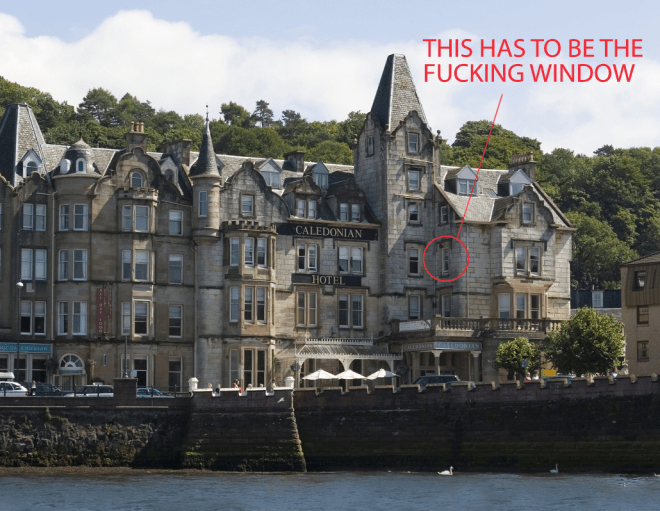
caledonian

My calculations are, however, sometimes wrong. Who knows what room number it is – I’ll take a wild guess at 222.

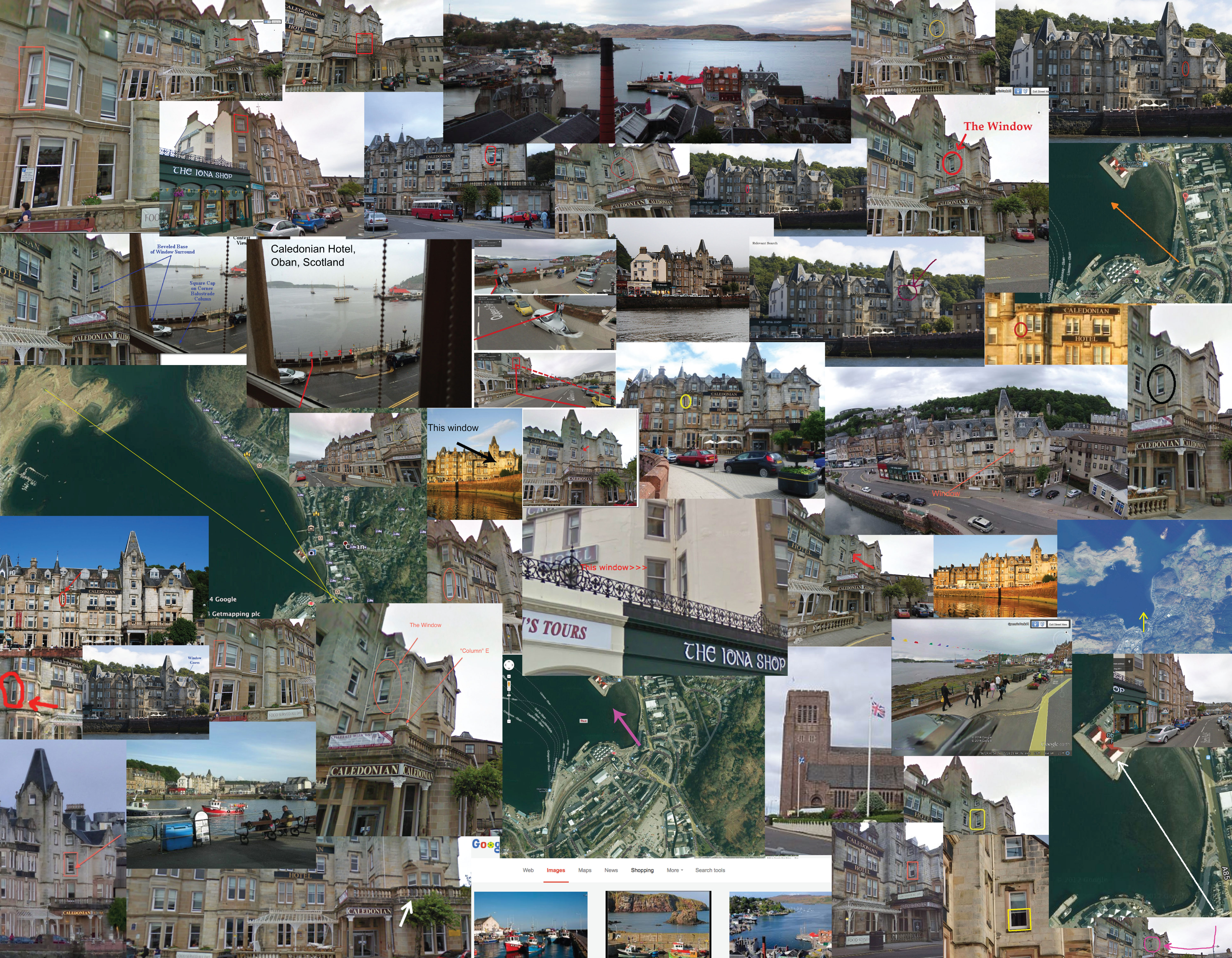
There were so many great entries this week, so see if you can find yours in our collage:

vfywc-210-guess-collage

This week’s winner is a three-year, 19-contest veteran from our esteemed list of players who have correctly guessed difficult views in the past without winning:

My first thought was British Columbia/Alaska, but then I noticed the yellow elongated license plate and figured it must be Scotland. I googled “tall ships Scotland”, found a couple companies offering holidays on tall and small ships, and started looking at the ports mentioned. Oban was the first place I checked out, and the red roof on the Ee-usk Seafood Restaurant on the North Pier made it clear that I had found the right location. Looking for the crenelated seawall and the area with the benches got me to the Caledonian Hotel.

oban-210

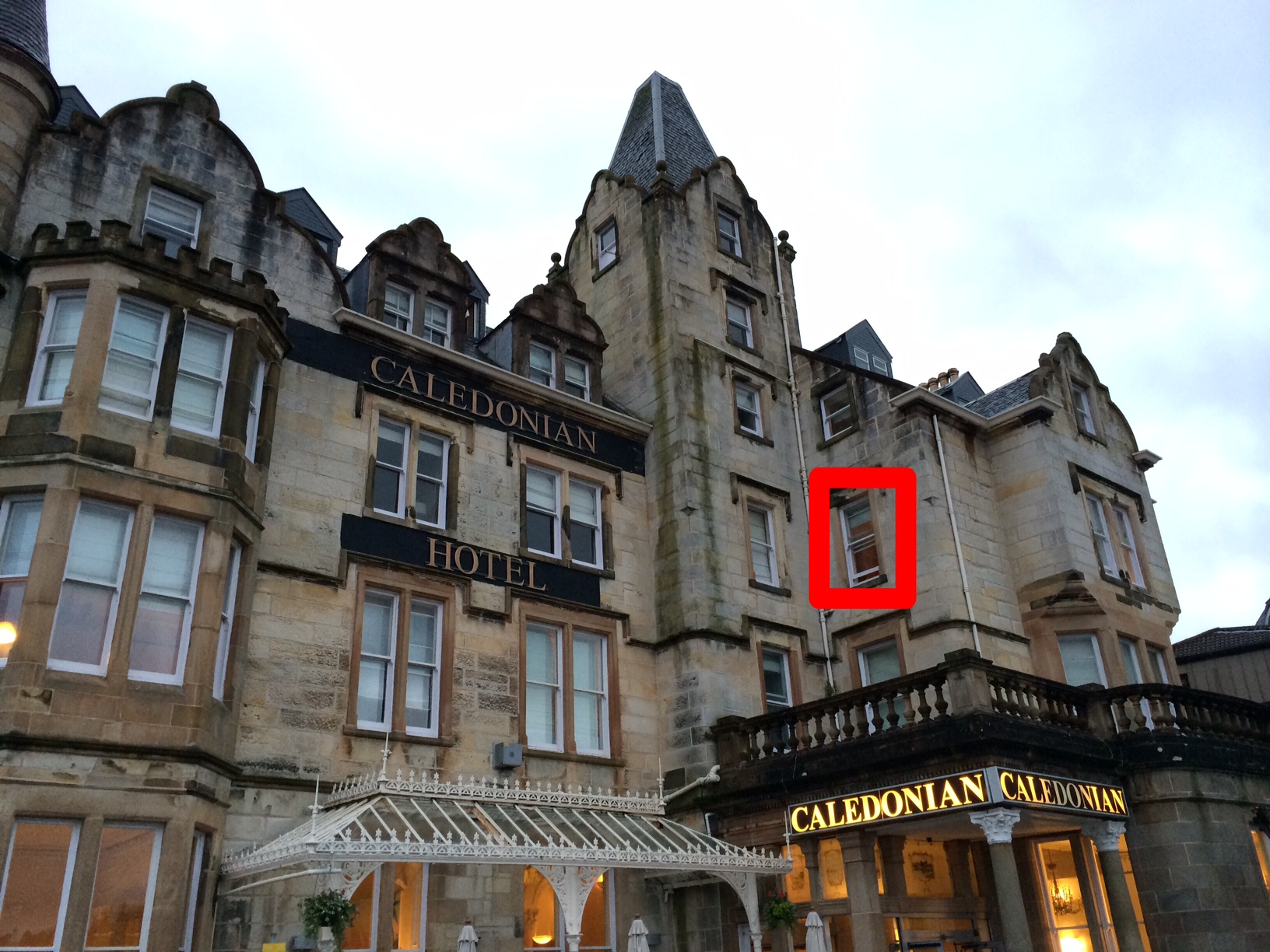
So far, so good. I’ve found the correct building any number of times, but I always lose it on the precise window locations – I’ve decided I have some hereditary problem judging sight lines and angles. After looking through every single customer photo of the Caledonia Hotel on Trip Advisor, I’m guessing the photograph was taken from room 204. I’m inserting a picture with a circle around the (I’m desperately hoping) correct window.

That’s exactly correct. From the photo’s submitter:

We’re terrible at playing VFYW, but we thought our current view would make an excellent submission for an upcoming contest.

image_1

We’re currently staying in room 204 of the Oban Caledonian Hotel in Oban, Scotland. Since their upcoming vote on separating from Britain has been in the news, we thought it would be timely too.

image_2

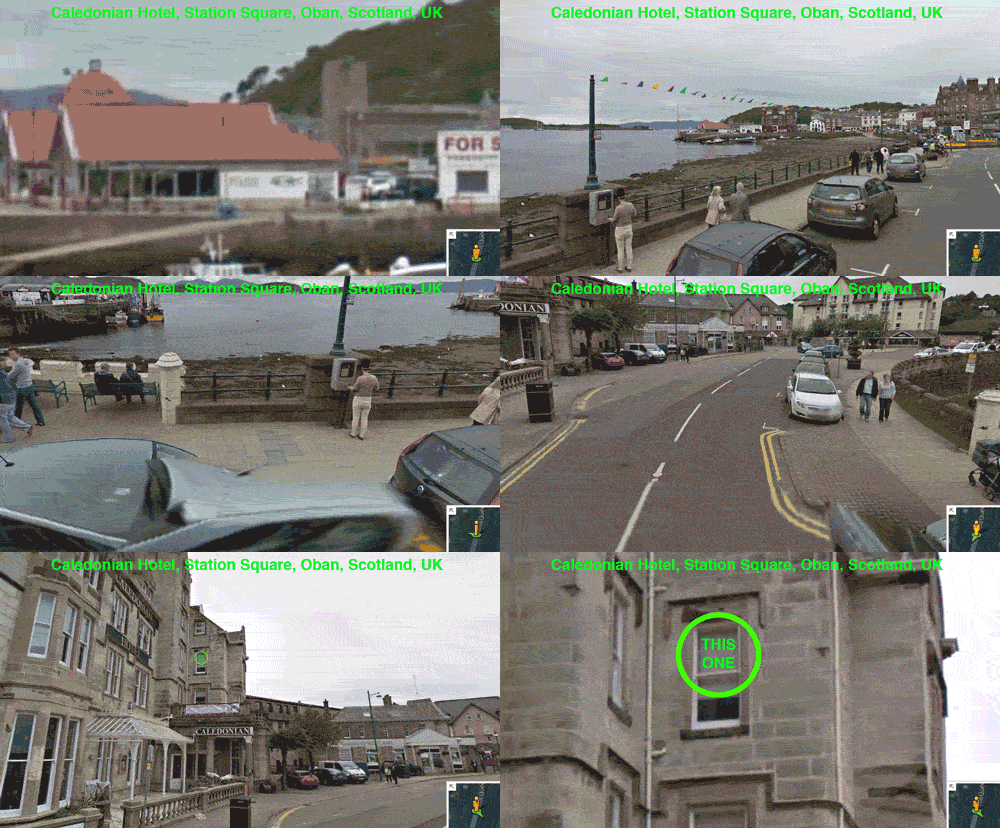
We snapped the photo upon our arrival this afternoon, being careful not to show any buildings that included “Oban” or other obvious words on them. We’re including Skitched photos from two angles in case someone identifies the window that way vs by room number. We thought it might be extra challenging to get the exact window because it looks out the side of the building rather than the front (which you can see by comparing the two angles.

By the way, this is our very first time on the UK, and we love it so far!

image_3

(Archive: Text|Gallery)

Quote For The Day II

“I repeat the firm condemnation of every form of torture and invite Christians to commit themselves to work together for its abolition and to support victims and their families. To torture persons is a mortal sin. A very grave sin,” – Pope Francis. One wonders whether George W. Bush will ever hear him.

EPA Regulations Hold Up In Court, Sort Of

Yesterday, SCOTUS issued a ruling on the EPA’s powers to regulate greenhouse gas emissions under the Clean Air Act, but nobody could seem to decide whether it was good or bad news for the agency:

The cases, led by Utility Air Regulatory Group v. the EPA, challenged the EPA’s authority to regulate greenhouse gasses from stationary sources (like coal plants.) The 5-4 decision — split along several lines — will effectively limit the EPA’s ability to regulate those gasses in some instances. However, it seems likely that the EPA will be able to find a way of maintaining those regulations even with today’s decision.

The mixed, complicated opinion is producing split results from the media, too. The New York Times’s quick take on the opinion proclaimed it a “victory” for “President Obama’s Environmental Protection Agency,” because it preserves most of the EPA’s tools and programs for regulating greenhouse gasses in stationary sources. However, because the court’s opinion rejects the way in which the EPA imposed those regulations in some instances, the decision produced a different lede over at Fox News: “the Supreme Court delivered a setback to the Environmental Protection Agency,” it begins. As experts comb through the details of the opinion, its likely that the reality lies somewhere in the middle.

Essentially, the court ruled that the law does not give the agency carte blanche to regulate greenhouse gas emissions but left it with a workaround that would allow it to continue doing so in most cases:

The high court ruled 5-4 that EPA may only require newly built or modified industrial pollution sources—such as power plants, refineries, and factories—to limit greenhouse gases if those same sources must already obtain permits for their so-called conventional pollutants. In practice, that means only a slight change in the number of big industrial polluters that would be captured by the existing, case-by-case greenhouse-gas permitting program at issue in the case decided Monday. The permitting program itself was not struck down.

The permitting program requires polluters to use so-called best available control technology, which for greenhouse gases has largely meant increased energy efficiency thus far, the Obama administration noted when defending the program before the Court in February. Limiting the program to facilities that must already get permits for their conventional pollutants (such as emissions that cause smog) addresses the sources of 83 percent of U.S. greenhouse-gas emissions from industrial polluters, compared with 86 percent without that restriction, according to the Obama administration.

At issue was whether the agency had overreached in “tailoring” the Clean Air Act to regulate CO2:

The statute calls for the EPA to regulate any source that emits more than 250 tons of the pollutant; most major sources of CO2 emit far more than that. In fact, under a strict regulatory approach, the EPA would have to issue permits to 6.1 million facilities (it currently regulates 15,000 under this provision). The administrative costs alone would jump by $21 billion. Since the EPA recognized this as unworkable, it set a much higher limit of 100,000 tons per year of carbon dioxide or an equivalently potent amount of another greenhouse gas. This “tailoring” approach to the distinct issue of greenhouse gases was then challenged in court by a variety of groups, from industry organizations to individual states.

Writing for the majority, Justice Antonin Scalia struck down the tailoring approach. The general argument is that if a statute produces absurd results—and even the EPA recognizes that the Clean Air Act does in this case—then an agency doesn’t gain the right to rework the statute in order to produce saner results. Left on its own, this portion of the ruling would be enough to throw out the EPA’s regulations.

Doug Kendall and Mei-Wah Lee call it “a 97% victory for the environment.” Their caveats:

First, the court’s willingness to find the Clean Air Act’s text of “any air pollutant” ambiguous — despite both the term’s capacious definition and its acceptance in Massachusetts v. EPA — will be cited by industry challengers as evidence that EPA’s authority is limited when it comes to regulating greenhouse gases. In effect, that would be an argument that greenhouse gases are somehow separate and unequal pollutants for purposes of the Clean Air Act. Massachusetts v. EPA makes it clear that this isn’t true, but some of the language in Scalia’s opinion may inspire other last-ditch efforts by industry groups to undermine the government’s authority to address the gravest environmental challenge of our time.

Second, in rejecting EPA’s attempt to keep faith with the act’s text and underlying purpose by adjusting the PSD program’s numerical threshold requirements, Scalia appears to define “reasonable” merely in terms of how much the interpretation would increase EPA’s regulatory authority — the more authority for the EPA, the less reasonable the interpretation (or, at least, so some challengers may argue). Again, industry will take heart in the limits drawn by Scalia’s decision and emphasize them in future cases.

For Jonathan Adler, the bottom line is that the “EPA can regulate, but it does not have free rein”:

The court made clear that it was not addressing any potential objections as to how the EPA decides to regulate stationary source emissions of GHGs going forward. On this the Court was explicit: “our decision should not be taken as an endorsement of all aspects of EPA’s current approach, nor as a free rein for any future regulatory application of BACT in this distinct context.”

In upholding the EPA’ authority to require facilities already subject to regulation under the PSD program, the court seemed aware that regulating GHG emissions, and carbon dioxide emissions in particular, is different from regulating traditional pollutants and that the EPA may not have a free hand in controlling GHG emissions however it sees fit.  So, for instance, the EPA may be limited in its ability to force facilities to adopt energy efficiency improvements as a means of reducing GHG emissions.

Daniel Gross shrugs off the ruling, noting that the tide is already turning against carbon:

[We’re seeing] a heartening effort by polluting industries to get ahead of regulations rather than fight or undermine them. Since the promulgation of new gasoline mileage standards, as I noted earlier this month, the U.S. auto industry has made stunning progress. The typical new car sold in May got 25.6 miles per gallon, up an impressive 27.4 percent from the rating of the typical new car sold in October 2007. Less gasoline used equals fewer emissions.

America’s power industry is likewise taking steps to reduce emissions—partly in response to higher standards, partly due to tax credits and other financial incentives attached to renewables, and partly because of the availability of cheap, cleaner-burning natural gas. The fastest way to reduce emissions sharply would be to stop using coal in generating electricity. The EPA can’t ban the use of coal, and the Supreme Court wouldn’t sign off any such effort. But the market, structured as it is now, is slowly driving coal out of America’s energy mix.

In Drum’s view, the real story here is about how the court views the power of executive agencies to interpret the law:

[T]oday’s ruling is a demonstration of something I’ve mentioned before: When an executive agency modifies the way it interprets a law, it’s a fairly routine affair. Interpretations of federal statutes, especially complex regulatory constructions, are notoriously difficult, and agencies do it all the time. There’s no presidential “lawlessness” or “tyranny” involved, and disputes over these interpretations are routinely resolved by courts. In this case, it was obviously a close call, since the decision was 5-4 and the opinion was long and dense. This is what’s likely to happen in other cases where the Obama administration has interpreted a law in ways that his critics don’t like. If the critics are serious, they’ll go to court, and in some cases they’ll win. In others, they’ll lose. Welcome to the 21st century.

Also picking up on that theme, Andrew Grossman looks ahead:

The Court’s decision may be a prelude of more to come. Since the Obama Administration issued its first round of greenhouse gas regulations, it has become even more aggressive in wielding executive power so as to circumvent the need to work with Congress on legislation. That includes recent actions on such issues as immigration, welfare reform, and drug enforcement. It also includes new regulations for greenhouse gas emissions by power plants, proposed just this month, that go beyond traditional plant-level controls to include regulation of electricity usage and demand—that is, to convert EPA into a nationwide electricity regulator.

Today’s decision—as well as one last month by the D.C. Circuit rejecting a nearly identical regulatory gambit by the Federal Energy Regulatory Commission—suggests that this won’t be the last court decision throwing out Obama Administration actions as incompatible with the law.

The Case For Killing Awlaki Is [REDACTED]

Anwar Al-Awlaki

David Barron’s Office of Legal Counsel memo making the case for the drone strike that killed Anwar al-Awlaki in 2011 has been released, with lots of redactions of course. The memo touches on the major controversies surrounding the operation, including Awlaki’s due process rights, the risk of killing innocent civilians, and the CIA’s involvement. Scott Shackford provides the tl;dr version of what the release does and doesn’t tell us:

The Authorization to Use Military Force (AUMF) that gave us wars in Iraq and Afghanistan gave the administration permission to pursue and capture or kill members of Al Qaeda; Al-Awlaki was a member of Al Qaeda; therefore, killing was legal. Al-Awlaki’s Fourth Amendment right to due process is brought up toward the end. The Justice Department argues here that capturing Al-Awlaki was infeasible, yet he presented a threat to the United States as “continued” and “imminent,” therefore lethal force was justified.

What sort of continued and imminent threat did Al-Awlaki present from Yemen? Don’t know. That part is all redacted. The justification of why the CIA pursued this course of action is also almost entirely redacted. Even with the memo, we actually don’t learn anything new from a leak of a similar memo NBC published last year. We don’t know why Al-Awlaki was considered to be an imminent threat and why this drone strike was the only way the Obama administration believed it needed to deal with him.

Benjamin Wittes combs through the argument in more detail, but the redactions, as Wittes observes and as Serwer highlights here, leave some key points to the imagination:

The portion of the memo dealing with potential Fifth Amendment objections to targeting al-Awlaki remains heavily redacted, though the portion dealing with the Fourth Amendment is largely readable. Attorney General Eric Holder has argued publicly that ”The Constitution guarantees due process, not judicial process,” an argument later mocked by comedian Stephen Colbert, who deadpanned in response, “due process just means there’s a process that you do.”

“To my mind, the most controversial argument we’ve heard from the Administration was Attorney General Holder’s suggestion that due process is not a requirement of judicial process,” said Stephen Vladeck, a professor at American University’s Washington College of Law. “Presumably, that argument turns on the rigor and thoroughness of the internal Executive Branch decision-making that goes into ensuring that the target may legally be attacked, and that we’re absolutely sure the target is who we think it is. But the version of the memo disclosed today offers vanishingly little insight into these critical questions–leaving most of the presumably critical analysis blacked out behind redactions.”

Conor is particularly spooked at Barron’s contention that “a decision-maker could reasonably decide that the threat posed by al-Awlaki’s activities to United States persons is ‘continued’ and ‘imminent.’”:

This passage is alarming for two reasons:

1) It asserts that the executive branch can kill Americans in secret under the standard, “a decision-maker could reasonably decide…” Dick Cheney was “a decision-maker.” So was J. Edgar Hoover. Are we prepared to accept that 5th Amendment protections are null based on a relativistic standard as interpreted in secret by men like them?

2) The memo treats the representation that al-Awlaki posed an “imminent” threat as important. But unless it is hidden in a redaction, the memo does not address how “imminent” is defined, and there is good reason to believe that the Obama Administration has defined it so dubiously as to render the term meaningless. I explored this problem at greater length back on February 5, 2013, when Michael Isikoff published another memo that dealt with extrajudicial killings. It set, as a precondition of such killings, “an imminent threat of violent attack.”

David Kravets focuses on how the memo addresses the question of collateral damage:

“DoD has represented to us that it would make every effort to minimize civilian casualties and that the officer who launches the ordnance would be required to abort a strike if he or she concludes that civilian casualties would be disproportionate or that such a strike will in any other respect violate the laws of war,” according to the “memorandum for the attorney general.”

But that didn’t sit well with [Pardiss] Kebriaei. In a telephone interview, the Center For Constitutional Rights attorney said that “if you accept the idea of a global war and you can follow a target wherever he goes, there is a significant risk of harm to civilians in the area precisely because the laws of war do allow some collateral harm. It’s basically a huge risk of harm to ordinary people and civilians if you accept this premise which can be invoked by other countries.”

And Kevin Jon Heller picks apart the justification for letting the CIA carry out the assassination:

Is it really the case that the CIA is no less entitled to invoke the [public authority justification] than the DoD? There is at least one obvious difference between the two: because international law entitles only the members of a state’s regular armed forces to participate in hostilities, the CIA had no authority under international law to use armed force against al-Awlaki. The CIA is not part of the US’s regular armed forces. …

[T]he AUMF specifically authorizes the President to use the “United States Armed Forces” against AQ; it says nothing about the CIA using force. And, of course, the War Powers Resolution, which the AUMF specifically references, applies only to “the introduction of United States Armed Forces into hostilities.” How, then, can the AUMF provide the domestic authorization necessary for the PAJ to apply to the CIA? Nor is that all. The memo’s own cites strongly suggest that the PAJ applies only to the “lawful conduct of war” by the US’s regular armed forces

This doesn’t quite settle the matter for Drum, whose beef with the Awlaki affair was never the strike itself, “but with the fact that the targeting was based on such a flimsy legal pretext”. He blames Congress for not fixing the AUMF:

The AUMF is now more than a dozen years old, and it’s long past time for Congress to emerge from its fetal crouch and write a new law specifically designed for our present circumstances. Among other things, it should address the president’s ability to target American citizens for killing. If Congress wants to give the president that power, it should debate and pass a law and the courts should rule on its constitutionality. That’s the rule of law. And regardless of whether I liked the law, I’d accept it if Congress passed it, the president signed it, and the Supreme Court declared it constitutional. Instead, as usual, Congress prefers to do nothing. This leaves them free to kibitz if they don’t like what the president is doing, or to simply avoid having to take a stand at all. It’s shameful.

On that, I think, we can all agree. And not just on this question either.

(Photo: Anwar Al-Awlaki at Dar al Hijrah Mosque on October 4 2001 in Falls Church, VA. By Tracy Woodward/The Washington Post via Getty Images.)

Americans Learn How To Be Sad And Love Soccer

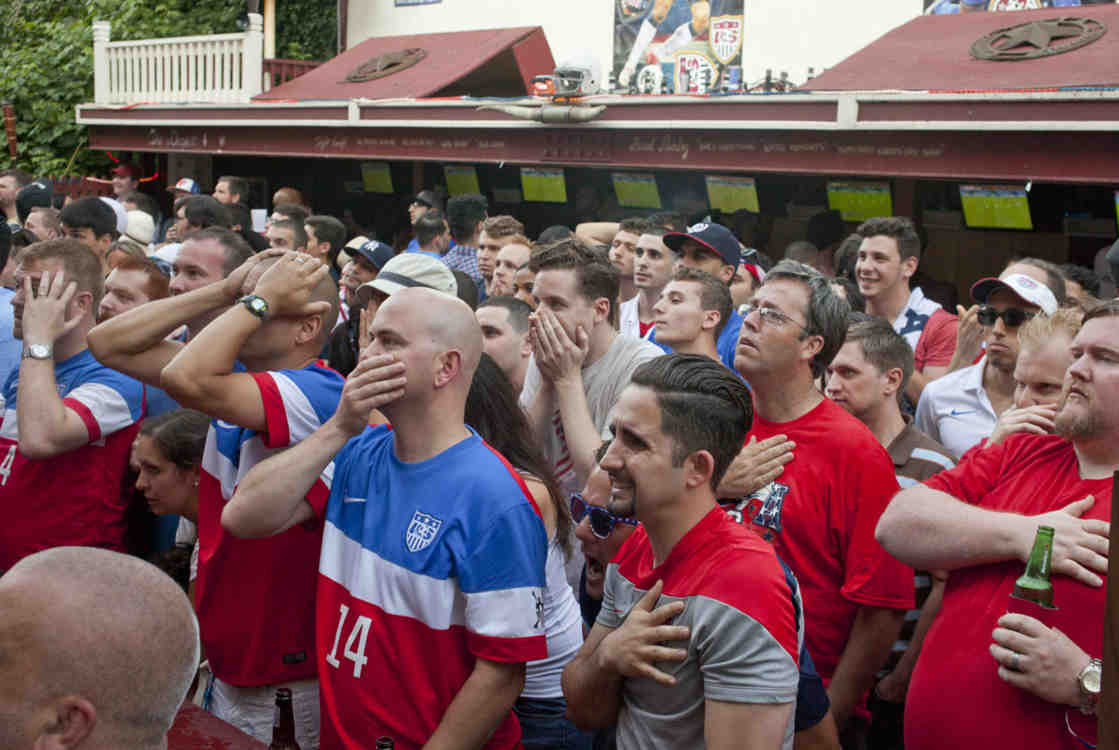
10-usa-portugal.w560.h375.2x

Sunday’s World Cup match between the US and Portugal ended with a last-second goal from Portugal’s Silvestre Varela that turned a 2-1 comeback victory for the US into a disappointing draw. John Cassidy describes the match as a teachable moment for American World Cup fans, evoking soccer’s peculiar mix of pride and deflation:

In the chichi French café where I had been watching the second half with my two young daughters, there were groans and howls of astonishment. Fifteen minutes earlier, when Dempsey scored, the joint had been rocking to chants of “U.S.A., U.S.A.” Now there was a dejected silence. I explained to my elder daughter, who earlier had colored in her own U.S. flag, that, no, Team U.S.A. hadn’t lost; and, no, it hadn’t been knocked out of the tournament. To the contrary, it had performed magnificently, and it still had a very good chance of qualifying for the final stages.

I didn’t bother explaining that the World Cup is like that: it builds you up and lets you down, warping your judgment.

Now that America has finally embraced this quadrennial exercise in fanatical but largely peaceful nationalism, our kids and their friends will have plenty of chances to experience it for themselves: the highs, the lows, and the bits in between. For that, surely, is the lasting message of Sunday’s game. Americans, like practically everybody else, have gone a little World Cup crazy.

Sophie Gilbert has a similar view, using the match to make the case that such sudden, unjust twists are part of what makes the sport exciting to watch:

Take a moment to consider the possibility that it might be more fun this way.

This might sound like the twistiest pretzel logic ever spun (and bear in mind that it’s coming from an England fan), but soccer wouldn’t be half as enjoyable without its extravagant pendulum shifts between beer-soaked elation and crushing agony. It’s profoundly, messily (or Messi-ly, depending on which team you root for) unfair. The U.S. side played with real fortitude in Manaus, not only proving itself to be eminently capable, but actually showing up the depleted Portuguese team. They should have won the game; thanks to some early sloppiness from Geoff Cameron and last minute fumbling from Bradley, they left it with one point instead of three. But doesn’t that make it more exciting?

As thrilled as Cassidy is that Americans are finally getting into the World Cup, Derek Thompson observes that this enthusiasm doesn’t extend to Major League Soccer:

The soccer evangelist says: The World Cup is nearly as popular as the World Series on television. The soccer skeptic says: … and in the 1,400 days between World Cup matches, everybody goes back to not watching soccer on TV.

There is good news for MLS investors and soccer fans. Average stadium attendance is way up in the last few years. Networks are desperate to break out soccer, because the audiences are young, the Hispanic population is growing, and the exclusive rights are dirt cheap compared to the NFL and NBA. But the reality is that nobody is watching American soccer outside the stadium (and few Americans are watching world-class matches in the Premier League on NBC). …

The World Cup is essentially a single-sport Summer Olympics introducing tens of millions of viewers to a thrilling contest in a sport they typically don’t care about. Unfortunately for America’s soccer fans, the vast majority of yesterday’s domestic viewers won’t watch another soccer game between August and 2018.

Previous Dish on Americans and soccer here, here, and here.

(Photo: The scene at Lonestar Bar and Grill, where Varela’s goal left U.S. fans stunned. By Alyssa Tanchajja.)

Friends Don’t Let Friends Abet Human Trafficking

The State Department’s annual Trafficking in Persons report, which came out on Friday, bumped several countries into its lowest tier, including Thailand:

Thailand, Malaysia, and Venezuela’s status was automatically downgraded this year because they have been on a State Department human trafficking watch list for over four years and have not improved. Thailand is among the worst offenders, according to the State Department. … Though the Thai government reportedly paid a U.S. public relations firm $51,000 a month to help it boost its rating on the State Department report, the U.S. downgraded the country to the bottom tier, where it stands alongside 23 others including North Korea, Iran, Russia, China, Libya and Cuba. The 23 countries that were placed in the report’s lowest tier could face U.S. government sanctions on non-humanitarian, non-trade-related aid.

Joshua Kurlantzick is cheered that the Thai PR campaign failed:

[It’s] a particularly tough blow at a time when Thailand has just suffered a military coup and is facing penalties for the coup not only from the United States but also from Europe, Australia, and many other countries. Besides Thailand, other countries downgraded in the new report also had lobbied the administration hard, stressing not only that they were (allegedly) taking action against trafficking but also emphasizing their increasingly warm bilateral ties with the United States. Qatar, an important American partner which received a ranking slightly above that of Thailand, had pushed to be given a higher rating. This time, to its credit, the White House was not swayed.

For example, Thailand surely deserves to be placed among the Tier 3 nations, and should have been downgraded to Tier 3 years ago. In just the past year, the Thai navy has been implicated in the trafficking and outright murder of refugees fleeing Myanmar, Thailand’s seafood industry has been the subject of damning reports from nonprofit organizations and journalists revealing outright slavery in the industry, and in just the past two weeks over 100,000 Cambodian migrant workers in Thailand, many of whom worked under slave-like conditions, have fled the country in panic, fearing that the junta is going to arbitrarily detain and abuse them.

Keating highlights another angle:

The report is also worth considering in light of the World Cup. It specifically highlights the role that trafficked labor can play in the preparations for mega-events like the World Cup and the Olympics as well as the heightened risk of sex trafficking during the events themselves. Qatar, the 2022 World Cup host whose manipulative practices toward foreign laborers have recently become a topic of international interest, was downgraded this year to the “tier 2 watch list,” the second-lowest designation. Russia, the 2018 host, was downgraded to Tier 3 last year.