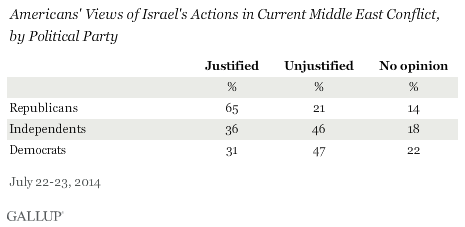
Larison flags a new Gallup poll suggesting that US public opinion on the Gaza war is more complicated than our government’s response to it:
Gallup finds that Americans are split on the question of whether Israel’s actions in Gaza have been justified or not. Overall, 42% say that they are justified, 39% say they are not, and 20% have no opinion. These results are comparable to a Gallup poll taken during the second intifada twelve years ago, but there are slightly more on the ‘unjustified’ side than there were then. As we have seen in other polls on related matters, there is a significant gap between Republicans and everyone else[.]
It is striking how evenly divided the public is on this question when there is total uniformity among political leaders in the U.S. that Israel is justified in what it has been doing. There is always a significant gap between popular and elite views on foreign policy issues, but it is still fairly unusual for a view held by almost 40% of Americans to have virtually no representation in Congress.
Another poll from YouGov finds that more detailed questions yield more nuanced answers:
Americans are much more likely to hold Hamas responsible for the current crisis than they are to put responsibility on Israeli Prime Minister
Benjamin Netanyahu. But that doesn’t mean that Netanyahu is totally blameless: 47% of the public says he deserves at least half the blame. But two-thirds say that about Hamas. Three in four Republicans give Hamas at least half the blame. Just 40% of Republicans say that about Netanyahu. Democrats share the responsibility more evenly: 60% give Hamas at least half the responsibility; 54% say that about Netanyahu.
But some are concerned about Israeli actions. One in four believes Israel is using too much force in Gaza, with Democrats and those under 30 especially concerned. But more believe Israel is using the right amount of force; 15% (and nearly one in four Republicans) believe Israel is using too little force.

But as we know, the right wasn’t always reflexively behind Israel. Looking back on the history of American-Israeli relations, Zack Beauchamp susses out the sources of the staunchly pro-Israel foreign policy the US follows today:
For one thing, the US approach to the Middle East didn’t change that much after the Cold War. The US became increasingly involved in managing disputes and problems inside the Middle East during the Cold War, and it maintained that role as the world’s sole super-power in the 90s. Stability in the Middle East continued to be a major American interest, for a number of reasons that included the global oil market, and the US took on the role as guarantor of regional stability.
That meant the US saw it as strategically worthwhile to support states like Egypt, Saudi Arabia, and Israel, which saw themselves as benefitting from an essentially conservative US approach to Middle Eastern regional politics. Unlike, say, Iran, Syria, and Saddam’s Iraq, these countries were basically OK with the status quo in the Middle East. The US also supported the status quo, so it supported them accordingly.
Previous Dish on the partisan divide in American public opinion of Israel here.
 The Dish