Chart Of The Day

Wealth Gap

Josh Marshall highlights a depressing one:

The chart illustrates a pattern that most of us probably do not find surprising. But the sheer chasm separating single white men from Black and Hispanic single women is still shocking to see visualized so clearly. Single white men have 438 times the assets as single Black women and 365 times that of single Hispanic women. As we can see, marriage is a huge determinant of wealth – but mainly if you’re not white, and especially if you’re a woman.

Note that the chart provides data for wealth with and without vehicles (in most cases, cars). Here I’ve referenced the latter statistic. As the report notes, owning a car is an important way to access more employment opportunities among other things. But that wealth is not easily accessible in dollar terms, which is highly relevant for the following reason. Great disparities of wealth not only have a huge impact on life opportunities and the prospects for wealth accumulation. They are hugely important factor in the precariousness of economic life experienced by different demographic groups.

Kurdistan’s Petro-Politics

The US has been pressuring governments and private companies not to buy Kurdish oil, out of fear that oil sales will make it easier for the Kurdistan Regional Government to declare independence from Iraq. But this strategy, Dov Friedman posits, is actually having the opposite of its intended effect:

The U.S.’s logic is clear. KRG oil sales provide the Kurds a financial base with which to stabilize a potential fledging independent state. If the Kurds are unable to sell oil, they will have to parlay with Baghdad to solve the budgetary dispute. However, the U.S. misjudges the Kurdsboth their likely steps after independent oil sales and their response to interference with oil revenues. Distinct Kurdish oil sales have always been more likely to bring the KRG to the Iraqi bargaining table. They seek concessions from the central government, and the threat posed by independent revenue streams may be more valuable than the ability to declare national independence.

First, Kurdistan benefits greatly from its access to the greater Iraqi market.

Kurdish businesses of all sizes are bolstered by a market size of 30 million people, and these businesses would suffer from an independence bid thatat least in the near termslashed the market size by five-sixths. A fledgling independent Kurdistan with a hobbled private sector would rely even more heavily on oil revenuesintensifying the oil-fueled Dutch disease and jeopardizing the nascent country’s economic health.

Second, the Kurds have historicallyand to this daylooked for opportunities to strike bargains with their Arab co-nationalists to the south. … Once in control of Kirkuk’s oil establishments, the KRG initially demanded an increase in its share of the national budget from 17 to 25 percent, to account for increases in the population servedand energy resources controlledby the KRG. Having just taken control of one of the largest, highest quality oil fields in the world, the Kurds spoke not of an independence bid but of renegotiating terms with Baghdad.

Previous Dish on the prospects for Kurdish independence here.

The STD We Snicker At

Jon Fortenbury resents herpes’ reputation as both shameful condition and punchline:

Herpes has a unique stigma among sexually transmitted diseases. HIV/AIDS is stigmatized, but few laugh at people who have it because it’s a serious illness. HPV can lead to cancer, on occasion, and women get tested TIme Herpesregularly for it, making it no joke to most. Chlamydia, syphilis, crabs, scabies, and gonorrhea are sometimes the target of jokes, but these STDS are typically curable, so people won’t have to endure the annoyance for too long. Genital herpes, though, isn’t curable, is thought of as a disease only the promiscuous and cheating-types get, and is a popular joke topic.

Despite the fact that herpes has been around since the time of the Ancient Greeks, according to Stanford University, the widespread stigma seems to be just decades old. …  [F]ilm and TV no doubt keep it alive. Leah Berkenwald pointed out in an article for Scarleteen that almost every Judd Apatow movie includes a joke about herpes. Living Sphere has a large list of films, TV shows, and books that mention genital herpes, with many of the films and TV shows poking fun at people who have it. Sometimes the jokes directly suggest people with genital herpes are whores or cheaters or they indirectly make the connection, such as the classic Hangover line, “What happens in Vegas, stays in Vegas. Except for herpes.”

Update from a reader:

As your friend Dan Savage would attest, herpes is shameful only to Americans. Justine Henin, when she was the #1 tennis player on the world, was asked why she lost a match. She very matter of factly said she had a herpes outbreak. Americans attend support groups for herpes, can you imagine an American treating herpes like the flu, something you have, not something to be ashamed of?

Another:

Reader and subscriber here. In your post about herpes, you quoted another reader who argued that “herpes” is not a shameful condition in Europe, since “Justine Henin, when she was the #1 tennis player on the world, was asked why she lost a match. She very matter of factly said she had a herpes outbreak.”

A common misconception. Americans call herpes on the lips ‘cold sores’, reserving the term ‘herpes’ only for genital herpes. Most Europeans don’t – they call the lip blisters herpes too, since they’re caused by a herpes virus. So Henin was almost certainly talking about an outbreak of cold sores, not a sexually-transmitted disease. If you type the word ‘herpes’ into European google, you will get 98% links to cold-sore treatments. I can assure you that the attitude toward genital herpes in Europe is not very different from that in America.

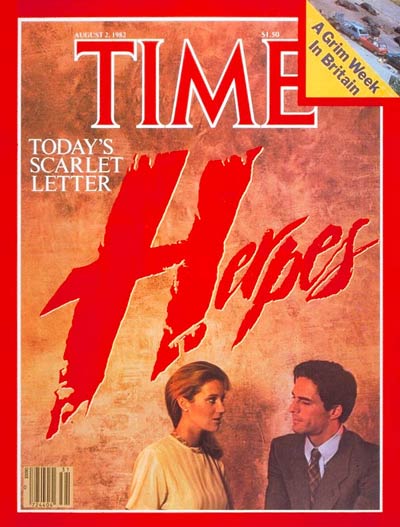
(Image from Time’s Aug. 2, 1982 issue)

The Ever-Expanding Novel

Jeremy Anderberg notes that the average “popular and prize-winning novel” has consistently passed the 400-page mark for the past 40 years, while the average turn-of-the-century read was nearly half that length. He speculates:

I think it’s largely the changing nature of consumers. Hardcover books are often expensive, regardless of length. As a consumer, I almost instinctively buy paper books that are meatier, because I feel like I’m getting my money’s worth. It’s also never been easier to lug around huge books with us at all times in our digital devices, so why not make ‘em longer. A publisher a hundred years ago might have scoffed at the cost of printing a long book, but now with e-books, the cost of publishing a 1,000-page book vs. a 150-page book is virtually the same (obviously it’s still different with print versions…).

Our lifestyle may also play a part. This is completely just conjecture, so bear with me. We, as a people, are far more sedentary than we were a hundred years ago. Does our tendency to sit on the couch for more and more hours a day play a part in how we consume media? Absolutely. Look at the phenomenon of Netflix binge watching. Could the same effect take place with books? We are into bingeing our media, and the bigger the binge the better, so we eat our hearts out with giant books that can completely remove us from reality and how sedentary we really are. If books were shorter, our escapes from reality wouldn’t last so long.