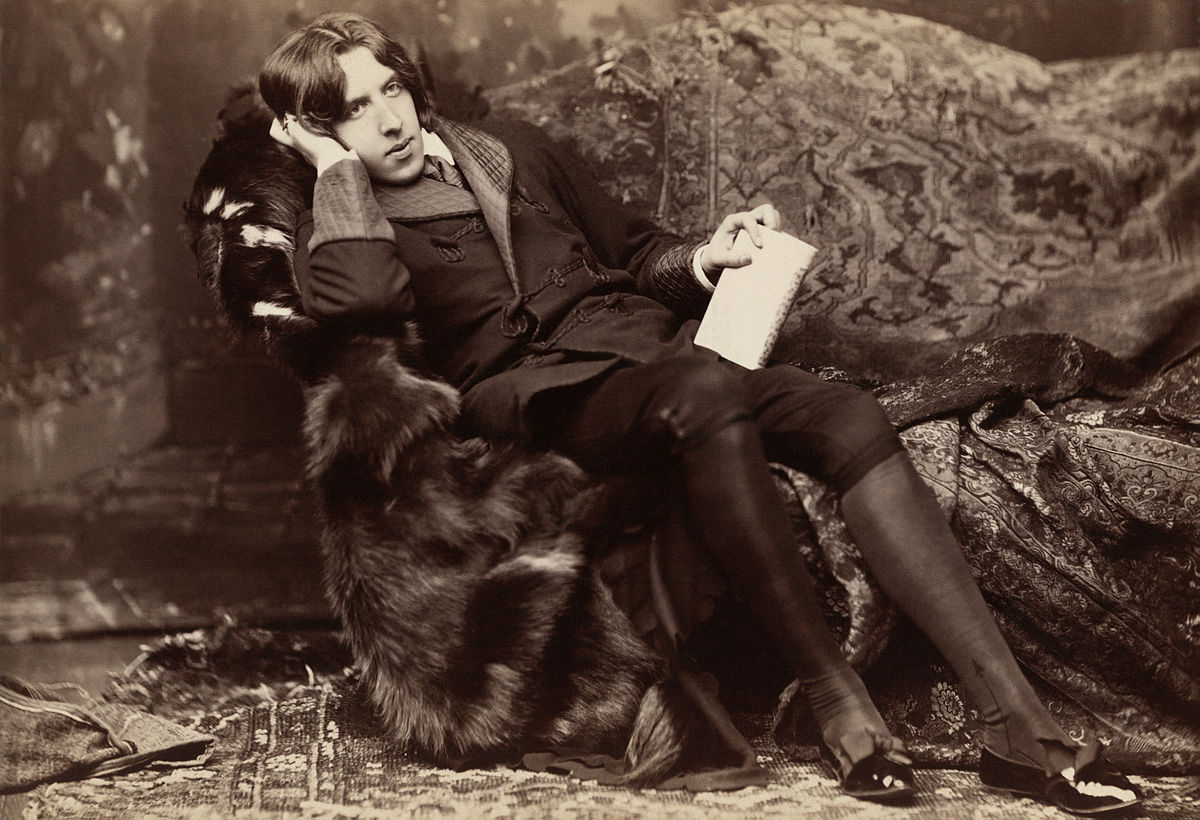
Thursday marked the 160th birthday of Oscar Wilde. To celebrate, TNR republished a classic essay from their archives by George Woodcock, who pondered the writer’s enduring appeal:
Wilde’s broadest appeal lies in the mood of daring thought and enthusiasm from which such insights emerged. It is significant that he had always attracted the adolescent, and in this way has influenced the literary and intellectual awakening of each generation that has followed his own. “I have met no one who made me so aware of the possibilities latent in myself,” said William Rothenstein, remembering his own youth, and many young people who have met Wilde only through his writings have found there an invaluable stimulus at certain stages of their development. This peculiar appeal to the young arises not only from the romantic iconoclasm of Wilde’s ideas, but also from the almost adolescent zeal with which he champions them. … “Disobedience,” he reminds us, “is man’s original virtue. It is through disobedience that progress has been made, through disobedience and through rebellion.” Here the best of the nineteenth century speaks through its most wayward representative.
Richard Ellmann, who wrote a Pulitzer Prize-winning biography of Wilde, details a bit of that rebelliousness in an account of his years as a student at Oxford:
Wilde seems to have enjoyed subverting authorities.
At the examination in Divinity which he had to take at the end of his second year, he went up to the proctor to obtain the examination paper. The proctor inquired, “Are you taking Divinity or Substituted Matter?” (The substituted matter was for non-Anglicans.) “Oh, the Forty-Nine Articles,” Wilde replied indifferently. “The Thirty-Nine, you mean, Mr. Wilde,” said the proctor. “Oh, is it really?” asked Wilde in his weariest manner. (He would talk later of the Twenty Commandments; by miscounting them he discounted them.) The examiner on this occasion was W.H. Spooner, later Warden of New College. Spooner reproved Wilde for being late, to which Wilde replied airily, “You must excuse me. I have no experience of these pass examinations,” meaning that an examination where one simply passed or failed was beneath his notice.
Spooner, himself in orders and a nephew of the Archbishop of Canterbury, reprimanded him by telling him to copy out the twenty-sixth chapter of Acts in Greek. After a time, seeing that Wilde was toiling away industriously, Spooner relented, “You have done enough.” But Wilde continued to write. Spooner said, “Did you hear me tell you, Mr. Wilde, that you needn’t write any more?” “Oh yes, I heard,” said Wilde, “but I was so interested in what I was copying that I could not leave off. It was all about a man named Paul, who went on a voyage and was caught in a terrible storm, and I was afraid that he would be drowned; but do you know, Mr. Spooner, he was saved; and when I found that he was saved, I thought of coming to tell you.”
And of course, it’s hard to mention Wilde without noting his sexuality. Maria highlights his love letters to Lord Alfred Douglas, including this one:
My Own Boy,
Your sonnet is quite lovely, and it is a marvel that those red rose-leaf lips of yours should be made no less for the madness of music and song than for the madness of kissing. Your slim gilt soul walks between passion and poetry. I know Hyacinthus, whom Apollo loved so madly, was you in Greek days.
Why are you alone in London, and when do you go to Salisbury? Do go there to cool your hands in the grey twilight of Gothic things, and come here whenever you like. It is a lovely place and lacks only you; but go to Salisbury first.
Always, with undying love, yours,
Oscar
For more Dish on Wilde, check out this post on the time he (almost certainly) had sex with Walt Whitman.
(Image: Oscar Wilde in New York in 1882, via Wikimedia Commons)
 The Dish
