PZ Myers wants to retire the ubiquitous term:
It vexes me. The official definition says the Bible Belt is the deep South, but that makes no sense. Dwight Moody, of the influential Moody Bible College, was from Massachusetts. William Riley, the pastor who invented fundamentalism, was from … Minneapolis. Saddleback Church is in Orange County. New Saint Andrews College and Doug Wilson are in Idaho; Mars Hill, before its founder’s meltdown, was based in Seattle. The burned over district? New York.
I travel a lot, all over the country, and everywhere I go, North and South, East and West, people tell me they’re living in the Bible Belt. Worse, they’re prone to tell me that their local religious fanatics form the “buckle of the Bible Belt”. Everywhere. The whole damn country. I’ve heard it in Oregon and Ohio, as well as Florida and Texas.
It’s not a belt. It’s a great fat corset, wrapped all around the USA, and it’s covered with elaborate chains and straps and buckles and fasteners. Some people use the term “Bible Belt” to disparage the South, others use it to refer to any entrenched collection of rabid believers, and it’s no longer useful at all. Stop using it!
Less anecdotally, back in 2012, Gallup released a map of the country’s “religiosity belt,” below:
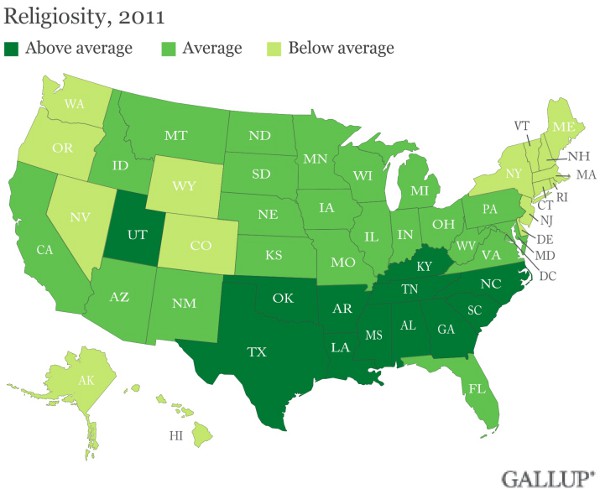
In a post about Gallup’s findings, Richard Florida remarked on how religiosity related to political affiliation:
The map charts state-by-state differences in Gallup’s Religiosity Index, which is based on respondents’ answers to questions about the importance of religion to their everyday lives, and how often they attend religious services. …
Gallup notes the relationship between religious intensity and American voting patterns, with the most religious states generally skewing Republican and the least religious trending Democrat. Our own analysis bears this out. We found a substantial positive correlation between religiosity and the percent of state residents that voted for McCain (.67) and consider themselves conservative (.78), and a substantial negative one between religiosity and the percent of residents who voted for Obama (-.64) and consider themselves liberal (-.75).
 The Dish