“Telegenically Dead” Ctd

Israel

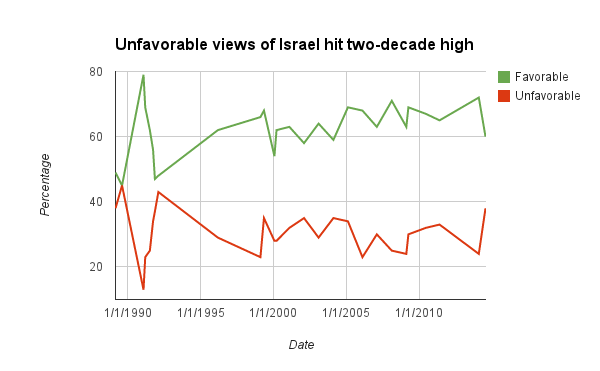
As the hasbara machine fails to stymie international outrage over the Gaza campaign, Aaron Blake highlights some polling that suggests American public support for the Jewish state is on the decline:

A new CNN/Opinion Research poll shows 38 percent of Americans now have an unfavorable view of Israel, which in recent days has launched a ground operation in Gaza that has resulted in more casualties than its allies would prefer (witness John Kerry’s reaction). The death toll in the current conflict includes more than 500 Palestinians. If you combine CNN and Gallup polling, that’s the most Americans who view Israel in a negative light since 1992. Israel is hardly a pariah on the scale of Russia, and 60 percent of Americans still have a positive view of Israel. But the increase in negative views reinforces an emerging trend in the American electorate: It wants nothing to do with overseas conflict, and would prefer that such conflict didn’t exist.

Keating remarks on the role Twitter has played in leveling the propaganda playing field:

Twitter was not even three years old when Israel launched Operation Cast Lead, its last, and far bloodier, incursion into Gaza, and Twitter was certainly not the indispensible tool for gathering and disseminating news that it has since become. … Despite the Israeli government’s large social media campaign—in constrast to that of Hamas, whose accounts are routinely blocked—it has undoubtedly been losing the online information war. As the New York Times notes the “hashtag #GazaUnderAttack has been used in nearly 4 million Twitter posts, compared with 170,000 for #IsraelUnderFire.”

“On the other hand,” he adds, “it’s not clear how much difference this will make”:

Support for Israel remains extremely high in the United States and is increasingly defined by party affiliation. The coverage may be becoming more balanced, but the audience may not have much interest in nuance.

Emily Shire scans the social media vitriol and wonders if Twitter hasn’t actually made the situation worse for everyone:

Since the recent violence has broken out between Israelis and Palestinians, Twitter and Facebook have become a parallel battleground. Inane and disturbing hashtags have been lobbed by those often far removed from the rocket fire. And it’s not just from random, anonymous civilians. A social media manager for the African National Congress, South Africa’s ruling political party, posted a message on Facebook that featured an image of Adolph Hitler with the text “Yes man, you were right …I could have killed all the Jews, but I left some of them to let you know why I was killing them.”

The conflation of anti-Semitism and anti-Israel sentiments is nothing new. The hate behind both have long bled into each other. But the flippant use of extremist hashtags only helps to validate the worst fears that anti-Semitism is alive and well in too many parts of the world (in case the firebombing of a Paris synagogue didn’t already do that). This, in turn, feeds into an outpouring of anti-Arab vitriol on social mediaDavid Sheen reportedly translated tweets by Israeli teens calling for death sentences to Arabs. And just prior to the most recent outbreak of all-out violence, Facebook groups like “The People of Israel Demand Revenge” grew by the tens of thousand in response to the abduction and murder of the three Israeli teenagers.

Keeping Secrets From Ourselves

Joshua Rothman contemplates the “artist’s sense of privacy” in Virginia Woolf’s Mrs. Dalloway, which he describes as an “inner privacy, by means of which you shield yourself not just from others’ prying eyes, but from your own”:

By learning to leave your inner life alone, you learn to cultivate and appreciate it. And you gain another, strangely spiritual power: the power to regard yourself abstractly. Instead of getting lost in the details of your life, you hold onto the feelings, the patterns, the tones. You learn to treasure those aspects of life without communicating them, and without ruining them, for yourself, by analyzing them too much.

Woolf suggests that those treasured feelings might be the source of charisma: when Peter, seeing Clarissa at her party, asks himself, “What is this terror? what is this ecstasy? … What is it that fills me with extraordinary excitement?,” the answer might be that it’s Clarissa’s radiance, never seen directly, but burning through. Clarissa, meanwhile, lets her spiritual intuitions lift her a little above the moment. Wandering through her lamp-lit garden, she sees her party guests: “She didn’t know their names, but friends she knew they were, friends without names, songs without words, always the best.” That’s the power of artist’s privacy. It preserves the melodies otherwise drowned out by words, stories, information.

Libya’s Sorta-Kinda Civil War

Tripoli residents are fleeing their homes by the thousands after militia clashes destroyed the country’s main airport and left 47 people dead. A look at the airport:

The Economist brings us up to speed:

Militias from Misrata, frustrated at their failure to capture the airport after a week of fighting with the Zintan militia that holds it, arrived with tanks to pound the perimeter. The Zintanis responded with shells and anti-aircraft fire. As the violence expanded, huge fires burned in the city’s western districts. “A shell hit my neighbour’s house and a lot of people left,” says Seraj, a resident of the western suburb of Janzour.  “We stayed inside, it was not safe on the streets.” When the smoke cleared, Zintanis remained in control of the airport, but it is now a shambles of wrecked buildings and burned-out aircraft. …

Without command of any troops willing and able to intervene, Libya’s foreign minister, Muhammad Abdul Aziz, on July 17th asked the UN Security Council to send military advisers to bolster state forces guarding ports, airports and other strategic locations. He warned that Libya risks going “out of control” without such help. But he found no takers. The Security Council, which passed resolution 1973 authorising NATO bombing of Gaddafi’s forces in March 2011, worries about committing troops to a war featuring a mosaic of competing factions. “Whose side are we supposed to intervene on?”  asks a Western diplomat in Tripoli.

The government is apparently weighing whether to ask the International Criminal Court to go after the leaders of these militias. Mark Kersten, who finds this idea pretty rich given Libya’s prior refusal to hand over Saif al-Islam Qaddafi to the ICC, is skeptical that it would do anything:

Libya wants the ICC to be very selective in who it targets. The government wants the ICC to target its adversaries which, at the moment, are those forces responsible for violence at Tripoli airport. According to some estimates, clashes between the Zintani militia (the same one that has Saif al-Islam Gaddafi in its ‘custody’) and the Misratan militia have resulted in the destruction of 90 percent of the airport’s aircrafts. The fighting also prompted the UN to pull its staff out of the country.

But it is hard to see how the Court could become involved. After all, it isn’t clear how one militia attacking another to gain control of an asset like an airport constitutes a crime against humanity. The destruction of Sufi shrines, political assassinations and illegal detention and torture of thousands of former combatants hasn’t led to an ICC investigation. The battle for Tripoli airport pales in comparison.

Face Of The Day

Naturalization Ceremony At Metropolitan Museum Of Art

Giselle Fernandez sits with her mother Katy, who is participating in a special naturalization ceremony at the Metropolitan Museum of Art on July 22, 2014. Over fifty people representing countries from Albania to Burundi took part in the morning ceremony at the American Wing of the museum. The Oath of Allegiance was administered by U.S. Citizenship and Immigration Services (USCIS) Deputy Director Lori L. Scialabba. By Spencer Platt/Getty Images.

Dating With Mental Illness

Molly Pohlig opens up about seeking a partner while suffering from a “tangle of depression, anxiety, OCD, and borderline personality disorder”:

I am not ashamed of my condition. Or not exactly. I think there is still a lot more stigma than we admit, and every joke someone cracks about being “so OCD” makes it harder to explain that while you all think you’re totally cool with me being obsessive-compulsive, it’s a lot more than lining up pencils and touching the light switch. Men have broken up with me after getting only a glimpse of my worst looming on the horizon, and others have stayed with me through abhorrent behavior because they were afraid of what I might do if they left.

I have no qualms about someone seeing my cellulite, but I am afraid of him seeing my self-inflicted scars; I’m not sure I would trust a person who had caused herself such violence, so why should he trust me? I am getting ready to switch medications, which can be ugly. Can I—should I—invite someone along for the ride? I’ve seen how my illness affects my loved ones, and as much as I long for marriage and children, I often think everyone might be better off if I moved to a secluded fjord in Iceland and just sent postcards.

No Quiet On The ISIS Front

Hanna Kozlowska provides an update on Syria, where as many as 700 people were killed last Thursday and Friday in fighting between ISIS and regime forces – the highest death toll in 48 hours since the start of the war in 2011:

The Shaar gas field in central Syria saw some of the heaviest fighting. It is a crucial gas supply facility for the country’s central region and among the largest in Syria. Islamic State fighters attacked the field Wednesday night — just hours after Bashar al-Assad was sworn in for a third, seven-year term as president —  and seized it Thursday, killing 270 government soldiers, guards, and staff. According to the Syrian Observatory for Human Rights, a Britain-based NGO, at least 40 militants from the group formerly known as ISIS were killed. Over the weekend the body count grew by 100. More than 170,000 people have died since began in March 2011. And the war created an unprecedented refugee crisis displacing 2.8 million people, including many women and children.

On Monday, Islamic State fighters clashed in Damascus with other anti-Assad rebels who initially embraced the group but now are trying to expel it from the city. They’ve successfully ousted the organization from sections of the capital and its outskirts but the Islamic State’s influence has recently expanded, encompassing an oil-rich area in the eastern Deir Az Zor province. The organization controls much of Syria’s east.

The conflict also continues to have a severe impact on its neighbors. Alice Su takes stock of the ever-heavier burden the Syrian refugee crisis is imposing on Jordan, which is also host to thousands of refugees from Iraq and other war-torn countries:

A year passes, then two, then three. Rents rise—up to 300 percent in some areas—along with gas, electricity, and water bills. The Jordanian economy, already destabilized by disrupted trade and transit routes across the region, wobbles. GDP growth declines. Foreign direct investment shrivels. Budget deficits and public debt grow.

Jordan’s government has drafted a National Resilience Plan to mitigate this kind of damage for its citizens, 14 percent of whom live below the national poverty line. But the plan, along with all the humanitarian work in the country, depends on international funding, which is dwindling. To date, UNHCR has received 33 percent of its 2014 regional appeal for the Syrian crisis, leaving a gap of nearly $2.5 billion.

Jordan is not meant to be a host country indefinitely. Refugees are supposed to stop here for relief until they reach a “durable solution”—meaning returning home or resettling somewhere with permanent residence. So far, 22 countrieshave pledged to receive almost 35,000 Syrians, with UNHCR calling for a further 100,000 pledged spots by 2016. But there are more than 2.6 million Syrian refugees total, and only some of the pledges— just 121 resettled in America and 24 in the U.K., for example—have been fulfilled. The remaining refugees are stuck here, lives frozen, told to wait for a resolution that may not come.

Dodd-Frank Turns Four

Suzy Khimm checks in on the impact of Wall Street reform upon Dodd-Frank’s four-year anniversary yesterday:

We’ve eliminated some of the causes of the last crisis, but that doesn’t mean we’ve prevented the next one. The toxic mortgage products that led to the last financial collapse have been all but eliminated from the marketplace. If anything, policy experts and advocates are concerned that federal officials have gone too far in tamping down mortgage risk. But the next crisis isn’t likely to resemble the last one. Faced with increased regulation and scrutiny in one sector, financial institutions will simply turn to other kinds of financial products. A post-recession boom in subprime auto lending and junk-rated corporate debt, for instance, have recently raised concerns that few had anticipated four years ago. Such risky loans will continue unless regulations are implemented and enforced more effectively, said [finance professor Anat] Admati.

Patrick Caldwell blames regulators and Republicans for failures in implementation:

Congressional Republicans have done everything in their power to stall the process. They’ve introduced bills to hamper rulemaking and, when that has failed, hamstrung regulators by holding back funding for the agencies, blocking their ability to hire the new employees necessary to write and enforce Dodd-Frank rules.

Peter Suderman, meanwhile, argues that the problem is excessive regulation within Dodd-Frank:

By its third anniversary last summer, the 848-page law had generated nearly 14,000 pages of new regulations, with who knows how many more in the lifetimes of rule-writing to come. …  Dodd-Frank is not a law that was passed to do any specific thing, or even several specific things. It regulates all manner of minutiae: the particulars of debit card surcharges, mortgage qualification rules, bank capital requirements, energy company finances, and even disclosures on the corporate use of tungsten and other minerals from the Congo. In practice, it looks more like a law designed to do anything, and perhaps everything. Judging by the results, it’s hard not to conclude that the legislators behind the law did not really know what it was supposed to do at all.

The Left’s Elizabeth Warren Fantasy

Warren’s speech last week at Netroots Nation gave it new life. Her fans even created this cringe-inducing hathetic theme song:

But there are few signs that Warren is preparing for a run:

[S]he is not doing behind-the-scenes spadework expected for a White House run. When she headlined the Minnesota Democratic-Farmer-Labor Party’s Humphrey-Mondale Dinner in March, Warren did not take down names and numbers of the people she met. She traveled with only one aide, hitching a ride from the airport from a local party official, said Corey Day, the party’s executive director.

“There was no advance guy making sure the room was exactly right and her water was cold,” Day said. “You didn’t sense an urgency for her to build a political operation. It was just her and her message, all very low-key.”

Weigel understands the game activists are playing:

The Dean campaign lost every major primary. The lesson activists took away: Try something. The media, at least, is going to cover a primary threat more than it covers a sui generis student loan bill. Thus the Warren “presidential campaign,” a masterful branding and messaging exercise.

In September 2013, the New York Times wrote an attention-getting profile of Warren’s appeal to progressives, proven by the growing crowds for organizers wise enough to book her. “Bumper stickers and T-shirts surfacing in liberal enclaves proclaim, ‘I’m from the Elizabeth Warren Wing of the Democratic Party.’ ” Jonathan Martin reported that those stickers were mass-produced by the Progressive Change Campaign Committee, which was founded in 2009 by Adam Green (a veteran of MoveOn and Democratic campaigns) and Stephanie Taylor (a veteran of the SEIU, AFL-CIO, and yes, MoveOn).

Enten shows that Warren, if she ran, would be the most liberal candidate in decades:

If Warren were to win the Democratic nomination, she’d rank as the second-most liberal nominee who served in the Senate or House. Her voting record has been to the left of Walter Mondale’s; only the famously liberal George McGovern had a more leftward-leaning legislative record. By contrast, the past three Democrats to represent the party on the presidential ticket were all near the center of the Democratic Senate caucus, while Warren has the fifth-most liberal voting record in the Senate today.

And, as Andrew Prokop explains, merely running to Hillary’s left isn’t likely to succeed:

The assumption among people who talk to a lot of very progressive activists is that the Democratic base is yearning for a much more liberal nominee. But according to a poll from CNN and ORC International, that’s not the case at all. Only 11 percent of Democrats would prefer a nominee who’s more liberal than Clinton — compared to 20 percent who’d like a more conservative nominee. Once again, it’s difficult to see the opening for a progressive challenger here.

Criminally Bad Parenting, Ctd

Douthat takes a deeper look at “the obligations of conservatives, who tend to support measures that encourage single parents to take jobs, to fiercely oppose policies and practices that then punish such parents when they leave their kids unsupervised.” He suggests building on “direct, paycheck-based success rather than trying to build out the existing K-through-12 system,” and warns against looking to Europe for answers:

[T]he more regimented and mandate-thick a society’s child care system, the more likely it is to have unexpected and perverse consequences for parents and families whose lives don’t quite fit the system’s implicit norms — which could mean anyone from high-achieving professional women (who often fare better in the laissez-faire U.S. than under family-friendly socialism) to would-be stay-at-home parents (who get nothing from a government-run child care system, and who can be effectively prodded into the workforce by the taxes required to pay for it).

Which is why it’s a little unfortunate that American liberalism is pressing so hard right now on ideas (universal daycare, mandated family leave) that could just import some of the European system’s problems to our shores.

Ross returns to the practical childcare issues for struggling families within the US:

Whatever policy outcomes we’re seeking for working families, I still want to resist one possible implication here, because by allowing that it’s reasonable to debate whether policy can do more for parents in Debra Harrell’s position I’m in no way conceding that she actually did anything wrong or problematic, or for that matter that letting one’s children roam or play unsupervised is ever necessarily a sign that government assistance is needed, stat.

My Sunday column began with a childhood anecdote, but I think the far better anecdata comes from today’s piece by Michael Brendan Dougherty, who unlike myself actually grew up with a single mother, somewhat outside the upper middle class cocoon. Part of his argument, and it’s an important one, is that whatever we do to help working parents cope, we should also want to live in a society where parents — regardless of their material situation — feel entirely comfortable leaving their kids to play in park while they work, or letting them wander the woods and streets near their house, or leaving them home alone for a few hours under an older sibling’s supervision.

Michael Kress at Parents, responding to Ross’ column, is more sympathetic to Europe’s approach:

Affordable, reliable, and safe childcare is a necessary component of a functioning society, especially one that expects—requires, even—parents to work. And so we need to figure out a way to guarantee it to all working parents. In Europe, “all European countries offer government subsidies and regulation support to early childhood care,” according to the European Union’s website. “These measures include tax breaks, vouchers, subsidies paid to parents or to the care provider; and in several European countries, capping of childcare costs relative to household income, or by obliging employers to support childcare costs (for instance in the Netherlands).”

I don’t know what form this sort of policy should take here in the United States, but whether it’s tax breaks or subsidies or publicly funded day-care centers or something else entirely, without addressing this problem, we will see many more Debra Harrells. …

Our public policy must recognize the realities of today’s families, especially the huge number of single parents (and the correlation between single parenthood and poverty). In addition, many families today lack the extensive familial and social networks that may have, in the past, provided (free) childcare so mom and/or dad could work. This is not just a problem for the very poor. There is nothing optional about working for most people trying to support their kids, and childcare could easily be beyond a single parent’s means.

As parents, most of us have said things to our kids like, “I don’t have eyes in the back of my head,” or, “I can’t be in two places at once.” For the single moms who must be at work in order to feed their families but have no one else to supervise their children, these are not flippant throw-away lines; they are realities that we as a society must help fix.

More blogging on bad parenting here and here, and some reader responses here.

Mental Health Break

Breaking the fourth wall:

Looking at you – Movie Montage from Brutzelpretzel on Vimeo.

Update from a reader:

A quick note: The vast majority of these clips are not really “Breaking the Fourth Wall.” They are simply POV shots, showing what one of the characters in the film is seeing. It’s an effective technique for helping the audience put themselves into the mind of one of the characters. But true breaking of the fourth wall is the direct acknowledgment of the audience. You are not being put in the position of a character; you are being asked to conspiratorially join in the movie.

My favorite versions are malevolent in nature; many remember several shots like this in the Austrian and American versions of Michael Haneke’s Funny Games, as one of the young killers turns to the camera and asks the audience their opinion. But my favorite comes in Atom Egoyan’s Felicia’s Journey as repressed serial killer Bob Hoskins slowly walks through his home, I believe up some stairs, presumably on his way to kill a young victim. And then he pauses, and looks directly at the camera for an uncomfortable moment, before continuing on. Essentially he was indicting us in his crimes, there are no passive observers.