An epic rap about regressing with the folks:
Why Being Trans Could Cost You The House
Christin Scarlett Milloy couldn’t get a mortgage approval, because she couldn’t get a photo ID, because she’s transgender:
I sat on the phone and patiently explained why I can’t provide photo ID. Because I don’t have any. Because the government has destroyed all my previous ID documents and refused to replace them on several occasions. Because I am transgender. Yes, really. No, I don’t think it’s fair, either. Yes, a lot of people are surprised it’s so hard for us, but there it is. No, I really don’t have anything at all. Mmm, OK. Call me back. Goodbye.
We looked into other ways I could prove my identity. It turns out, there aren’t any. What if I show the dozens of letters back and forth between me and the government, where officials explain that my identity is not in question, but they still won’t send me new ID, because I refuse to check “male” on the application form? Apparently that doesn’t count.
How about expired government-issued ID? Back from a simpler time, when the government and I agreed on what my gender should be. I have that; it even has my photo and my old name on it. (Old-name ID presented alongside a legal ”change of name” certificate is considered valid to identify a person by their new name.) But alas, it’s against the rules to accept expired ID, even under exceptional circumstances.
Update from a reader:
Thank you for continuing your coverage of trans related issues. However, don’t you think that the headline that you wrote is over the top? Would you lend money to someone that did not have a proper ID? Seriously. Trans or not, that is nuts. It sounds like real estate lending pre-2008.
Calling Out The Smears Of Media Matters
Steve Jimenez is not interested in allowing the liberal media monitor to slime his book on the Matthew Shepard murder while offering no substance to back up their claims. In Out magazine, he challenges their assumptions:
In its attacks against me and my book, Media Matters relies frequently on the claim that “investigators… have denounced the book as ‘fictional.’ ” Although two police officers, Dave O’Malley and Rob DeBree, have quarreled with some of the findings of my 13-year
investigation, Media Matters fails to mention that several key law enforcement officials involved in the Shepard case agree with my conclusions. In September 2014, veteran prosecutor Cal Rerucha, who won life sentences for Shepard’s assailants, was quoted in The Casper Star-Tribune stating unequivocally, “If methamphetamine [hadn’t been present] in this case, we wouldn’t have had a murder.” The newspaper also noted, “[Rerucha] remains adamant that Shepard’s death wasn’t a hate crime.” He has repeatedly gone on record praising me and my work. In 2004, O’Malley, a police commander at the time of the murder, urged prosecutor Rerucha not to talk to ABC News 20/20 for a story I produced about undisclosed aspects of the Shepard case — “because of all the good that’s been done in Matt’s name,” according to Rerucha. In essence, O’Malley tried to enlist Rerucha in covering up the truth.
Lieutenant Ben Fritzen of the Albany County Sheriff’s Office, who was a lead detective on the Shepard case and took killer Aaron McKinney’s recorded confession, has also stated on the record that the homicide was driven by drugs and money, not anti-gay bias. Former Laramie officer and state drug enforcement agent Flint Waters, who arrested McKinney’s accomplice Russell Henderson on the night of the crime, agrees with Rerucha and Fritzen. Is Media Matters saying these and other law enforcement officials interviewed for my book have been “discredited” and “debunked,” too?

There’s one way to find out, isn’t there? In the piece, Steve dares someone from Media Matters to debate him in public on the facts behind the case. Will they? And if they won’t, will they retract the smears and apologize?
Illiberal Feminism Strikes Again, Ctd
A reader very close to the controversy writes:
I saw your blog post about the feministic censoring of my debate in Oxford. I thought you might be interested in my piece about this debacle published in this week’s Spectator. The terrible irony of my having effectively been banned by “pro-choice” students is that I intended to make a very pro-choice speech … now published here.
Another dissents:
Oy, Andrew, your framing of this situation. Like the group who shut down the debate, you have a salient point but undermine it with utter, contemptuous bullshit lines like this:
But men, it seems, are not allowed to debate abortion at all, according to a fem-left group at my alma mater. Because: men. Even pro-choice men.
Come on, you know the impetus behind why they’re upset is bigger than such an idiotic reduction. As a straight man who is also pro-choice, I’m not at all hesitant to say that while I might debate the topic off the cuff with other men, if a woman’s voice is available, I’m going to cede to that voice. The reason should be obvious given that as a man I have no way of knowing the anxieties and issues that go along with childbearing and the general reproductive issues that women face. Similarly to that being that I’m not African American or Asian American, I’m not going to go diving into any debates that concern those groups.
Another responds to that kind of that argument:
Men are not allowed to speak about matters related to the female body? That drives me crazy. Question for these women: how many of them have male doctors who advise them on their health, including pregnancy and abortion?
Another dissenter of sorts:
As a feminist, I share your belief that anti-feminist ideas should be openly engaged and debated, not censored and suppressed, on college campuses. But the ferocity of your response got me thinking. You say that “free speech should be absolute.” But in universities, as everywhere else, there are always ideas that are beyond the pale.
What changes over time is that some ideas break out of that closet, and others get pushed back into it. For myself, I’m not sure it’s such a bad thing that advocacy of slavery, Jim Crow and genocide have been pushed into the closet. I am glad that arguments for inter-racial marriage and gay marriage broke out of it. I am horrified that arguments for torture and ethnic cleansing (just this week!) have broken out of it too.
Some ideas still need to be branded taboo. So it is reassuring to me that you will see campus debates on the proposition that the president should be impeached, but not on the proposition that the president should be shot. You will see proponents of fundamentalist religion, but no one given a stage to declare that priests should be allowed to rape little boys. I’m ok with that.
I guess what I’m saying, Andrew, is that the argument over what ideas should be off-limits is itself one of the most vital arguments a society has with itself. I realize that this position locks us in a conundrum of sorts. But it does give me a lot more sympathy for someone who genuinely believes that pro-life arguments are as odious and threatening as pro-torture or pro-rape arguments, and wants to shut them down.
My point is that a free society will always veer on the side of being able to debate anything. Taboos are dangerous. They can cut us off from various arguments that deserve to be heard, if only to be dismissed. Rendering them unmentionable can give them an allure they would never have in the light of day. Another reader:
I’ve been following your posts on feminism with a lot of interest, and I’ve noticed a trend in some of the responses from readers that I wanted to highlight, ones that take a particularly unfair and pernicious strategy for engaging in debate, and it occurs with great frequency in the context of identity politics. These responses take the form of “I know you think what you’re doing is OK, but it’s not for some unspecified reason that you can’t understand because you are not the correct gender/race/religion. Because of this, you should refrain from expressing an opinion and solicit feedback from those who do possess the relevant identity.”
This is one of the more frustrating rhetorical strategies to encounter, because it doesn’t actually constitute an argument. People who argue this way don’t really seem interested in debate so much as having others agree with their point. They believe they’re self-evidently correct, and that if you just think about it long enough you’ll figure it out for yourself. It’s condescending, self-righteous and lazy, and it flies in the face of intelligent, open discourse.
I strongly believe in social, political and legal equality regardless of gender, race, or any other factor. I consider myself a feminist, and I try to go out of my way to treat the women in my life decently and respectfully. I’m also straight, white, male and Jewish, but that doesn’t mean I’m either unwilling or incapable of listening to and understanding other perspectives. What I’m not willing to do is engage in a debate where the other party refuses to even formulate the terms of the exchange, and you shouldn’t either.
At some point, this is an argument about citizenship. I believe in equal citizenship on an open society. That means we interact solely because we are human in a certain polity. No one is excluded from the debate because of their identity; and no one is given special privileges because of it either. So, yes, straights get to debate the rights of gays. That’s how we’ve gotten this far – and have it stick. Another zooms out:
Of course there has been this illiberal strain in feminism for as long as people have been calling themselves feminist – but I also think that by and large it has been overblown by your coverage. Yes, feminism has shades and facets – some much more militant than others. And yes, there is certainly a backlash against the concept of “mansplaining”, but by and large that’s been directed at male politicians and others who have tried to put forth some truly myopic advice to women on the topics of how to avoid being raped and that they can “shut all that down” to keep from getting pregnant. Or use why they didn’t use their teeth to ward off a lecherous comedian who drugged and orally raped them. You know, that sort of idiocy.
In my experience as a 39-year-old white man, I’ve been involved in countless discussions in many of the feminists sites I like to frequent (as I do a vast number of specialized sites to get a more robust understanding on a lot of issues from a lot of directions), and my opinions have been met largely with rigorous and lively debate with the participants even when in disagreement with much of the consensus there. Most of the people I’ve talked to feel that shutting down discussion like in the article you posted earlier is detrimental to all sides of a debate, and that feminism belongs to and is the responsibly of everyone.
For example, I agree that there is too much focus on culture and society rather than chemical and physical understanding of gender differences. Both play a major role, but only one can really be modified with any real efficacy. So, having seen how effective modifying cultural norms have been for other political ventures like gay marriage/rights and marijuana laws, by and large this is the way that many feminists feel they have a chance to make a real progress. I get this, but also think that if you try to take physiological differences out of the equation it makes changing the culture difficult because it’s important to understand how the culture evolved this way in the first place.
Like many of your readers, I find it fairly odd that you seem to have serious blinders on this topic. It’s starting to feel like an axe to grind, and that’s not like you when discussing non-Palin matters …
One more reader:
I spent a whole dinner party in Cambridge last night trying to keep my cool, infuriating especially because by the end it was clear that I was the leper, with death stares from the wife, merely from failing to go along with the vapid indignation. Talking with her afterwards it was clear her issues are motivated by sexual violence that occurred to her as child and for which she still bears true trauma. Likely she always will. If that’s the deeper issue more broadly, it deserves my compassion, but it will force me to engage every debate on the proposed policy prescriptions. Not one good idea last night. Just people patting themselves on the back for being aware of sexual video games.
To your credit, Andrew, your eloquence on marriage is something feminism should be learning from. Yours was a discriminated class just ten years ago. The focused efforts at something so basic as marriage changed everything and quickly. Real change to real policies affecting real people.
The problem with feminism today, by contrast, is no clear outcome worth fighting for, so no real change. And nothing I’m hearing from the proposed first female president is inspired either.
Obama should feel great shame that so many young men are in prison for non-violent crimes and he has done nothing to address the issue as a policy matter. Where is the left’s answer there? By contrast, Gamergate and Hollaback are a cruel joke.
Scientific Paper Of The Day
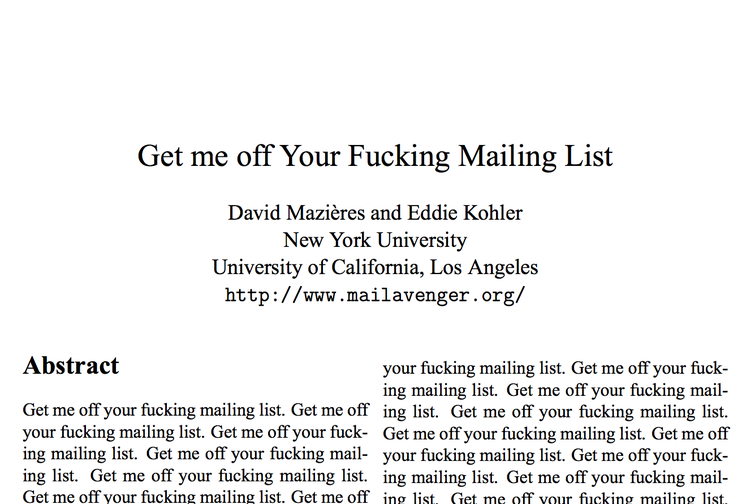
Joseph Stromberg flags the above document (pdf):
According to the blog Scholarly Open Access, this PDF made the rounds, and an Australian computer scientist named Peter Vamplew sent it to the International Journal of Advanced Computer Technology in response to spam from the journal. Apparently, he thought the editors might simply open and read it. Instead, they automatically accepted the paper — with an anonymous reviewer rating it as “excellent” — and requested a fee of $150.
This incident is pretty hilarious. But it’s a sign of a bigger problem in science publishing. This journal is one of many online-only, for-profit operations that take advantage of inexperienced researchers under pressure to publish their work in any outlet that seems superficially legitimate. They’re very different from respected, rigorous journals like Science and Nature that publish much of the research you read about in the news. Most troublingly, the predatory journals don’t conduct peer-review — the process where other scientists in the field evaluate a paper before it’s published.
The Strangeness Of Our Love Of Our Pets, Ctd
A reader is moved by this post:
I have sat in the waiting room of my vet’s office three times a week for the last two months, waiting while my beautiful Maine Coon gets subcutaneous fluids for his failing kidneys. I have seen an entire cross section of the population – all ages, all economic levels, many races, and definitely an abundance of both genders. It has been so heart-opening for me to watch people with their sick pets. There is an attachment that I don’t even see as I sit in the pediatricians office. The look of sweetness and aching pain on the faces of owners as they try to comfort their dog or cat is a lesson in pure love.
But what has struck me is the realization of that universal desire to love and be loved, to need to be cared for and to want to care for others. From the cranky old man in tears over his sick poodle to the hassled moms with the limping giant dog and crying toddlers, to the teenager cradling her sick cat fearing maybe the first loss in her life, the love and the care is the same. It’s such a beautiful window into our humanity. It has been quite the gift to my life to see it all.
Another reader shares his own relationship:
Thank you for sharing the post on pets and recovering from addictions. While I have some doubts about the efficacy of dolphin or wolf therapy (especially as a primary component of therapy), I can testify that pets can, and for me have, played a very helpful role in my ongoing treatment.
In March of this year I was at the end of my rope with depression and anxiety, had been feeling emotionally and physically isolated and was drinking too much. I tried to kill myself, and fortunately, had second thoughts and instead reached out to family for help. In the days immediately following I began a course of medication and therapy, as well as abstaining from alcohol. The first few weeks were, as you’d expect, tough. My primary focus was on taking my meds, making my therapy appointments and maintaining sobriety. But as I began to put pick up and reassemble the other parts of my life (like going back to work) I received a call from my brother-in-law one Saturday asking me if I wanted to get out of the house and go with him to the local animal shelter.
I did not have any intention of adopting a cat when I walked into the shelter. I was going with my
brother-in-law because he and my sister were looking for a kitten. It was maybe a month after my suicide attempt, so I figured going with him would at least get me out of the house for a few hours. As soon as we walked into the room with the younger cats and kittens, he was chirping and mewing at us from his crate, rubbing up against the sides to be petted. All of the other cats/kittens remained sleeping or seemed a little skittish. But not this little black cat. He didn’t quite meet what my brother-in-law and sister were looking for, since he was a he and he was a little old to truly still be considered a kitten. But we asked if we could take him out of the crate and pet him. He was great, continuing to make his little cat chirps and purrs while batting at our hands.
I went home that day and mentioned to my mom what a great little cat I had seen. I told her that if I was going to get a cat, I’d want one like that. She and my father and I discussed it, and we all decided that, why not get a cat? If I liked this one so much and could provide him with a good home, why wouldn’t I adopt him?
So the next day I went back to the ASPCA, filled out the paperwork and within a day or two, I was taking the little guy home. Since that day in April, the cat, who I named Bogey, has become such a positive influence on my life and my recovery. Taking care of him provides a structure to my days, companionship in the moments where I feel lonely, but above all, and I cannot say it any better than you did; “[he can] break my spell of narcissism.” Bogey gives me something to care about and for every day that is bigger than me. There have been nights where I might be tempted to drink, and see him, and decide not to for his sake – not for mine.
I still am on medication and I still see my therapist each week. But I have 260 days of sobriety and without attempts at self-harm, and I don’t know if I could say that if I didn’t have that little face looking at me every day and his weird (he is a cat, after all) fits of insanity to make me laugh. Thank you for letting me share this.

Update from a reader:
This thread really hits home. I put my 13-year-old Belgian Malinois down in early June. Less than two weeks later, our newest and third dog Casey, who had been with us just over the year, went out one day and never came back. Three weeks ago we adopted a new dog to keep Miss Annie company. (One is never enough.) Today I called my vet to bring my oldest feline friend Tux to the vet tomorrow to say goodbye. I love my pets but damn, it’s been a rough year.
For much more along those lines, check out what was perhaps our most popular thread last year, “The Last Lesson We Learn From Our Pets“.
Climate Change As God’s Will
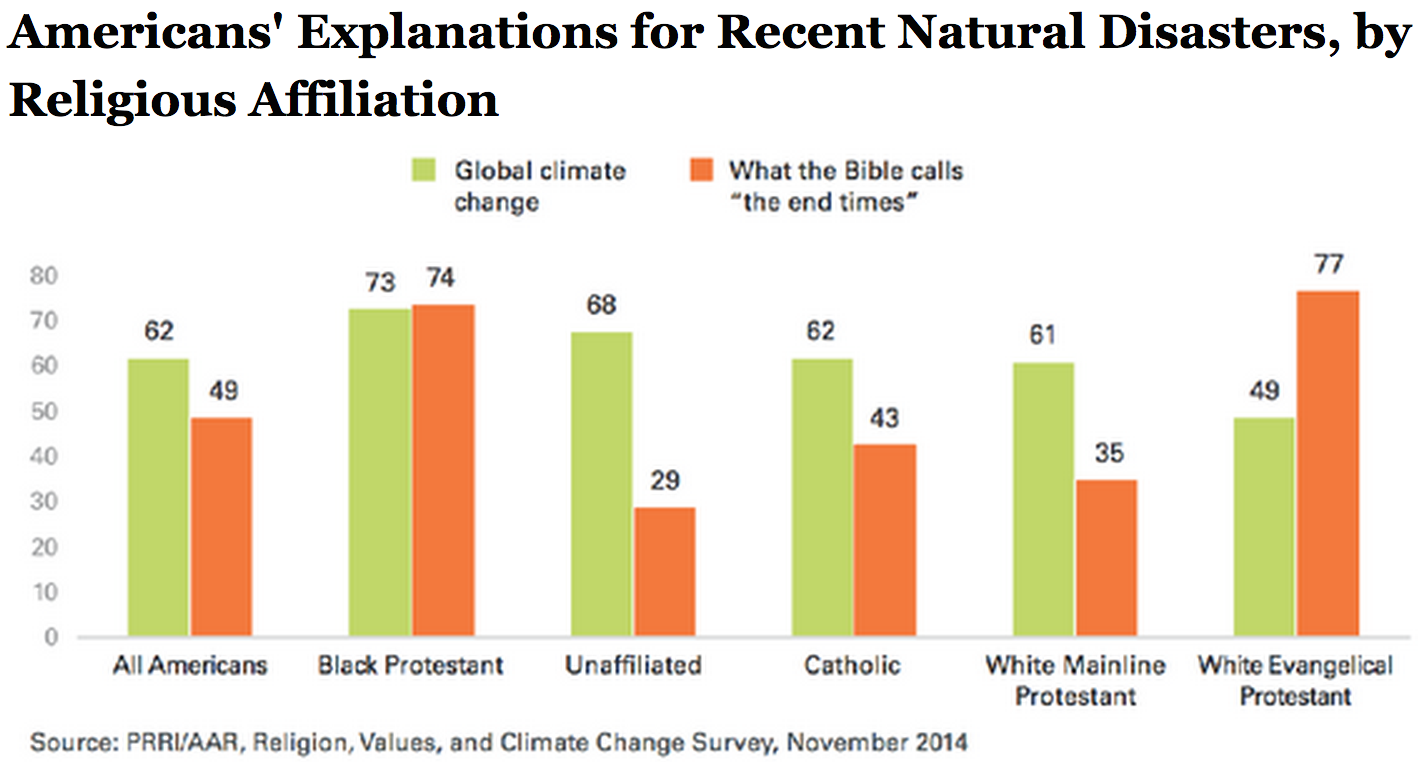
Emma Green passes along an unsettling survey:
As of 2014, it’s estimated that nearly half of Americans—49 percent—say natural disasters are a sign of “the end times,” as described in the Bible. That’s up from an estimated 44 percent in 2011.
This belief is more prevalent in some religious communities than others. White evangelical Protestants, for example, are more likely than any other group to believe that natural disasters are a sign of the end times, and they’re least likely to assign some of the blame to climate change (participants were allowed to select both options if they wanted). Black Protestants were close behind white evangelicals in terms of apprehending the apocalypse, but they were also the group most likely to believe in climate change, too. Predictably, the religiously unaffiliated were the least likely to believe superstorms are apocalyptic—but even so, a third of that group said they see signs of the end times in the weather.
Ryan Koronowski also analyzes the poll:
This fatalistic view of the impacts caused in part by burning fossil fuels could influence the national policy responses to the problem. More than half of the total respondents (53 percent) thought that God would not intercede if humans were destroying the Earth, while 39 percent said that God would step in.
Aaron Blake adds:
[A]pparently, most of those who believe we’re in the end times also believe God would intervene. Basically at least four in 10 Americans see little reason for a human response — or, at least, doubt things will wind up being catastrophic. It should be no surprise, then, that of all the issues tested by PRRI’s poll, climate change is viewed as the least important. Just 5 percent rate it as the No. 1 issue, behind things like immigration, education and the wealth gap.
Meanwhile, the National Oceanic and Atmospheric Administration reports that last month was the hottest October on record worldwide. Rebecca Leber puts this in perspective:
The last two months of the year would simply have to be an average month in order for 2014 to go on record as the hottest year we’ve experienced yet. As Chris Mooney has written at Wonkblog, we’ve now had 356-straight months of warmer-than-average temperatures (through October). Anyone under 30 years old has never seen a month that was simply average in global temperature compared to the 20th century.
What climate-change deniers confuse is that temperatures in specific parts of the world, like North America, don’t always conform to global trends—which is why scientists look at the bigger picture of temperature records to judge climate trends. Temperatures in North America have been much colder than average, by 1.5 degrees Celsius, this year. This isn’t “proof” that global warming doesn’t exist, and research even links some extreme swings in temperatures, including wintry weather, to climate change.
Iran Talks Get An Extension
After failing to reach a permanent agreement, the officials representing Iran and the P5+1 in the ongoing nuclear negotiations in Vienna extended the talks for seven more months:
“We have had to conclude it is not possible to get to an agreement by the deadline that was set for today and therefore we will extend the JPOA to June 30, 2015,” British Foreign Secretary Philip Hammond told reporters at the end of the talks. He was referring to the so-called Joint Plan of Action, an interim deal agreed between the six and Iran a year ago in Geneva, under which Tehran halted higher level uranium enrichment in exchange for a limited easing of sanctions, including access to some frozen oil revenues abroad.
Hammond said the expectation was that Iran would continue to refrain from sensitive atomic activity. He added that Iran and the powers “made some significant progress” in the latest round of talks, which began last Tuesday in the Austrian capital. Hammond said that there was a clear target to reach a “headline agreement” of substance within the next three months and talks would resume next month.
The failure to meet today’s deadline was not unexpected. Elias Groll and John Hudson look over the sticking points that remain unresolved:
“There are still gaps on some of the major issues, particularly the size of Iran’s uranium enrichment program and the sequence of sanctions relief,” Kelsey Davenport, director for nonproliferation policy at the Arms Control Association, told Foreign Policy. “Both Iran and the United States will need to be flexible and willing to make concessions to overcome the remaining hurdles.” At the moment, American diplomats are refusing to provide a date by which sanctions will be lifted and inspectors can ensure Iran is complying with the deal. … Among the other points of disagreement is how long it will take for Iran to be allowed to freely develop a civilian nuclear infrastructure and how much freedom inspectors will have inside Iran to carry out their work.
Morrissey isn’t surprised:
In reality, the gaps have always been big, and they will remain big as long as Iran wants to develop nuclear weapons. They have played this strategy of using negotiations as stall tactics for more than a decade, after their nuclear-weapons program got exposed in 2003. The Iranians make a big show of holding talks and sometimes even reaching interim agreements, always to find some excuse or provocation to renege or pull out. They then dangle the possibility of talks in order to forestall tougher consequences for their intransigence. Barack Obama and John Kerry were foolish enough to buy this routine as sincere, throwing away the tougher sanctions that forced Iran to deal with West at all.
Time is running out, all right. The Iranians are making sure of that by running out the clock while they finalize their entry into the nuclear-armed state club. They just bought themselves seven more months of time to complete their efforts and deliver a fait accompli. The West is digging its own grave, and Iran is providing the shovels.
The new deadline, of course, means that any prospective deal will come up against the implacable obstacle of the incoming Republican Congress. John Bradshaw encourages Congressional hawks to take a deep breath, think back to the bad old days of negotiating arms control with the Soviets, and not be willfully blind to the benefits of a deal:
Conservative hardliners in Congress say they would support a deal if it guaranteed that Iran would never be able to build a nuclear weapon. This disingenuous claim ignores the fact that the Iranians already have the necessary knowledge to build a weapon. A good agreement can minimize the risks that Iran can clandestinely move toward building a nuclear weapon, and it can provide incentives for the Iranians to step back from the path toward nuclear arms. More thoughtful members of Congress recognize that without a deal Iran can resume activities that can lead to a nuclear weapon, leaving us with only two options: military action or dealing with a nuclear-armed Iran. Without a deal, the international sanctions regime will likely unravel, diminishing pressure on Iran to allow continued intrusive inspections. The world will be more dangerous and unstable in this scenario than it would be if there is a good, verifiable deal that still entails some uncertainties and risks. A little historical perspective can help spark the political courage needed now in Congress to back a deal which will make America safer and prevent an unnecessary war.
Israeli PM Benjamin Netanyahu is pleased about the extension, mainly because it means there’s no deal yet:
“The right deal that is needed is to dismantle Iran’s capacity to make atomic bombs and only then dismantle the sanctions,” the prime minister continued. “Since that’s not in the offing, this result is better. A lot better. I think Iran should not have any capacity to enrich. There is no right to enrich. What do you need to enrich uranium for if you are not developing an atomic bomb?”
Netanyahu highlighted the fact that in addition to its uranium enrichment program, Iran has also also been developing intercontinental ballistic missiles. “The only reason you build ICBMs is to launch a nuclear warhead,” he said. “So I think everyone agrees that Iran is unabashedly seeking to develop atomic bombs and I think they shouldn’t have the capacity to enrich uranium or to deliver nuclear warheads.”
Larison points out that Bibi and other opponents of a comprehensive agreement are in effectively rooting for their own worst-case scenario:
The failure of negotiations with Iran would not be to the advantage of Israel or any of the Gulf states that claim to be so horrified by a deal. Failure would strengthen Iranian hard-liners, it would likely increase tensions between Iran and many other regional governments, and would leave the path open for the nuclear program’s continued development. Republicans may want to deprive Obama of a major achievement for partisan reasons, but Republican Iran hawks shouldn’t want the negotiations to fail. A deal that imposes significant limits on Iranian enrichment would restrict the Iranian nuclear program in a way that nothing else available could. Despite this, the regional governments and hawks here at home have been demanding conditions for a final deal that can’t possibly be met, and they have declared their hostility to any agreement that could be reached. The only conclusion we can reach from all this is that most of these actors are hostile to any diplomacy with Iran and want to make conflict between the U.S. and Iran more likely.
The Party Of Executive Power?
Julia Azari suspects “strong executive action enjoys more legitimacy when it’s taken by a Republican president than a Democratic one”:
Obama’s supporters on the left haven’t really developed a good political story about why governing through enforcement is a good thing. Most justifications involve vilifying Congress – satisfying for partisans but still casting the administration in a defensive role.
For conservatives during the Bush administration, the narrative was pretty easy to develop. Unilateral presidential action defends
the nation. Furthermore, the president is a legitimate defender of his own Constitutional prerogatives (so the justification goes; not necessarily my view). This works better for Republican presidents because conservatives have gained issue ownership not only over national security but also, to a great extent, over the question of Constitutional protection.
Civil libertarians are an important part of American political and legal culture. But they haven’t recently formed a political movement around their ideas about the Constitution the way that the Tea Party has. The dominant political framework for understanding the Constitution casts it as a procedural document, meant to protect against excessive government action – even when that action might bring about positive results. This framework is a much more powerful tool for conservatives than for liberals. Although liberals also sometimes draw on Constitutional principles – including limits on executive action – it’s less central to their ideology. This means the politics of enforcement are much more difficult for a Democratic president to justify – enforcement decisions must either be done on substantive, rather than constitutional grounds, or they must tread on territory usually dominated by the other party.

Maybe the Democrats need to take another look at Burke. Or be reminded of the roots of progressivism in The New Republic‘s founder, Herbert Croly. Frank Foer explains:
By the time he crept toward middle age, after so many years of drift, Herbert attempted to fulfill his father’s dreams for him, in one last mad dash for greatness. He poured all his accumulated thoughts and theories into a bulging manifesto called The Promise of American Life. The book, which appeared in 1909, argued that American life had grown hobbled by the lingering legacy of Thomas Jefferson—the nation celebrated an antiquated form of individualism and libertarianism that no longer matched the realities of the industrial age. Modern life had sapped the energy from America; it tolerated rampant mediocrity. To restore itself, the country would have to turn to the theory of government espoused by Jefferson’s old nemesis, Alexander Hamilton. That is, it would need a strong central state. Croly’s book embodied many of the characteristics of the magazine he created: It was in turns wonky and literary; it rigorously analyzed the economic perils of unregulated trusts and calculated the toll of intellectual conformism.
I come at this from a very different Tory tradition. That line of thought wants government to be both limited and yet strong within its rightful parameters. So I don’t have much of a problem with the EPA making rulings based on its statutory authority as an executive office. Or with the president’s war-conducting (if not war-making) privileges. Or with setting priorities within law enforcement. Where does the executive action on undocumented immigrants stand? Somewhere in the middle: within the bounds of legal executive discretion, but in scale and intent, beyond anything that has occurred before – including, it now appears, the actions of president George H W Bush. On balance, I think it’s an over-reach – but an over-reach that needs to be understood in the context of unprecedented Congressional obstructionism. Or to put it tartly in the words of Kevin Drum:
You know, the more I mull over the Republican complaint about how immigration reform is being implemented, the more I sympathize with them. Public policy, especially on big, hot button issues like immigration, shouldn’t be made by one person. One person doesn’t represent the will of the people, no matter what position he holds. Congress does, and the will of Congress should be paramount in policymaking … Both the law and past precedent are clear: John Boehner is well within his legal rights to refuse to allow the House to vote on the immigration bill passed by the Senate in 2013.
Hagel Out
https://twitter.com/MJayRosenberg/statuses/536916392818524160
While the White House is at pains to say he was not fired, it sorta looks that way:
Administration officials said that Mr. Obama made the decision to remove Mr. Hagel, the sole Republican on his national security team, last Friday after a series of meetings between the two men over the past two weeks. The officials characterized the decision as a recognition that the threat from the militant group Islamic State will require different skills from those that Mr. Hagel, who often struggled to articulate a clear viewpoint and was widely viewed as a passive defense secretary, was brought in to employ.
“This,” Morrissey declares, “is what happens with Cabinet Secretaries when policies go bad”:
Presidents ditch them as a signal for a shift in direction.
In this case, it’s more than fitting, because Hagel was appointed by Obama as Republican cover for his unwillingness to maintain a forward strategy against radical Islamist terror networks. Hagel had long opposed the Iraq war from the ranks of the Senate Republican caucus, and lent Obama some cheap credit on bipartisanship without challenging him on policy in the least. Hagel had next to no qualifications to lead the massive Defense Department, and despite getting ISIS right has not exactly impressed as SecDef. …
The question now will be who replaces Hagel, and when. It won’t be in the lame-duck session; there isn’t enough time. That means Obama has to find a candidate who can pass muster with the new Republican majority in January, while still hewing close to Obama’s middle-of-the-road, hesitationist impulses. It’ll be interesting to see who Obama chooses, but don’t expect the GOP to block anyone who’s capable of handling the new policy. They will have lots of room to fight over Obama’s nominees, but not in national-security positions.
Michael Auslin calls Hagel’s uninspiring tenure at the Pentagon “more evidence of the damage that occurs when a president surrounds himself with those he knows he can dominate”:
[A]s the threats from Russia, China, and the Islamic State developed over the past two years, the president was more concerned about his image as the smartest man in the room and who would brook no opposition to his view of the world. A view, one might add, that shows remarkably little evolution during his six years as president. Thus, at a time of extraordinary global danger, America was saddled with a defense secretary not respected by his president, not expected to bring a sharp intellectual scalpel to the challenges of the day, and one who simply wasn’t up for the job. Early, private reports from inside the Pentagon indicate a sigh of relief, since the thought is it can’t get any worse.
Peter Feaver characterizes Hagel’s ouster as scapegoating for Obama’s own poor policy choices:
Pick your issue: the failure in Syria, the rise of the Islamic State, the inability to check Russian President Vladimir Putin, the yawning ends-means gap in the defense budget, the fractious civil-military relations, the failure to stop Iran’s nuclear ambitions, and so on. Regardless the issue, the chief weakness is not the performance of the staff but the decisions that could only have been made by the president. Of course, these are tough foreign policy problems and much of the difficulty can also be attributed to factors well beyond the control of the U.S. government. But to the extent that U.S. action or inaction is exacerbating the problem, those sins of omission and commission are primarily the president’s, not his staff’s.
Armin Rosen identifies Michèle Flournoy as the most likely choice among Hagel’s potential successors:
One of the leaders of Obama’s transition team at the Department of Defense, Flournoy was an under-secretary of defense from 2009 to 2012, during Robert Gates’ widely praised leadership at the Pentagon. She was was involved in implementing the surge in Afghanistan and is “widely seen as an advocate for the counterinsurgency approach,” former Navy intelligence officer Robert Caruso told Business Insider. Flournoy is also the co-founder of the Center for a New American Security, a Washington think-tank that became a Defense Department-in-waiting for Democratic-aligned natural security hands during the second Bush administration. CNAS is now viewed as an ideas factory — if not an adjunct — for the Obama-era Pentagon.
But Scott Shackford shudders at that possibility:
She seems to think it’s possible for America to “achieve its strategic objectives in Afghanistan” as long as we stay committed with money and resources. Read her report here, and then read some of examples of where money sent to Afghanistan is actually going here. The progressive anti-war group Institute for Policy Studies describes Flournoy’s love of military intervention and spending from the left here. They note she actually has more support from neoconservatives than Republican Hagel, vocal critic of the Iraq war. Rather than proposing a different course for the administration’s foreign policy, she appears to possibly be the person to entrench it for rest of Obama’s term.
And David Rothkopf, who approves of Flournoy, doubts she will solve what he sees as the administration’s fundamental problem:
The challenge is that the NSC and the national security team are always just a reflection of what the president wants. If President Obama is unwilling to ask himself how he must change in order to avoid and undo mistakes like those of the past two years, it doesn’t matter how many Cabinet secretaries come or go. If the move to swap out Chuck Hagel (apparently after a rather contentious tug-of-war about whether he should depart), is as it appears to be — a gesture designed to avoid addressing the real problems within the Obama team — then it is worse than empty. It is a further sign that this is a president resistant to growth or to finding a way to effectively advance the national security interests of the United States.
 The Dish