The Most Egalitarian Of All Possible Worlds?

poverty world

Pointing to a new study showing that income inequality is rapidly declining at the global level, Tyler Cowen argues that the redistribution favored by egalitarian movements in the US would end up hurting international prosperity:

Although significant economic problems remain, we have been living in equalizing times for the world — a change that has been largely for the good. That may not make for convincing sloganeering, but it’s the truth. … Many egalitarians push for policies to redistribute some income within nations, including the United States. That’s worth considering, but with a cautionary note. Such initiatives will prove more beneficial on the global level if there is more wealth to redistribute. In the United States, greater wealth would maintain the nation’s ability to invest abroad, buy foreign products, absorb immigrants and generate innovation, with significant benefit for global income and equality.

Mark Perry backs up Cowen’s thesis with the above chart. But Daniel Little criticizes Cowen’s “Panglossian” picture of global inequality:

Cowen bases his case on what seems on its face paradoxical but is in fact correct: it is possible for a set of 100 countries to each experience increasing income inequality and yet the aggregate of those populations to experience falling inequality. And this is precisely what he thinks is happening.

Incomes in (some of) the poorest countries are rising, and the gap between the top and the bottom has fallen. So the gap between the richest and the poorest citizens of planet Earth has declined. The economic growth in developing countries in the past twenty years, principally China, has led to rapid per capita growth in several of those countries. This helps the distribution of income globally — even as it worsens China’s income distribution.

But this isn’t what most people are concerned about when they express criticisms of rising inequalities, either nationally or internationally. They are concerned about the fact that our economies have very systematically increased the percentage of income and wealth flowing to the top 1, 5, and 10 percent, while allowing the bottom 40% to stagnate. And this concentration of wealth and income is widespread across the globe.

Ryan Avent pushes back as well:

There is an alternative hypothesis, however, which Mr Cowen mostly disregards: that redistribution provides insurance against economic dislocation and therefore softens resistance to globalisation. It’s worth pointing out that the world has experienced two great eras of globalisation. The first combined minimal redistribution with minimal political power for non-elites. The second combined universal suffrage with substantial redistribution. I don’t think it’s unreasonable to conclude that redistribution is the price democracies pay for globalisation.

And that makes perfect sense! Reducing barriers to trade generates net gains, but those gains will occasionally be distributed in highly unequal fashion. If gains are concentrated and no provision is made for redistribution, then a voting majority might well conclude that openness is a losing proposition. Mr Cowen seems to want voters to recognise that whether or not they personally are made better off by globalisation it is a good thing to support, because it enables the enrichment of poor areas of the globe. But few voters are content to have their economies run as charities (and a good thing for economists that they aren’t, as that would make a baseline assumption of rational self-interest look pretty absurd).

Are We Abetting Central American Gangs? Ctd

EL SALVADOR-GANGS-TRUCE

Alec MacGillis shines a light on US gun trafficking to Central America, making the argument that our loose gun regulations are contributing to these countries’ gang violence problem:

According to data collected by the ATF, nearly half of the guns seized from criminals in El Salvador and submitted for tracing in the ATF’s online system last year originated in the U.S., versus 38 and 24 percent in Honduras and Guatemala, respectively. Many of those guns were imported through legal channels, either to government or law enforcement agencies in the three countries or to firearms dealers there.

But a not-insignificant number of the U.S.-sourced gunsmore than 20 percent in both Guatemala and Honduraswere traced to retail sales in the U.S. That is, they were sold by U.S. gun dealers and then transported south, typically hidden in vehicles headed across Mexico, though sometimes also stowed in checked airline luggage, air cargo, or even boat shipments. (Similar ratios were found in traces the ATF conducted in 2009 of 6,000 seized guns stored in a Guatemalan military bunker40 percent of the guns came from the United States, and slightly less than half of those were found to have been legally imported, leaving hundreds that were apparently trafficked.)

“It is a problem,” says Jose Miguel Cruz, an expert in Central American gang violence at Florida International University. “The problem is we don’t have any idea how many [of the trafficked guns] there are. It’s a big, dark area.”

Cynthia Arnson, director of the Latin American Program at the Woodrow Wilson International Center for Scholars, tells Dylan Matthews that an effective US response to the crisis must address its root causes:

Of the $3.7 billion requested by the administration for dealing with the child migrant crisis, a very small percentage of it, about $295 million, goes to addressing root causes of the violence. I think that ever since the United States, starting with the end of the Bush administration, began to pay more attention to Central America as the drug violence was spilling over from Mexico to Central America, there’s been an overemphasis on security and controlling drug trafficking and also just not enough resources overall. …

There’s been a focus in the US and elsewhere in the region on capturing drug kingpins, but I think a lot of people who have looked at this, given the weakness of institutions, including police and law enforcement, including the judiciary, have said that a better approach is to try to reduce the violence connected with local illegal markets, and focus on providing citizen security to the general population. You can’t abandon the attempt to capture major traffickers, but you cannot do that without providing for safer communities and creating greater resilience at the individual and the community level.

Previous Dish on the violence in Central America and the US’s role in it here and here.

(Photo: A member of the “18 street” gang takes part in an event to hand in weapons in Apopa, 14 Km north of San Salvador, El Salvador on March 9, 2013. Gang leaders surrendered about 267 weapons as part of the truce process between gangs in El Salvador. By Jose Cabezas/AFP/Getty Images)

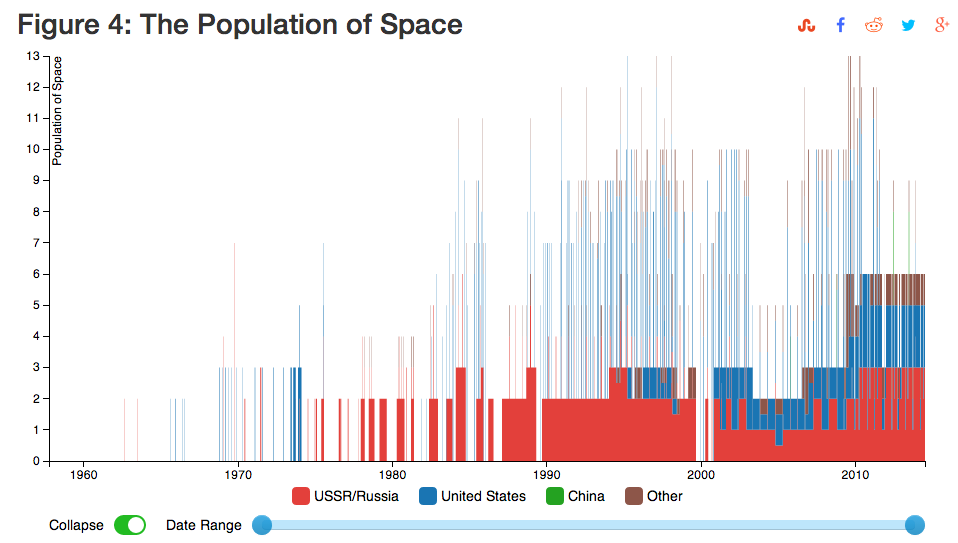
The Final Frontier: Population 6

To mark the 45th anniversary of the Apollo moon landing, Nefarious Plots charted the total number of humans in space over time:

Space Population

Interactive version of the chart here. Susannah Locke captions:

Check out the big, red USSR/Russian blocks versus those skinny American lines in blue. That’s because the American presence in space has often consisted of shorter missions. A lot of this discrepancy has to do with access to space stations, where people can hang out for long periods, sometimes even longer than a year at a time.

All-You-Can-Read

Hayley Tsukayama urges consumers to be honest with themselves about their reading habits before signing up for Amazon’s new literary service:

Kindle Unlimited is $9.99 per month. So you’ll be paying Amazon, whose chief executive Jeffrey Bezos owns The Washington Post, around $120 per year for the unfettered e-book access. If you’re habitually spending money on more than one book per month, then it’s a service to think about. It has its perks for big book buyers – namely that don’t have to worry about spending money on a book you end up hating.

But, chances are, you aren’t reading more than one book per month. In January, the Pew Internet and American Life Project asked how many books the typical American had read in the past year.

The answer? Five.

Maria Bustillos contends that “it shouldn’t cost a thing to borrow a book”:

For a monthly cost of zero dollars, it is possible to read six million e-texts at the Open Library, right now. On a Kindle, or any other tablet or screen thing. You can borrow up to five titles for two weeks at no cost, and read them in-browser or in any of several other formats (not all titles are supported in all formats, but most offer at least a couple): PDF, .mobi, Kindle or ePub (you’ll need to download the Bluefire Reader—for free—in order to read ePub format on Kindle.) I currently have on loan Alan Moore’s WatchmenOriginal Sin by P.D. James, and The Dead Zone by Stephen King.

Alison Griswold concentrates on the business angle:

Kindle Unlimited will add a new layer of complexity to negotiations between Amazon and publishers. So far, it seems that most of the big-name publishers haven’t agreed to let their titles onto the subscription platform. Books published by HarperCollins and Simon & Schuster aren’t offered and those from Penguin Random House are notably absent. Amazon has not said how authors and publishers will be paid for participating in Kindle Unlimited, but it’s unlikely that the models currently used for e-book sales through its store will do the trick.

Brian Heater is concerned that writers like him will get screwed:

We’ve all heard the horror stories of the fractions of cents being doled out by Spotify, with the justification that many musicians make their mint touring anyway. For one thing, that’s hardly a universal and for another, where’s the author’s analog to touring? Unless you’re, say, Hillary Clinton pulling in $200,000 per speaking engagement, no one’s paying big bucks to watch you read. You’re there to sell more books.

The other justification for music-streaming services is the notion that people who really love a record will go out and buy it. Perhaps I’ve just become too immersed in the world of e-books too quickly, but I’m having difficulty imagining a scenario in which I run out and buy a hard copy of a book after reading the electronic version. It certainly hasn’t happened to me yet – I also haven’t found myself going back and re-reading too many e-books to this point.

Joshua Gans fears that Amazon’s new service will discourage the creation of long books:

Amazon’s payment to authors is similar to its payment to them for the Kindle Owner’s Lending Library. There is a fund (amount = F) that is set monthly by Amazon. If there are a certain number of books downloaded that month (N) and your book is downloaded n times, you receive (n/N)*F in payments that month. That’s for lending. For books under the Unlimited plan, they have to be at least 10% ‘read’ (on the assumption that flipping 10% of the pages is the same as reading them). And so your share is based on how often your book is minimally read. Basically, people can try before they buy with their attention.

Now this plan isn’t all rosy because while it rewards books that are readable, it does so asymmetrically. For instance, Piketty’s recent book has 696 pages whereas mine most recent one has 93. Suffice it to say, Piketty will receive the same payment for another book read this month beyond 70 pages as I would get for 10. That strikes me as amiss.

Konnikova, meanwhile, looks at the impact digital devices have on the reading experience:

When Ziming Liu, a professor at San Jose State University whose research centers on digital reading and the use of e-books, conducted a review of studies that compared print and digital reading experiences, supplementing their conclusions with his own research, he found that several things had changed. On screen, people tended to browse and scan, to look for keywords, and to read in a less linear, more selective fashion. On the page, they tended to concentrate more on following the text. Skimming, Liu concluded, had become the new reading: the more we read online, the more likely we were to move quickly, without stopping to ponder any one thought.

The online world, too, tends to exhaust our resources more quickly than the page. We become tired from the constant need to filter out hyperlinks and possible distractions. And our eyes themselves may grow fatigued from the constantly shifting screens, layouts, colors, and contrasts, an effect that holds for e-readers as well as computers.

Not Single-Issue Voters

Reacting to the “Beyoncé voters” meme spawned by that awful Fox segment, Tanya Basu warns against seeing single women as a monolithic voting bloc:

The only thing that unites all single women is their marital status. That’s it.

Simply looking at their marital status doesn’t begin to speak to the complexity of their lives. Some have been married before. Some are in relationships. Some are engaged. Some have children. But at this moment, just about the only thing linking the struggling single mother working a minimum-wage job and the middle-aged businesswoman with a swanky Upper East Side apartment is the lack of jewelry on their left ring finger.

Basu also reminds us that female voters’ concerns do not always center on gender-related issues:

While many women do care a great deal about contraception and equal pay, the biggest concern most women have right now is how the leaders we elect will create a job-friendly environment. Since single women earn less than single men and married women, their jobs are extremely important, especially if they’re trying to get health insurance for themselves and/or their children. They were hit especially hard by unemployment during the Great Recession. And job security isn’t just on the minds of 20-somethings: Senior single women are facing increasing economic insecurity too. In other words, birth control isn’t what will get single women (or for that matter, anyone) to the polls come November. It’s jobs and economic stability.

Shifty Work Conditions

McArdle contemplates the current state of part-time labor:

Unfortunately, the weakness in the labor market has coincided with yet another market development: scheduling software and technology that allows retailers to manage their workforce as another just-in-time input.

Workers are asked to input blocks of hours when they will be available; the software then crunches through everyone’s availability and spits out a schedule that takes account of everything from weather forecasts to the danger that a worker will go over the maximum number of hours to still be considered part time. Obviously, you can’t string together multiple jobs this way, because each job requires that you block out many more available hours than you will actually work. Meanwhile, Steve Greenhouse reports on even worse practices that I hadn’t heard of: requiring workers to be “on call” at short notice or scheduling them for shifts and then sending them home if business looks light.

In this situation, no matter how hard you are willing to work, stringing together anything approaching a minimum income becomes impossible. That makes it much more deeply troubling than low pay.

Update from a reader, who brings up unions:

This is why anyone who works at a part-time job in a non-union shop is essentially a wage slave.

My company – a major grocery chain – uses similar software for scheduling, but union rules specifically rule out “on call” employees, or sending employees home during unexpectedly light business without their consent. In addition, it is strictly against the rules – and grounds for a grievance – to schedule an employee outside their available hours.

Thus many of our employees can work multiple jobs – several spend three or four days with us and another two or three with another employer (the only stipulation being it cannot be a competitor, obviously). Some even work making deliveries for our suppliers on their “off days”. It also means working moms can schedule themselves to be home when the kids arrive from school or daycare, students can reliably schedule college classes without worrying about work conflicts, etc.

Without union rules, none of this would be possible.

The Best Of The Dish Today

Tensions Remain High At Israeli Gaza Border

If you believe, as most Republicans still seem to do, that the most important boon for the economy and the deficit would be further tax cuts, then surely Kansas’ recent, radical experiment in slashing tax rates should merit a view. The result, it now appears, is that tax revenues in Kansas have collapsed:

From June, 2013 to June, 2014, all Kansas tax revenue plunged by 11 percent. Individual income taxes fell from $2.9 billion to $2.2 billion and all income tax collections plummeted from $3.3 billion to $2.6 billion, a drop of more than 20 percent.

Did growth rebound? Nah: “Since the first round of tax cuts, job growth in Kansas has lagged the U.S. economy. So have personal incomes.” Now take a look at California, that big tax-and-spend liberal state. In 2013, they went in the opposite direction and raised taxes considerably on sales and high incomes. Many predicted disaster. The result?

Last year California added 410,418 jobs, an increase of 2.8 percent over 2012, significantly better than the 1.8 percent national increase in jobs. California is home to 12 percent of Americans, but last year it accounted for 17.5 percent of new jobs, Bureau of Labor Statistics data shows.

Obviously, there are other factors involved in both cases, and you should read the links to see the qualifications. But they are qualifications. We’ve know for a long time that cutting taxes does not help the government’s bottom line and has very limited potential for job growth given the historically low rates of tax in the US right now. But we didn’t know that tax increases could coexist with quite robust job growth and fiscal health. Count this as one more piece of evidence that re-thinking Republican economics on reformocon lines is a necessary but not sufficient initiative to alter GOP dogma.

Today, we covered the ever-more-sobering news out of Ukraine and Gaza – in particular Putin’s dead end and Netanyahu’s Gaza strategy (if you can call it that). And if you weren’t depressed enough, here’s a look at the fate of Iraq’s beleaguered Christians. To balance this a bit, check out pheromone dating rituals and an ode to the pit-bull as the archetypal American dog.

The most popular post of the day was “The Oldest Depiction Of Sex On Record” on the Ron Jeremys of ancient Egypt, followed by Holding Corpses Hostage. Many of today’s posts were updated with your emails, including this back and forth sparked by a reader upset with his situation under Obamacare.

39 more readers became subscribers today (a much bigger Monday total than usual, probably due to our Gaza coverage and Ukraine coverage). You can join those new subscribers here – and get access to all the readons and Deep Dish – for a little as $1.99 month. Gift subscriptions are available here.

See you in the morning.

(Photo: Family members  of Major Tsafrir Bar-Or mourn and cry during his funeral on July 21, 2014 in Holon, Israel. By Ilia Yefimovich/Getty Images)

In Case You Need Another Reason To Hate Mosquitos …

Last week, Maggie Koerth-Baker warned that chikungunya, a mosquito-borne disease that’s not typically fatal but currently has no cure, is inevitably making its way to the US:

The virus has been known since the 1950s, but because it was largely non-lethal and largely confined to developing countries in Africa and Asia, the Western medical establishment didn’t much care about it until 10 years ago. That’s when chikungunya showed up on the French-controlled island of La Réunion, in the Indian Ocean, where it infected 40 percent of the population. Since then, it’s exploded in parts of Asia where it hadn’t been seen in decades (and other parts where it hadn’t been seen at all), reached Australia and Taiwan, and made landfall in Italy and France. And all of that was before the outbreak in the Caribbean.

So what changed? The sudden spread of chikungunya seems to be related to two things. First, the virus itself mutated. The strain that’s spreading around the world is different from the one that hung around sub-Saharan Africa. Specifically, it’s much more efficient at replicating itself in the guts of mosquitoes. That seems to have increased both its ability to move into new places and its ability to be carried by different species of mosquito.

That same day, the CDC announced the first locally acquired case of the virus in Florida. Vanessa Vitiello Urquhart explains why medical entomologists (like her wife Cassandra) are freaking out:

To understand why it’s chikungunya, not dengue, that makes entomologists so nervous, you’ll need to know a bit about another mosquito; Aedes albopictus (more pronouncably known as the Asian tiger mosquito). The Asian tiger mosquito is an invasive species that has spread over much of the eastern half of the United States since its introduction in 1985. These back-and-white-striped jerks are capable of spreading all sorts of diseases, including West Nile, dengue, and yellow fever. However, they often do so pretty inefficiently, with viruses found in only the tiniest minority of the mosquitoes tested. In the case of chikungunya, however, at least one strain has been shown to spread as easily in tiger mosquitoes as in Aedes aegypti.

Adding to the reasons for alarm is the fact that chikungunya doesn’t need a reservoir—it can be spread directly from one human host to another. This is in contrast with several other mosquito-borne pathogens, including West Nile virus, which needs to replicate inside a bird before it can pass from a mosquito to a human. The special characteristics of tiger mosquitoes once again exacerbate the problem—these particular mosquitoes prefer feeding off of, and living close to, humans. (Many mosquitoes, in contrast, feed opportunistically on humans, while primarily targeting other animals.) Tiger mosquitoes are also daytime feeders, which means that while other species are taking a break, preferring to feed at dawn or twilight, the tigers keep chomping during the times of day when humans are most active.