There Go Those Pesky Aligned Interests Again …

Iraq isn’t the only place where America and Iran are fast becoming best frenemies. “When it comes to Afghanistan,” Michael Kugelman argues, “Tehran and Washington tend to see eye to eye on many core issues, including the Taliban”:

There’s good reason to believe that Tehran wants a stable Afghanistan. Greater instability would intensify narcotics trafficking. Additionally, it would lead to further influxes of Afghan refugees (only Pakistan has more). In recent years, these immigrants have been increasingly unwelcome in Iran, and many have been deported. Tehran also likely worries that a deteriorating Afghan security environment would embolden anti-Shia forces, including the Pakistani organization Lashkar-e-Jhangvi, whose commanders vow to march into Afghanistan when international troops depart. Though Iran publicly opposes any U.S. troops in Afghanistan, in private it would probably happily accept the presence of a residual post-2014 force.

Tehran also shares the U.S. objective of an Afghanistan that is more integrated with South and Central Asia. Iran has pursued rail, pipeline, and trade projects meant to better link Central Asian states. It is also cooperating with India on the construction of a port that would facilitate more Indian trade with Afghanistan and Central Asia (the Chabahar port would enable India to bypass longer routes through Pakistan). These efforts dovetail with Washington’s “New Silk Road” initiative, which aims to develop regional energy markets in South and Central Asia and more broadly to boost cross-border trade and transit across these regions. However, U.S. sanctions on Iran have prevented Tehran from obtaining international financing for some of its projects. Phasing out these sanctions — a possible upshot of improved bilateral relations — could bring in more financing, and allow regional integration initiatives to truly take off.

The Challenge Of Reform Conservatism, Ctd

In response to me, Douthat expounds on the nature of and audience for reform conservatism. This is well said:

The reality is that, except in truly exceptional cases, our politics is better off in the long run when views held by large proportions of the public are represented in some form by one of our two parties. Right now (to run down a partial list of divisive cultural issues), a burke_1.jpgplurality of Americans want the immigration rate decreased; about half the country opposes affirmative action; more than half supports the death penalty; about half of Americans call themselves pro-life. Support for gay marriage and marijuana legalization has skyrocketed, but in both cases about 40 percent of the country is still opposed. Even independent of my own (yes, populist and socially conservative) views, I think these people, these opinions, deserve democratic representation: Representation that leads and channels and restrains, representation that recognizes trends and trajectories and political realities, but also representation that makes them feel well-served, spoken for, and (in the case of issues where they’re probably on the losing side) respected even in defeat.

Because without that representation, populism doesn’t go away; it festers. Just ask David Cameron, Sullivan’s example of a modernizing conservative, a politician whose agenda has had a number of admirable features … but whose style and approach also helped roll out the red carpet for UKIP and Nigel Farage. In the United States, a more populist and conservative and religious country than Britain, the Farage scenario would look wilder and stranger and much, much worse for conservatism and the country. And so Republican politicians interested in outreach and coalition-building and modernization have an obligation to make sure they don’t also create a pervasive sense of populist disenfranchisement along the way.

I take Ross’s other points as well – especially about social issues like marriage equality. The GOP will probably adjust soon enough to the radically new landscape, and I may even find them more sympathetic if they try simply to protect a dissenting religious minority, rather than over-reaching. I’m in favor of religious freedom over any attempt to ram a new gay orthodoxy on the entire country. I still don’t see a powerful theme or a leader who could turn this constructive caucus into an administration. But the future is wide open. Frum joins the conversation:

The reform conservatives seem more open to the new. This is progress. If the policy agenda that follows remains cautious, remember: These conservative reformers aren’t trying to change the world. They’re trying to change a political party.

You don’t change people’s minds by telling them they are wrong, even—or especially—if they are wrong. You change their minds first by establishing an emotional connection with them. Next you ratify their existing beliefs. When it comes time to introduce a new idea, you emphasize its consistency with things they already believe. This is what the reform conservatives are doing, or have begun to do. If they seem to be moving slowly, well, take it from me: It’s no good being even 10 minutes ahead of the times.

Kilgore criticizes Frum for setting the bar so low:

As I recall, it was Michael Gerson, not David Frum, who penned George W. Bush’s memorable line that accepting bad public schools for poor and minority students reflected “the soft bigotry of low expectations.” But it’s a not a bad description for Frum’s attitude towards the GOP, and thus towards the reformicons. He clearly thinks his party is so deep in ideological sin that it can tolerate only brief and veiled exposure to the light.

Well, yes. This won’t be easy, especially if the GOP doesn’t want to chip away at its base as it now exists. Bernstein adds:

Liberals shouldn’t expect to agree with the reformers, or to find their policies appealing. But they should expect the other party to have real policy preferences, and something resembling policy proposals, and for them to abide by the basic norms of the political system. By those standards, reform conservatives deserve an incomplete grade, but one that is more positive than negative.

Drum’s take:

Are [reform conservatives] trying to build credibility with conservatives so they can later nudge them in a new direction? Or are they mostly just trying to put a friendly veneer on an essentially tea partyish agenda? We don’t know yet, because so far they haven’t been willing to take many risks. And with good reason. As a friend emailed just a few minutes ago, “The reformers are one bad suggestion away from being fully Frumanized out of the party.” I wish the reformers luck. And I don’t really blame them for their timidity so far. Still, it’s far too early to tell how serious they are. We’ll just have to wait and see.

Frumanized? I think he means Frummed.

Understanding The Permanence Of Greater Israel

Israeli air strikes on Gaza

My old sparring partner, Jeffrey Goldberg, has been busy pondering why Hamas has sent hundreds of rockets – with no fatalities – into Israel. He argues that it does this in order to kill Palestinians. It’s an arresting idea, and it helps perpetuate the notion that there are no depths to which these Islamist fanatics and war criminals will not sink.

It also helps distract from the fact that Hamas itself did not kill the three Israeli teens which was the casus belli for the latest Israeli swoop through the West Bank; that Netanyahu had called for generalized revenge in the wake of the killings, while concealing the fact that the teens had been murdered almost as soon as they had been captured; and that Israeli public hysteria, tapping into the Gilad-like trauma of captivity, then began to spawn increasingly ugly, sectarian and racist acts of revenge and brutality. It also side-steps the rather awful fact that this nihilist and futile war crime is all that Hamas has really got left.

Yes, they conceal armaments and rockets and weapons in civilian areas – and that undoubtedly increases civilian deaths. But what alternative do they have exactly, if they wish to have any military capacity at all? Should they build clearly demarcated camps and barracks and munitions stores, where the IDF could just destroy them at will? As for the argument that no democratic society could tolerate terrorist attacks without responding with this kind of disproportionate force, what about the country I grew up in, where pubs and department stores in the mainland were blown up, where the prime minister and her entire cabinet were bombed and some killed in a hotel? I don’t recall aerial bombing of Catholic areas in Belfast, do you? Or fatality numbers approaching 200 – 0? Democratic countries are marked by this kind of restraint – not by calls for revenge and bombardment of a densely populated urban area, where civilian casualties, even with the best precision targeting and warnings, are inevitable.

And there is, for all the talk of aggression on both sides, no serious equivalence in capabilities between Hamas and the IDF. The IDF has the firepower to level Gaza to the ground if it really wants to. Hamas, if it’s lucky, might get a rocket near a town or city. I suppose Israel’s reluctance just to raze Gaza for good and all is why John McCain marveled that in a war where one side has had more than 170 fatalities, 1,200 casualties, 80 percent of whom are civilians, and the other side has no fatalities and a handful of injuries, Israel has somehow practiced restraint. One wonders what no restraint would mean.

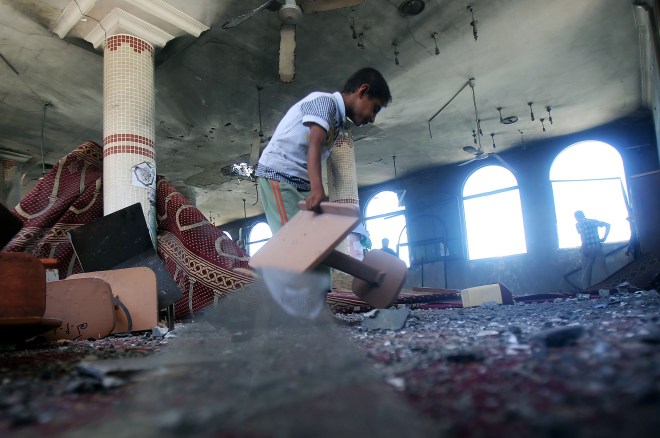
And look at the image above. Part of our skewed perspective is revealed by it. Imagine for a second that Hamas had leveled a synagogue. Can you imagine what Israel would feel justified in doing as a response? Or imagine if a Jewish extended family of 18 had been massacred by Hamas, including children? Would we not be in a major international crisis? At some point the lightness with which we treat Palestinian suffering compared with Jewish suffering needs to be addressed as an urgent moral matter. The United States is committed to human rights, not rights scaled to one’s religious heritage or race.

But this morning, as if to balance Hamas’s blame for every single death in the conflict, Goldblog feels the need to chide the Israeli prime minister for his “mistake” in having utter contempt for any two-state solution. “Mistake” is an interesting word to use.

It implies a relatively minor slip-up, a miscalculation, a foolish divergence from sanity. But it is perfectly clear to anyone not always finding excuses for the Israeli government that Netanyahu wasn’t making a mistake. He was simply reiterating his longstanding view that Israel will never, ever allow a sovereign Palestinian state to co-exist as a neighbor. And unless you understand that, nothing he has done since taking office makes any sense at all. Everything he has said and done presupposes permanent Greater Israel. And he is not some outlier. Israel’s entire political center of gravity is now firmly where Netanyahu is. The rank failure of the peace process simply underlines this fact. As do half a million Jewish settlers and religious fanatics on the West Bank. Which means that US policy is completely incoherent. Since the whole idea of a two-state solution is as dead as the infamous parrot, why on earth are Americans still pursuing it?

I think because many want Israel to be other than what it plainly is. They understand that this project of a bi-national state with Jim Crow segregation and disenfranchisement is a horrible fate. Jeffrey is as eloquent on this today as he has ever been:

If Netanyahu has convinced himself that a Palestinian state is an impossibility, then he has no choice but to accept the idea that the status quo eventually brings him to binationalism, either in its Jim Crow form—Palestinians absorbed into Israel, except without full voting rights—or its end-of-Israel-as-a-Jewish-state form, in which the two warring populations, Jewish and Arab, are combined into a single political entity, with chaos to predictably ensue.

But this is clearly the reality. The Obama administration was the last hope for some kind of agreement, and the Israelis have told the president to go fuck himself on so many occasions the very thought of accommodation is preposterous. With the acceleration of the settlements, and the ever-rising racism and religious fundamentalism in Israel itself, this is what Israel now is. And what it will always be. Anyone still assuming that a two-state solution is actually in the minds of the leaders of Israel is therefore whistling in the wind. One wonders simply how many Palestinians have to die and how much largess we must keep sending to Israel before that whistling eventually stops.

A reader adds:

This is what really put Israel’s occupation and settlement of the West Bank in perspective for me: Israel has possessed the West Bank for almost precisely the same proportion of its national existence as the United States has possessed Texas and California. About seven-tenths.  That is, Israel has occupied the West Bank for 71 percent of the time since national independence in 1948; the United States has possessed Texas and California for 69 percent of the time since national independence in 1776.

Imagine an American claiming that possession of Texas and California was not in some way fundamental to the character of the nation. Imagine if American border politics was predicated on the claim that possession of Texas and California was temporary and both would someday be returned to Mexican sovereignty. Preposterous! A United States without Texas and California would not be the United States anymore. Though it might keep its name, it would be a fundamentally different nation. Even more, the United States would first have to become an existentially different nation before it would even consider peaceably permitting California and Texas to leave the union.

Just so with Israel. Despite protestations otherwise, possession of the West Bank has become a fundamental and existential part of the character of Israeli nationhood. Possession of the West Bank is not temporary, it is not contingent, and it is not an exception to the general rule of the character of Israeli nationhood. Occupation and settlement are as central to the Israeli nation, its politics and culture, as burritos, Hollywood, and Sunbelt conservatism are to American politics, culture, and national identity.

And this was the vision of many of the Jewish state’s founders. To see what is in front of one’s nose …


For more of our ongoing coverage of this latest Israel/Gaza conflict, go here.

(Photo:  A Palestinian boy inspects the Al-Noor Mosque destroyed in air attacks staged by Israel army within the scope of “Operation Protective Edge” on July 14, 2014 in Deir Al-Balah district of Gaza City, Gaza. By Belal Khaled/Anadolu Agency/Getty Images.)

The View From Your Window

kandahar-12pm

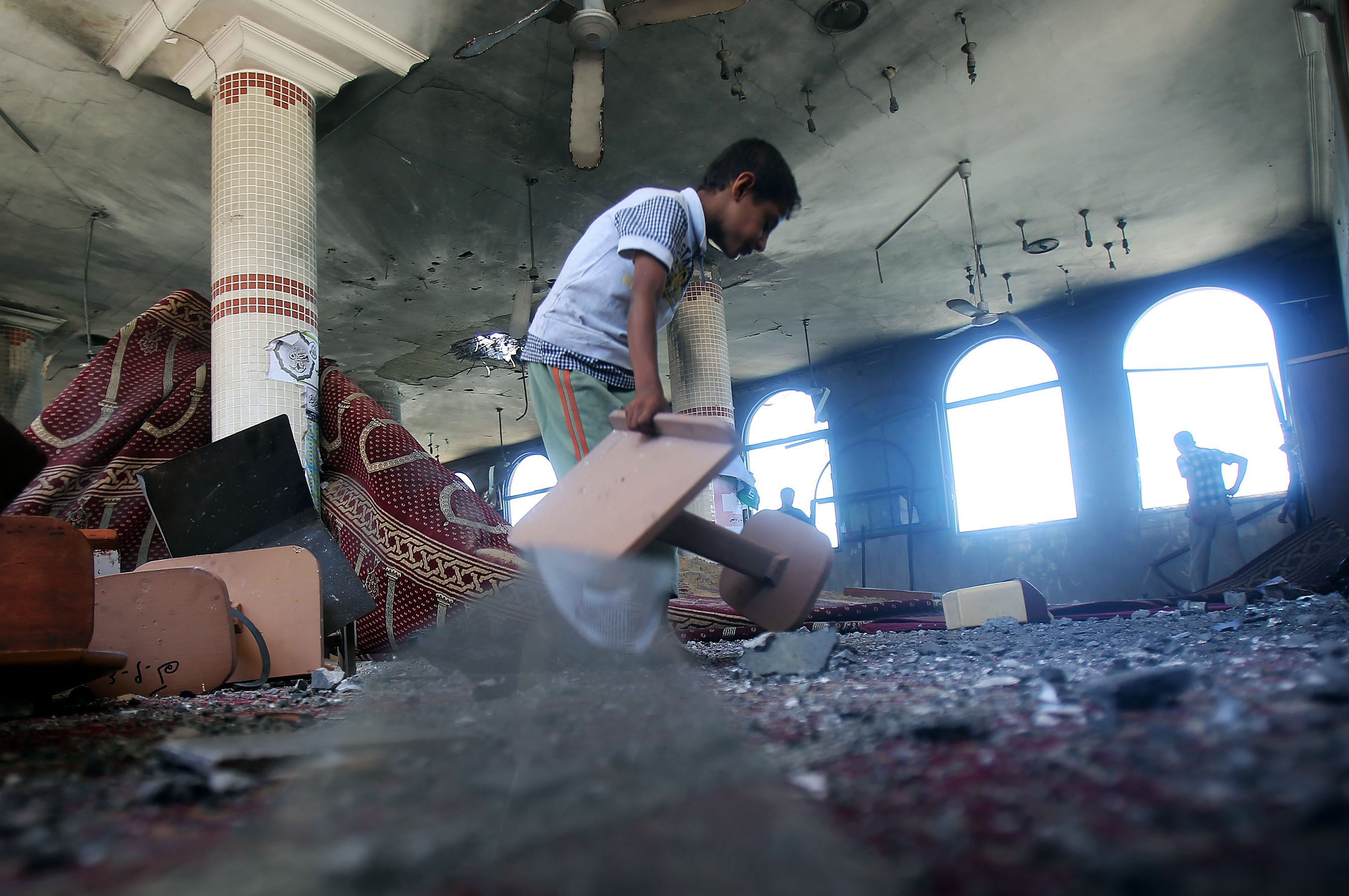
Kandahar, Afghanistan, 12 pm. The reader, a drone operator for the past six years, writes:

Subscriber here. Thanks for your site, on which I spend way too much time. I’ve attached a photo from my most recent Afghanistan trip, the third one in three years. This is the view from the Air Force compound at Kandahar AB looking northeast during a dust storm. Feel free to use it for the contest. If any one of your experts can get closer than just Afghanistan (since the flag is visible), I’ll be pretty impressed.

A Hail Mary Pass From The Iran Hawks

With the July 20 deadline for a final agreement looming, John Kerry returned to Vienna yesterday for another round of nuclear negotiations with his Iranian counterpart Mohammad Javad Zarif, saying “very significant gaps” still remain between Washington and Tehran’s positions. Opponents of a deal have already moved to preempt any possible success in Vienna, with House Foreign Relations Committee chair Ed Royce and ranking Democrat Eliot Engel circulating a letter

demanding that Obama consult Congress more closely on the ongoing negotiations and suggesting that Iran will have to satisfy Congressional demands on human rights, terrorism, ballistic missile development, and other issues unrelated to the ongoing nuclear negotiations before it will approve major sanctions relief. …

Of course, President Barack Obama himself can provide a certain degree of sanctions relief under executive order as he no doubt intends to if a deal is struck. And there is no doubt that Congress has a role to play in lifting sanctions. But the letter’s assertion that there is no exclusively defined “nuclear-related” sanction against Iran under US law and that any relief can only be extended by addressing a host of non-nuclear-related issues appears calculated to sow doubts about Obama’s ability to deliver among Iran’s leadership, thus strengthening hard-liners in Tehran who argue that Washington simply cannot be trusted.

The messaging continued on the Sunday talk show circuit. After Zarif went on “Meet the Press” to reiterate that Iran sees no benefit in developing a nuclear weapon, hawk-in-chief Benjamin Netanyahu, on “Fox News Sunday”, called that “a joke.” Speaking of the Iran hawks, James Traub urges Obama to “tell them — politely of course — to go to hell”:

After years of inaction and thunderous polemic, the negotiations of the past year have been remarkably professional. A report by the Arms Control Association lists 31 obligations that Iran undertook when it signed the so-called Joint Plan of Action; all but two are completed or in full compliance. Critically, Iran has agreed to stop enriching uranium at 20 percent, to dilute its existing stock of highly enriched uranium, and to allow regular inspections of its nuclear facilities by the International Atomic Energy Agency. The West, for its part, has made good on its promises of sanctions relief. …

Failure is still as likely as not. Very powerful forces in Iran are ideologically committed to an adversarial relationship with the West; others have earned a fortune in Iran’s isolated economy, and would lose out were the country to open up. Iranian negotiators continue to speak as if both sides must make equal compromises, when in fact the onus is on Tehran to comply with the NPT. Yet the Iranian people elected Rouhani to bring an end to their isolation and deprivation, and he knows — and presumably the supreme leader knows, too — that failure to reach a deal threatens Iran’s future, and perhaps the revolution as well.

Previous Dish on the latest round of Iran talks here and here.

Gaza Gets Worse

The conflict continues to escalate, with Israel launching a ground offensive and warning tens of thousands of northern Gazans to flee in advance of a major assault:

An estimated quarter of the 70,000 residents of the town of Beit Lahiya in northern Gaza fled their homes early Sunday after Israel dropped fliers and made phone calls warning residents of upcoming attacks. The United Nations reported 17,000 Palestinians have registered in shelters. The warnings came after Israeli special forces briefly raided Gaza to destroy a suspected long-range rocket launch site. Meanwhile, rockets were fired from Syria and Lebanon into northern Israel. The rocket attack from Lebanon was the third such incident since Friday. No one has claimed responsibility for the rocket fire Monday morning, and no injuries were reported.

The death toll in Gaza, according to Hamas officials, stands at 172, with over 1,100 injured. Gregg Carlstrom believes the Israelis when they say they are out to destroy Hamas for good:

The Palestinian militant group is, in the estimation of Israeli officials, weaker than it has been in memory, and Israel senses the best opportunity it has had in a long time to permanently degrade or even eliminate Hamas as a political factor.

It’s not just that the Israelis are pounding Hamas from the air and rounding up senior Hamas officials; with help from their de facto ally across the border—Egyptian general-cum-dictator-cum-president Abdel Fattah el-Sisi—they have managed to keep Hamas’ supply tunnels to Gaza virtually shut down. Analysts estimate that the roughly $20 million per month that Hamas collected in tax revenues from the tunnels has been reduced almost to zero.

Based on their public statements, it’s clear that at least some Israeli hawks would like to do to Hamas what Sisi has done to the Muslim Brotherhood group from which Hamas once sprung: batter it into submission. Officials in Israeli Prime Minister Benjamin Netanyahu’s cabinet have gone further, talking openly of a campaign to eradicate the group. Even Hamas officials admit they are worried. “I would say that, yes, the situation is not ideal,” Osama Hamdan, the head of Hamas’ foreign relations bureau, told me. “It’s certainly not as it was a few years ago.”

But as Juan Cole is quick to point out, it won’t work:

With leaders killed and rockets depleted, the Israeli hard liners probably believe, Hamas may be fatally weakened. At the very least, it will be less able to resist future episodes of lawn mowing in Gaza. The theory behind this campaign, however, is incorrect. Hamas is perfectly capable of building more rockets, even if they are smaller and have less range than the imported ones. And killed leaders can be replaced by their cousins.

Natan Sachs, however, doubts Israel actually wants to eradicate Hamas:

Even if Israel were to enter Gaza with ground forces, it’s unlikely to try and topple the Hamas regime, for fear of the immense cost of such an operation to the local population and to Israeli troops. Instead, Israel prefers a weakened, deterred, but effective Hamas. With the tunnels from Sinai now closed, a hit to the Hamas stockpile stands some chance of lasting longer than previous attempts, since it would be harder for Islamists to replace the lost weaponry.

But even if its weaponry were degraded, Hamas’s motivation to prove “resistance” to Israel will remain. Most acutely, this round of violence has the potential to reinforce the unrest — which had subsided — in the West Bank and in Jerusalem. A full blown Intifada, possibly coupled with attacks from Lebanon or elsewhere, could make this round of violence seem tame by comparison.

Previous Dish on the crisis in Israel and Palestine here, here, and here.

Is There Still A Chance To #BringBackOurGirls?

Marking the three-month anniversary of the mass kidnapping in Nigeria, Naunihal Singh considers the world’s options:

Foreign troops cannot swoop in and rescue the girls. Even if they are all in one place and can be located (Nigeria claims to know their location, but there are reasons to be skeptical), there is widespread agreement that it would be close to impossible to free them without a high number of casualties. Instead, concerned global citizens have to work for the release of the girls with Nigerian groups. They have to shield local activists from government harassment, and battle the news cycle and compassion fatigue to keep the spotlight on the abductees (perhaps with monthly, coördinated bursts of grassroots efforts).

Last, and more controversially, international activists should support local calls for the government to negotiate the release of the hostages. The armed conflict is already so bad; it is hard to see how a deal could create incentives that would make things worse. In addition, Boko Haram has always wanted to exchange the girls for some of their jailed comrades. What is less clear is whether the Nigerian government is interested in doing so.

Why Undertipping Makes You A Real Jackass

Tipped-minimum-wage

The minimum wage for tipped workers has remained stagnant for 23 years:

Tipped workers have been getting short-changed for years. At least that’s what the gap between the federally mandated regular minimum wage and federally mandated tipped minimum wage would suggest.

When the tip credit, as that difference is often called, was created in 1966, it split hotel, restaurant and other service industry salaries up so part was paid by their employers and another part was paid by their customers. The legislation was intended to protect service industry workers who had previously been unprotected under the Fair Labor Standards Act (FLSA). And the split was originally 50-50 – meaning employers and customers shared the cost of each tipped worker’s minimum salary.

But the burden is increasingly falling on America’s restaurant goers and other service industry customers. “Today this two-tiered wage system continues to exist, yet the subsidy provided by customers in restaurants, salons, casinos and other businesses that employ tipped workers is larger than it has ever been,” a new report (pdf) by the Economic Policy Institute says. The tip credit has surged from fewer than $3 in the late 1980s to more than $5 today, largely because the tipped minimum wage hasn’t increased in 23 years.

Plugging The Leaks In Our Water Supply

David Bornstein hopes it will become a higher priority:

The Environmental Protection Agency estimates (pdf) that public water systems lose, on average, one-sixth of their water — mainly from leaks in pipes. The E.P.A. asserts that 75 percent of that water is recoverable. (In truth, the volume of leakage in the nation’s 55,000 drinking-water systems is unknown, because few conduct water audits using the standards established by the International Water Association and the American Water Works Association.)

It’s been widely reported that California is experiencing its worst drought in history. But take a look at the United States Drought Monitor: much of the country is abnormally dry or in drought. Internationally, the problem is even more serious. The World Bank reports that, over the next decade and a half, water availability may fall 40 percent short of global need (pdf). Meanwhile, utilities in the developing world are hemorrhaging water. The World Bank estimates that water systems have real losses (leakages) of 8.6 trillion gallons per year, about half in developing countries (pdf, 11MB, p.6). That’s enough to serve 150 million Americans (and we use a lot of water!)