The Support For Obama’s War

Gallup finds that 60 percent of Americans support our attacks on ISIS. And a majority from both parties approve:

War Support

Aaron Blake is underwhelmed by these numbers. He observes that “the actions in Iraq and Syria have a lower initial level of support than almost every major U.S. military operation over the past three decades”:

60 percent is far less than the early levels of support for the wars in Iraq last decade (76 percent), Afghanistan in 2001 (90 percent), and the first Gulf War in the early 1990s (79 percent). It’s also less support than existed for smaller missions in Somalia in 1993, Afghanistan and Sudan in 1998 and Libya in 1986.

The only efforts which Iraq and Syria beat in initial popularity are the 2011 intervention in Libya, Kosovo in 1999, and Grenada in 1983. Given the negative coverage of the invasion in Grenada and the aforementioned war-weary American public in 2011, it’s not surprising to see Iraq and Syria outrank those too. Kosovo also ranked as a not-particularly-popular intervention.

Larison expects support to drop off:

The fact that only 39% favored military action a few months ago suggests that much of the current level of support for the war is ephemeral and won’t last as the war continues for months and years. That is especially true if the war is perceived as “not working,” and that perception is likely to grow thanks to the unrealistic stated goal of the war. As the Gallup report notes, the 60% figure is relatively lower than polling for most military interventions over the last thirty years, and once the initial “rally round the flag” effect wears off it is probably going to drop back down to significantly lower levels. The public’s underlying aversion to prolonged conflict is still there, and their opposition to sending ground forces into Iraq or Syria remains. Because there appears to be no effort to get Congress to vote on this anytime soon, and because the war is likely to last for several years, declining public support will become a serious political problem for the administration.

Better Reasons To Drop Bombs In Syria

Douthat identifies a few:

To the extent that these strikes have a limited military objective that either connects directly to the Iraqi front (by denying the Islamic State a secure rear) or targets groups plotting more actively against the United States, they trouble me much less than a more open-ended strategy in which we seek to conjure up a reliable ally (“you know, whatever the Free Syrian Army ever was,” to quote a U.S. official in Filkins’ piece) to be our well-armed boots on the Syrian ground.

Or put another way:

The idea that we can somehow hope to defeat ISIS outright in Syria, where we currently have no real allies capable of winning a war or securing a peace, without first seeing the Islamic State pushed back or defeated in Iraq — itself probably a long-term project — seems like the height of folly, and a royal road to another quagmire or bloody counterinsurgency campaign. But the possibility that strikes in Syria might modestly help our existing allies in Iraq seems at least somewhat more plausible, with a more limited worst-case scenario than a full-scale Syrian intervention if they don’t ultimately do much good.

But Larison fears that our limited involvement won’t stay limited:

Every step along the way, the administration has set down restrictions on what it would be willing to do, and it then cast those restrictions aside within days or weeks of imposing them. The administration is currently saying that there won’t be American forces on the ground engaged in combat, but as we should know by now every statement like this is entirely provisional and can be revoked at any time. Furthermore, because the administration persists in the lie that the 2001 AUMF covers this military action, it is very doubtful that the president will seek Congressional authorization for this war even if the war involves U.S. ground forces. I very much hope that Obama doesn’t yield yet again to the pressures in favor of escalation, but there is no reason to think that he will be able to resist them indefinitely.

Scaring Up Some Votes

The Republicans are already using ISIS as a wedge issue:

http://youtu.be/o1_6gjdqGRQ

Sargent passes along a new Scott Brown ad that also hypes the ISIS threat:

It’s true that the President’s approval on terrorism has plummeted and the GOP now holds a huge advantage on foreign policy. Republican strategists have been pretty explicit in explaining that they see this as a way to exploit a general public sense that things have gone off the rails, and polls do show high wrong-track numbers and rising worry about terrorism. If things go wrong, which is certainly possible, this could well redound to the benefit of Republican candidates.

But for now, it’s hard to imagine that arguments such as Brown’s above are going to cut it. After all, if GOP candidates are really going to paint the U.S. response to ISIS as insufficiently realistic about the nature of the threat, then that should theoretically open them up to thequestion of whether they support sending in ground troops. You’d think that if the criticism continues now that operations are underway, it would be harder for them to duck that basic follow-up.

Waldman agrees that ISIS fear-mongering is unlikely to work:

Despite the surface similarity between political attacks like those and the ones we saw when George W. Bush was president, there’s a crucial difference. Back then, there was a Republican president taking actions against America’s enemies, while Democrats supposedly didn’t want to protect the country (even if, in reality, elected Democrats gave ample support to the wars in Afghanistan and Iraq and other elements of the “War on Terror”).

Today, however, it’s a Democratic president who is taking action against terrorists. Even if you believe that action is inadequate, it still creates a fundamentally different impression with the public when they see Tomahawks launching and jets taking off from aircraft carriers on Barack Obama’s orders.

Which may explain why Josh Green found that few GOP ads thus far have mentioned ISIS:

Now that the U.S. has begun bombing Syria, those ads may start to materialize. Then again, maybe they won’t. Republicans leaders such as House Speaker John Boehner (R-Ohio) have endorsed Obama’s latest campaign. “ISIL is a direct threat to the safety and security of the United States and our allies,” Boehner said of the group formerly known as Islamic State in Iraq and the Levant, according to a statement. “I support the airstrikes launched by the president, understanding that this is just one step in what must be a larger effort to destroy and defeat this terrorist organization. I wish our men and women in uniform Godspeed as they carry out this fight.”


Because More Bombing Is Always The Answer

Mohammed Alaa Ghanem, writing in Politico, wants the US to target Assad, not just ISIS:

Assad’s record presents clear evidence: If his regime somehow survives the current conflict, ISIL will mysteriously regenerate itself while Assad approvingly observes. Unless the United States wants to be striking ISIL in Syria yet again in another five to 10 years, America should hit Assad now.

Larison pulls his hair out:

Attacking Syrian regime forces would drag the U.S. into a much larger, riskier, and more ambitious campaign that could have very dangerous consequences for U.S. pilots and could create yet another crisis in U.S.-Russian relations. The war against ISIS already promises to be long and desultory, and a war against the Syrian regime would make everything harder, raise the costs of the ongoing campaign, and risk the possibility of regime collapse and the even greater chaos that would consume the country as a result. The war against ISIS is a serious mistake, but fighting both the regime and ISIS at the same time would be a disaster.

Quote For The Day

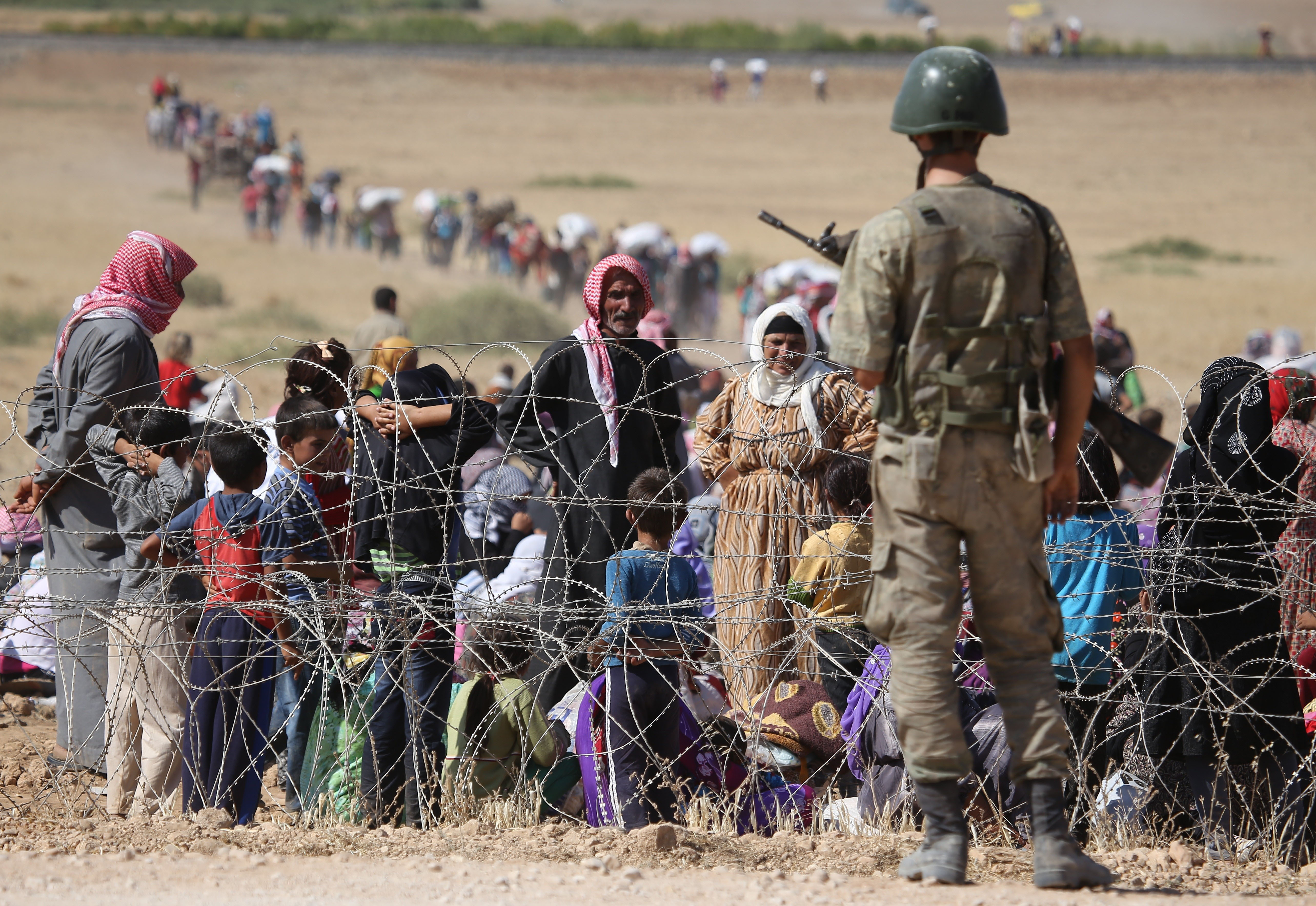
Syrians fleeing the war in their country wait to cross into Turkey

“We must begin by acknowledging the hard truth:  We will not eradicate violent conflict in our lifetimes.  There will be times when nations — acting individually or in concert — will find the use of force not only necessary but morally justified.

I make this statement mindful of what Martin Luther King Jr. said in this same ceremony years ago:  “Violence never brings permanent peace.  It solves no social problem:  it merely creates new and more complicated ones.”  As someone who stands here as a direct consequence of Dr. King’s life work, I am living testimony to the moral force of non-violence.  I know there’s nothing weak — nothing passive — nothing naïve — in the creed and lives of Gandhi and King.

But as a head of state sworn to protect and defend my nation, I cannot be guided by their examples alone.  I face the world as it is, and cannot stand idle in the face of threats to the American people.  For make no mistake:  Evil does exist in the world.  A non-violent movement could not have halted Hitler’s armies.  Negotiations cannot convince al Qaeda’s leaders to lay down their arms.  To say that force may sometimes be necessary is not a call to cynicism — it is a recognition of history; the imperfections of man and the limits of reason,” – Barack Obama, accepting the Nobel Peace Prize, December 10, 2009.

(Photo: Syrians fleeing from clashes between the Islamic State of Iraq and Levant (ISIL) militants and Democratic Union Party (PYD) forces in the Ar-Raqqah Governorate of Syria, wait at the Turkish-Syrian border to cross into Turkey on September 19, 2014 in Suruc district of Sanliurfa province of Turkey. By Orhan Cicek/Anadolu Agency/Getty Images.)

“A Thousand Little Saddams”

Reviewing recent Iraqi literature in light of the ISIS uprising, Max Rodenbeck turns to Zaid al-Ali’s The Struggle for Iraq’s Future, which he calls a “well-researched study of how Iraq has gotten into its current, worsening, and possibly terminal mess”:

The departure of Maliki, whose overstay of his welcome made him a sponge for dissent, could offer a window for reconciliation. Mainstream Sunni and Kurdish leaders, as well as some Shiites, had long demanded his exit. Yet the litany of failure that Ali describes is simply too long and wide-reaching to leave much room for optimism. Ali’s own concluding suggestions for how to right things seem sadly perfunctory. He also betrays, in occasional oversweeping judgments and in a peculiar lack of sympathy with the Kurdish yearning for independence (which seems only more justified by the ugly facts he himself reveals), an impractical wistfulness for an imaginary, whole, and complete Iraq.

What came to mind as I closed the book was the damning remark of a distinguished Iraqi exile I met in Kuwait shortly before the 2003 invasion. His father had served as prime minister under the monarchy whose overthrow in the bloody coup of 1958 had led to Iraq’s long era of turbulence. Still, he took a dim view of the looming ouster of Saddam Hussein, and held no dreams of return. “Of course the Americans will get rid of Saddam,” he said. “But what will we have then? A thousand little Saddams.”

And we have set ourselves the impossible task of trying to kill them all. And then what?

Now Will Turkey Tackle ISIS?

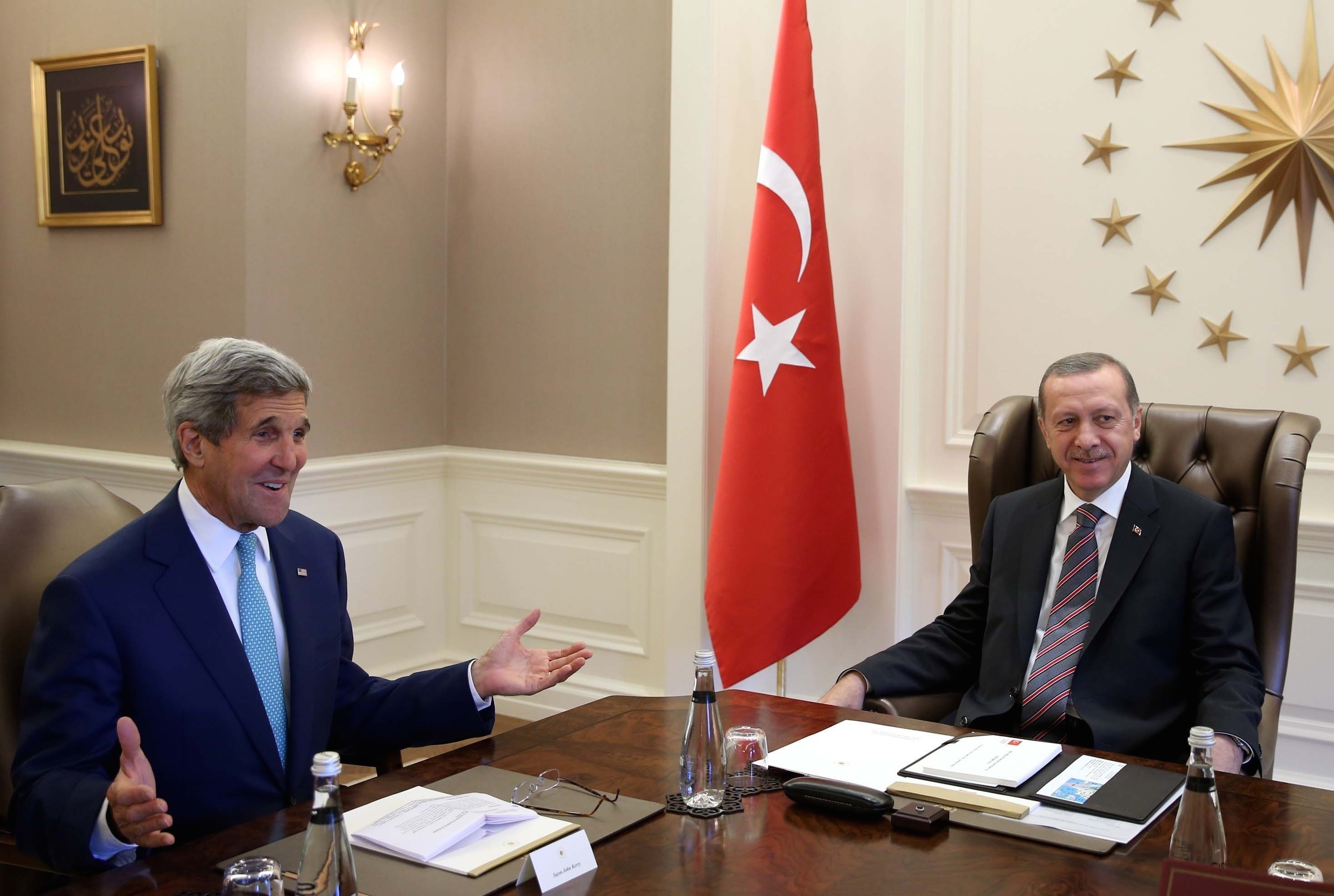
John Kerry - Recep Tayyip Erdogan

Turkey’s hostages were freed over the weekend:

Turkey’s President Recep Tayyip Erdogan said Sunday that the release of 49 hostages held by Islamic State had removed the main obstacle to joining a U.S.-led coalition against the extremist group, spurring hopes that Ankara would take a more robust role.

The US is certainly eager for Turkey to join the fight. Joshua Keating explains:

The U.S. badly wants Turkey to take a prominent role in its anti-ISIS coalition, including allowing its bases to be used to launch airstrikes. Ankara has been reluctant to fully commit to the effort so far, due to fears of blowback and, in particular, concerns about the status of the Turkish hostages. Secretary of State John Kerry said today that now that the hostage situation has been resolved, he expects Turkey to commit its resources to the fight. “The proof will be in the pudding,” he said.

Joshua Walker encourages Turkey to act:

The alternative of Ankara remaining on the sidelines once again dooms Iraq to the same outcomes it faced the last time Turkey chose not to participate. Unlike last year when Erdogan bemoaned the lack of international consensus behind acting in Syria, he should seize the initiative that President Obama has already provided with airstrikes and increased surveillance against a universally acknowledged threat to galvanize an international response. Only time will tell if Washington can “reset” its Turkey policy by bringing Ankara into its coalition by a mix of private tough love and public flattery. Assuring Ankara that the anti-ISIS coalition will not harm its own national interest, but rather help eliminate a mutual threat that Turks are struggling to cope with further through economic assistance for the refugees already within their borders and potentially creating defactobuffer zones within existing ISIS territory would go a long way. Making Turkey the tip of the spear against ISIS would defuse any anti-Islamic theatrics and also help plan for a post-ISIS future that involves complicated questions about the status of the Kurds that Ankara is particularly worried about.

But Marc Champion foresees complications:

Erdogan aggressively committed himself to Assad’s demise soon after Syria’s military began slaughtering protesters in 2011. He opened Turkey’s borders and coffers to opposition groups willing to fight the Syrian dictator, including Islamist radicals. Whether or not Islamic State received any of this official support, it has been recruiting within Turkey and is embedded among the 850,000 Syrian refugees on Turkish soil.

(Photo: By Kayhan Ozer/Anadolu Agency/Getty Images)


Syrians Don’t Really Want Our Help?

That’s what Edward Dark reported last week:

[I]t would be foolish to believe that US military action against IS is popular here or will go down well, especially when civilian casualties start to mount. On the contrary, it will most likely prove counterproductive, stoking anti-Western resentment among the population and increasing support for IS, driving even more recruits to its ranks.

The terror group knows this well, which is why it is secretly overjoyed at the prospect of military action against it. In its calculations, the loss of fighters to strikes is more than outweighed by the outpouring of support it expects both locally and on the international jihadist scene. And its fighters are not afraid of martyrdom by US bombs. In fact, the chance for martyrdom is why many of them came to fight in Syria in the first place.

America’s Newest War Spreads To Syria

US launches air strikes against Isil in Syria

The Guardian is live-blogging the US airstrikes against ISIS in Syria. Juan Cole expects them to do little good:

The some 22 sorties flown on Monday will have killed some ISIL terrorists, blown up some weapons warehouses, and destroyed some checkpoints. But ISIL are guerrillas, and they will just fade away into Raqqah’s back alleys. The US belief in air power is touching, but in fact no conflict has ever been quickly brought to an end where US planes have been involved.

Mark Thompson agrees the airstrikes will have limited impact:

The new attacks, against fixed ISIS targets, undoubtedly did significant damage. But they also will force ISIS fighters to hunker down, now that their sanctuary inside Syria has been breached. This means that the jihadists, who have shown little regard for civilians, will move in among them in the relatively few towns and villages in eastern Syria, betting that the U.S. and its allies will not attack them there and risk killing innocents.

That could lead to a stalemate. While air strikes are likely to keep ISIS from massing its forces, and traveling in easy-to-spot convoys, air power can do little to stop small groups of fighters from billeting with and intimidating the local population.

Jeffrey Goldberg admits that “there exists no strategy for victory, and no definition of victory”:

The advantage of launching strikes against ISIS positions early in this fight is that its commanders now have to spend extraordinary amounts of time, energy and resources merely digging in, and protecting their human and materiel assets, rather than pushing on, toward Baghdad, Jordan and Saudi Arabia. A terrorist preoccupied with his own survival has less bandwidth to threaten yours. But these strikes will not bring about the end of ISIS. Like other terror groups, it can “win” this current round of fighting by surviving, and maximizing civilian casualties on its own side.

The relatively easy task for airpower—of blunting ISIS’s lightning offensives against Iraqi cities—may already be accomplished. ISIS has not captured major population centers in Iraq since the beginning of the air campaign and in some areas, such as Haditha and the Baghdad suburbs, it is contributing to modest counteroffensive gains. Tactically, ISIS’s efforts to offensively employ heavy weapons, mass forces on technicals, and stage large amounts of its infrastructure in the open are highly vulnerable to airstrikes. However, it is important to remember that even in Iraq, where the United States has multiple partners and embedded advisers, these airstrikes have yet to precipitate major counteroffensive gains by Iraqi security forces. ISIS has repelled two major counteroffensives in Tikrit using a variety of guerrilla tactics, suggesting that it remains formidable defensively, a strength airpower has rather more difficulty countering.

ISIS’s tactics and structure suggest that rather than hitting only massed ISIS forces in Iraq and its fixed infrastructure across both Iraq and Syria, an offensive campaign should target its battlefield leadership and the elements of the organization necessary for sustaining and coordinating its operations across the region.

But Julien Barnes-Dacey doubts we can defeat ISIS:

The respective positioning of non-IS rebels and Assad highlights an inconvenient truth: as long as Syria’s civil war rages, international attempts to defeat Islamic State militarily will be significantly hampered, particularly if regional allies are also pulling in different directions. While tactical lines may shift as a result of air strikes, they are unlikely to provoke significant strategic realignments. Given their likely inconclusive nature, they risk drawing the West into deeper intervention. While Obama has clearly stated that US intervention in Syria will remain limited, those calling for wider action may see the proposed initial strikes and arming of rebels as the thin edge of the wedge, with further escalation inevitable.

Significantly, narrow air strikes that inflict collateral damage and leave the regime unscathed also risk further empowering Isis, consolidating its self-declared position as the only legitimate defender of Syria’s Sunni population. Isis’s apparent goading of the US to intervene in Syria and Iraq through the public beheading of a number of hostages may appear misguided given the power that the American military can bring to bear. But blunt military intervention may help entrench local support behind the group.

Larison sighs:

Loose talk of “destroying” ISIS practically demanded expanding the war into Syria. Obama stated he would not hesitate to do this. However, there is even less reason to think that U.S. air power will have the desired effect there than it will have in Iraq. It will not be lost on Sunnis in Syria and Iraq (and elsewhere) that the U.S. didn’t intervene directly in the Syrian civil war until it came time to attack a group opposed to their sectarian enemies. Even if the U.S. is not actively cooperating with the Syrian regime in all of this, it will be perceived as siding with it in the current conflict, and that will be to the detriment of American security now and in the future. For the second time this century, the U.S. is fighting a war that will benefit Iran and its regional allies and proxies, and it is doing so in a way that seems sure to trap the U.S. into open-ended fighting for many years to come.

Greenwald piles on:

Six weeks of bombing hasn’t budged ISIS in Iraq, but it has caused ISIS recruitment to soar. That’s all predictable: the U.S. has known for years that what fuels and strengthens anti-American sentiment (and thus anti-American extremism) is exactly what they keep doing: aggression in that region. If you know that, then they know that. At this point, it’s more rational to say they do all of this not despite triggering those outcomes, butbecause of it. Continuously creating and strengthening enemies is a feature, not a bug, as it is what then justifies the ongoing greasing of the profitable and power-vesting machine of Endless War.

And Hayes Brown wonders what comes next:

So far, Washington is mum on just how long the United States plans to keep up the strikes in Syria, though reports indicate that they will not continue at the tempo seen last night. U.S. Central Command has said only that “the U.S. military will continue to conduct targeted airstrikes against ISIL in Syria and Iraq as local forces go on the offensive against this terrorist group.” As for the people living in the areas that are now the target of these airstrikes, residents are reportedly fleeing Raqqa as quickly as possible. “There is an exodus out of Raqqa as we speak,” one resident told Reuters. “It started in the early hours of the day after the strikes. People are fleeing towards the countryside.” As the civil war in Syria has already caused over half of its population to flee their homes, it can only be assumed that the new campaign against ISIS will only exacerbate the refugee crisis the region has struggled to contain.

(Photo: Syrian children stand on the ruins of a destroyed building during a search and rescue operation among the ruins of it, in a region of Idlib, a northwestern city of Syria, on September 23, 2014. The US launched air strikes against ISIS in Idlib. By AA Video/Anadolu Agency/Getty Images)

An Actual War On Women, Ctd

Ariel Ahram goes deep in exploring ISIS’s use of sexual violence, arguing that it represents “as much an undertaking in state-making as in war-making”:

The power to control or manipulate sexual and ethnic identity is a key component of all state power. In the Middle East, the regulation of sexual relations is often used as a means to create or reinforce ethno-sectarian boundaries.

In the 19th century the Ottoman authorities prohibited marriage between Shi’i men and Sunni women in the provinces of Iraq for fear that Shi’i Iranians were gaining a demographic foothold in the region. Since Islamic law privileges male prerogative over children, the move was meant to block the propagation of Shi’ism within the Ottoman domain. Marriage of Shi’i women to Sunni men was still permitted, since the children of such a union were deemed Sunni. Saddam Hussein took similar measures in the 1970s and 1980s. In late 1970s, in the immediate wake of the Islamic Revolution in Iran, the government moved to deport some 40,000 people deemed to be of “Iranian” (i.e., Shi’i) origins.  Thousands of families were interned in prison or prison camps for months, where they were subject to rape and torture, before being transported to the border. …

ISIS’s violence is a heinous crime of war, but also represents a particular form of statecraft. At first glance, it might appear that these practices, though justified by selective interpretations of Islamic law, serve only to satisfy prurient sexual urges. Much like its manipulation of water and oil resources, though, ISIS’s use of sexual and ethnic violence has both ancient and modern antecedents. By selectively reinforcing, creating, and severing ties of kinship, these violent practices can affect bonds of loyalty and obedience far more substantially than the simple distribution of resource rents.