Desperately Seeking Moderates, Ctd

The House is working on an authorization to arm the “moderate” Syrian rebels:

The House Armed Services Committee has drafted an amendment to grant authorization to the President to arm and train Syrian rebels opposed to the Islamic State of Iraq and Greater Syria (ISIS). There are some strings attached, including requiring that the Pentagon report to Congress 15 days before it plans to train and equip the rebels, and provide subsequent updates to relevant committees every 90 days. The language will be included as an amendment to a government funding bill that needs to pass Congress by the end of the month to avert a partial government shut down. Rep. Patrick McHenry (R-N.C.), a key member of the House GOP whip team, said the amendment will pass this week.

But these “moderates” we’re supposed to be counting on seem to be on their last legs, to the point that a major American support group for them disbanded last month:

On August 19, the Syrian Support Group, which had previously arranged a few shipments of nonlethal aid to the Free Syrian Army, sent a letter to donors explaining why the group was shutting its doors. “Over the last year, the political winds have changed,” the letter read. “The rise of ISIS and Jabhat al-Nusra [an Al Qaeda-affiliated opposition force in Syria] and the internal divisions among rebel forces on the ground have complicated our efforts to provide direct support.”

The letter noted that “more significant support” was heading to the FSA from Saudi Arabia, Qatar, the United States, and other governments. But rivalries and rifts within the opposition had impeded the overall effort. “It was difficult to keep things going with the changes in the FSA and its Supreme Military Council and the advent of ISIS,” says Majd Abbar, who was a member of the Syrian Support Group’s board of directors. “It made our operations extremely difficult.”

Then there’s this:

Syrian rebels and jihadists from the Islamic State have agreed a non-aggression pact for the first time in a suburb of the capital Damascus, a monitoring group said on Friday. The Syrian Observatory for Human Rights said the ceasefire deal was agreed between IS and moderate and Islamist rebels in Hajar al-Aswad, south of the capital. Under the deal, “the two parties will respect a truce until a final solution is found and they promise not to attack each other because they consider the principal enemy to be the Nussayri regime.” Nussayri is a pejorative term for the Alawite sect, an offshoot of Shiite Islam to which President Bashar al-Assad belongs.

To which Ed Kilgore, who flagged it, remarks:

Perhaps this was all anticipated by the Obama administration and others—indeed, it does help explain the apparent desire of John McCain and Lindsay Graham to go to war with the entire region. But it doesn’t speak well for the idea that anyone who encounters IS understands immediately the organization must be destroyed at any cost lest or the world will come to an abrupt end.

And Allahpundit predicts that our de facto role as Assad’s air force will bring ISIS and Syrian rebel militias closer together, not drive them apart:

If ISIS’s grip begins to loosen in Sunni areas of Syria as the U.S. pounds them from the air, what are “moderates” more likely to do? Join with their hated enemy, the Shiite Assad, in stamping out ISIS, at which point Assad might turn around and attack the “moderates”? Or join with ISIS and fend off Assad in the name of keeping Iran’s Shiite death squads from cleansing those Sunni areas? Arguably, the more effective we are in damaging ISIS, the greater the risk that our “moderate” partner will turn on us and join the battle against the de facto U.S./Assad alliance. [Richard] Engel sees it coming. Does the White House?

It would appear not. Even though it’s bleeding obvious.

Is The Anti-ISIS Coalition Coalescing? Ctd

20140920_gdc901

Ali Murat Yel defends Turkey’s reluctance to join the war coalition against ISIS:

Public opinion in Turkey holds that a Muslim cannot be a terrorist and any terrorist cannot be a Muslim. In other words, terrorism and Islam cannot be reconciled. This public conviction is certainly the real attitude of the President Recep Tayyip Erdogan who has formed the Alliance of Civilizations with Spain against the expectation in some quarters of a “clash of civilizations” and has been trying to restore peace with different ethnic groups in Turkey. The President himself and the majority of Turkish people believe that terrorism could be defeated intellectually not through waging war on them.

Turkish foreign policy has been formed on the principle of “zero problems with neighbors” because we believe that stability in the region would only bring more peace and wealth. … Instead of an external military operation the local politicians and people should come together and find their own solution according to their own realities and circumstances. Outsiders cannot understand all the local realities like the ethnic origins, sectarian divisions, or the political or ideological power structures of these peoples. Turkey, finally, does not want to be in the position of going to war in another, neighboring Muslim country.

Sanity! But we, thousands of miles away, know better. Amos Harel takes a look at the background role Israel is playing:

Despite the growing concern, it should not come as a surprise that the Netanyahu government has not yet taken any immediate steps against IS. The government has only announced that the organization would be considered illegal in Israel and the Palestinian territories, and decided to focus intelligence-gathering on the group’s activities in Syria and Lebanon. But while IS might not present an imminent threat at home, Netanyahu has been extremely eager to aid the Arab world in the battle against the group. Last week, the prime minister confirmed media reports that Israel was supplying intelligence to the new anti-IS international coalition. Jerusalem no doubt has useful information to contribute: For decades, it focused on acquiring first-rate intelligence about events in Syria, which it considered its toughest enemy.

Michael Crowley turns to Saudi Arabia, the linchpin of the coalition, and what King Abdullah al-Saud brings to the table:

While Saudi money has long helped nurture a fundamentalist Sunni doctrine that inspires groups from al Qaeda to Boko Haram, Islamic radicalism has come to threaten the king as well. … ISIS seems to have raised the king’s anxiety another notch, however. He has banned Saudis from traveling to join the fight in Syria, lest they return to threaten his regime. Last month Saudi authorities arrested dozens of suspects linked to ISIS — including members of an alleged cell plotting attacks within the country. But Abdullah wields a potent weapon in his defense: his influence over Saudi Arabia’s religious leaders. The king has a symbiotic relationship with his kingdom’s hardline clerics, whose words hold sway far across the Muslim world.

But Simon Henderson suspects that the Saudis will prefer to play both sides:

Despite the diplomacy of recent days, which suggests an emerging coalition that includes Saudi Arabia and will take on the fighters of the Islamic State in Iraq and perhaps Syria, the House of Saud will likely continue to try to balance the threat of the head-chopping jihadists, while also trying to deliver a strategic setback to Iran by overthrowing the regime in Damascus. From a Saudi point of view, the move of IS forces into Iraq contributed to the removal of Nouri al-Maliki in Baghdad, whom they regarded as a stooge of Tehran. Despite official support by Riyadh for the new Baghdad government, many Saudis who despise Shiites probably regard IS as doing God’s work.

Which is why this really is whack-a-mole. The administration, meanwhile, is engaging in linguistic contortions to explain how we’re not “coordinating” with Iran or Syria even if we’re talking to them and perhaps sharing intelligence:

“Coordinating means we talk directly to [the] Syrian Air Force and coordinate our attacks against ISIS with their operations against ISIS,” Christopher Harmer, an analyst with the Institute for the Study of War, told Foreign Policy, using one of the Islamic State’s acronyms. “That’s not happening, won’t happen.” But “deconflicting,” Harmer explained, means that the United States will monitor where the Syrian aircraft are flying and stay out of their way, thus avoiding any potential skirmishes. “That way we don’t accidentally intrude on their operations, or they on ours,” he said.

Harmer said the United States and Iran followed this protocol during the 2003 invasion of Iraq. “The U.S. did not coordinate with Iran, but Iran definitely deconflicted their normal military operations to avoid any unwanted interaction with the U.S., particularly in the Persian Gulf,” he said. In that case, Harmer said, the Iranian Navy held back patrol boats that had often harassed U.S. Navy ships in the Strait of Hormuz. “They backed way down off of their normal operations in order to deconflict with the U.S. operations,” Harmer said.

But Jacob Siegel rightly worries that Iran could become our shadow enemy in Syria:

As Iran showed in the last war in Iraq, when it armed and backed insurgent groups fighting U.S. forces, having a common enemy, as Saddam Hussein once was, won’t prevent Tehran from trying to counter American influence in the Middle East. For Iran, the question is what comes after ISIS. In Iraq there is already a Shia-led government in Baghdad broadly aligned with Tehran. But in Syria, where Shia are a minority, a post-ISIS future threatens to freeze Iran out.

To defeat ISIS, the U.S. is relying heavily on Sunni coalition partners to give its aims local legitimacy and ensure that constructing the post-ISIS political order won’t fall solely to America. Fearing the loss of its power, Iran could try to destabilize U.S.-led efforts in Syria, causing a protracted conflict that would weaken the allied participants. Alternately, if Tehran resigns itself to Assad’s ouster, it may seek other means to maintain its influence in Syria. One option would be controlling the political transfer of power from Assad, to ensure that the new government installed in Damascus remains receptive to Iranian interests. Then there’s the real long shot: that Iran reaches a détente with its Sunni rivals and accepts a power-sharing arrangement rather than a client state in Syria.

(Chart of Middle Eastern relationships via The Economist)

Fear And Loathing In Lebanon

Sulome Anderson checks in from Tripoli, the northern Lebanese town that has become a microcosm of the Syrian civil war and which today “seems to lie in ISIS’s shadow”:

Although the extremist and ultraviolent Sunni group has few open supporters here, the appearance of pro-ISIS paraphernalia and graffiti, the clash last month in the Bekaa, and the fact that Tripoli’s Sunni-majority population has a historical tendency toward radicalism, have raised worries that the group might gain a foothold here and send the city into a spiral of deepening violence.

Local tensions in Tripoli follow essentially the same ethnic lines as those in Syria’s war:

Sunni citizens largely support the increasingly fundamentalist Syrian opposition — ISIS being the most notoriously brutal of the groups fighting Syrian president Bashar al-Assad; meanwhile, the Alawites of the Jabal Mohsen neighborhood are overwhelmingly sympathetic to Assad’s regime (the Syrian leader is Alawite) and its Hezbollah allies. There are frequent and bloody gunfights between Jabal Mohsen and the Sunni district of Bab el-Tabbeneh, which border each other. Fearing violence would engulf Tripoli and potentially spread to other regions in Lebanon, the army moved in, establishing a security zone within the city limits last year. That hasn’t stopped the bloodshed, though, and the situation in Arsal triggered fresh clashes at the end of August, in which an 8-year-old girl was killed.

Also, the local Christian community is feeling threatened in a way it never has before:

Tripoli’s Christian population has been a bit skittish lately. Several churches were vandalized at the beginning of September, their walls spray-painted with ominous threats including “The Islamic State is coming” and “We come to slaughter you, you worshippers of the cross.” Crosses were allegedly burned in retaliation for the #BurnISISFlag social media movement, Lebanon’s version of the Ice Bucket Challenge, in which people have been posting videos and pictures of themselves setting fire to the group’s banner.

Father Samir Hajjar sits in the priest’s quarters of the city’s Syriac Orthodox Church, one of the buildings that was vandalized. He is measured about the incident, but admits it was worrying. “At first, we thought this could just be ordinary vandals, or the work of children,” he says. “I’ve been here 17 years, and no one bothers us. We respect our neighbors and they respect us. But this graffiti on the walls of all the churches, that’s not children’s work. They used stencils. It’s a serious matter.”

Can America “Destroy” ISIS?

Tomasky wishes Obama would treat Americans like grownups and admit that we can’t eradicate the evil embedded in ISIS:

We’ve been trying to destroy Al Qaeda for 13 years now. We have not. We will not. And we will not destroy ISIS. We can’t destroy these outfits. They’re too nimble and slippery and amorphous, and everybody knows it. So why say it? Why not say what we hopefully can do and what we should do: contain it. We have contained Al Qaeda. Some of the methods have been morally problematic (drone strikes that sometimes kill innocents, etc.), but the methods have worked. Al Qaeda, say the experts, is now probably not in a position to pull off a 9/11. Containment is fine. It does the job. But no, I guess a president can’t say that. A president has to sound like John Wayne. It’s depressing and appalling.

Steve Chapman explains why, in his view, the war against ISIS is unlikely to succeed:

The United States is not incapable of fighting reasonably successful wars. It did so in the 1991 Iraq war, the 1999 Kosovo war and the 1989 invasion of Panama. In each case, we had a well-defined adversary in the form of a government, a limited goal and a clear path to the exit. We generally fail, though, when we undertake open-ended efforts to stamp out radical insurgents in societies alien to ours. We lack the knowledge, the resources, the compelling interest and the staying power to vanquish those groups.

The Islamic State is vulnerable to its local enemies—which include nearly every country in the region. But that doesn’t mean it can be destroyed by us. In fact, it stands to benefit from one thing at which both Obama and Bush have proved adept: creating enemies faster than we can kill them. We don’t know how to conduct a successful war against the Islamic State. So chances are we’ll have to settle for the other kind.

In fact, Ishaan Tharoor notes, the one time we managed to “destroy” a major terrorist outfit, it came back … as ISIS:

The closest the United States has come to destroying a terrorist organization like the Islamic State was when it subdued the al-Qaeda insurgency that led to its rise. A U.S. counteroffensive in 2008, aided by a coalition of Sunni tribal militias, beat back al-Qaeda in Iraq; Baghdad, for a brief moment, seemed to be showing the political will to better accommodate Iraq’s Sunni majority regions. But those gains didn’t hold and, in the chaos of Syria’s civil war, units that once belonged to al-Qaeda in Iraq reemerged as the Islamic State.

The irony is unwelcome for a raft of reasons: The Islamic State is far more powerful than its predecessor, boasting as many as 31,500 fighters, according to new estimates from the CIA. That includes an influx of radicalized European nationals, as well as opportunistic defectors from other Syrian rebel groups. The United States does not have the boots on the ground as it did during its occupation in Iraq; nor is it certain that the Obama administration or the Iraqi government can call on the same Sunni militias that helped first push back al-Qaeda in Iraq.

Americans Support Strategy They Know Won’t Work

Screen Shot 2014-09-15 at 11.55.24 AM

Aaron Blake flags a new poll showing lackluster public confidence that Obama’s approach to ISIS will work, even though most support military action against the group:

This vote of no/little confidence, without a doubt, owes in part to the tough situations in the two Middle Eastern counties the United States has attempted to stabilize over the past decade: Afghanistan and Iraq. Given those experiences, it’s not surprising that Americans would be pessimistic about succeeding against the Islamic State.

But Obama’s persistently low approval rating on foreign policy suggests that it’s also in large part because people doubt he’s up to the task. Polls have repeatedly shown that people don’t think Obama is tough enough. This is an extension of that.

Philip Klein observes that Americans want ISIS destroyed but don’t want to make too many commitments or sacrifices to that end:

A Wall Street Journal poll found that an overwhelming 74 percent of Americans favored at least air strikes against the Islamic State. But before seizing on this as evidence that Americans are now on the side of the uber-hawks, it’s telling that just 34 percent supported sending combat troops. Another way of thinking about this is that Americans don’t like it when the bad guys are kicking the U.S. around on the world stage and the president doesn’t seem to have any sort of plan to do anything about it. But that doesn’t necessarily mean that, in actuality, they are willing to do whatever it takes to stop the bad guys. …

The reality is that if Americans don’t want to bear the costs, they will have to tolerate a certain level of chaos in the world and the insecurity that comes along with it. On the other hand, if they want the U.S. to project strength and leadership abroad — and to aggressively respond to threats against American interests — there’s no way to do it on the cheap.

Daniel McCarthy names this shallow popular hawkishness as the main reason Obama warmed up to the idea of bombing Iraq again:

Obama resorts to bombing because our pundits demand that he “do something.” Leaving Iraq to its own devices, to suffer, burn, and ultimately rebuild, is too cruel, and ISIS with its spectacular propaganda videos makes a great cable news bite and social-media campaign. It’s evil, it’s scary, it’s on YouTube, so what are we going to do about it? Obama would be weak and callous if he did nothing. That he can’t actually do much that matters in the long run is unimportant—our humanitarian urges and Islamophobic fears will be satisfied as long as we get some kind of action right now. So we bomb.

There’s no political risk in bombing, as there is in putting “boots on the ground.” There won’t be too many body bags shipped home to Dover AFB to trouble voters. What’s more, bombing can be of any intensity political conditions demand: if John McCain is howling louder than usual on “Meet the Press,” just drop a few more bombs. That shows you’re a real leader.

Desperately Seeking Moderates

Juan Cole complicates the administration’s plans to fight ISIS in Syria by partnering with “moderate” rebel factions:

Obama’s desire to support a “moderate” opposition will lead him to back to the Muslim Brotherhood of Syria. But Saudi Arabia, one of Obama’s major partners, has declared the Muslim Brotherhood as a terrorist organization, and they have the money to make that stick. With Egypt and Saudi Arabia against the National Coalition and the Free Syrian Army (because of their Muslim Brotherhood ties), Obama by allying with them is basically allying with the murky Islamic Front, which has some al-Qaeda elements and now has turned openly anti-democracy and anti-rights for minorities.

Saudi Arabia will provide training camps for the rebels of the “moderate” opposition. But it is rumored that the Saudis are behind the splinter group from the Free Syrian army, the “Islamic Front.” It rejects democratic elections. The Islamic Front is full of people who have continued to have rigid religious views but who are trying to find new allies. The Saudis will be training people, in other words, very much like the Islamic State fighters in their fundamentalism, but who are less hostile to Saudi Arabia and perhaps slightly less openly brutal. That’s a “moderate” Sunni opposition?

Even the NYT editorial board is skeptical of this plan. Jamie Dettmer still wonders who these “moderates” are supposed to be, anyway:

Who in rebel ranks can be trusted not to turn Western-supplied weapons against the West later, or switch sides as we’ve seen in Mali and other countries racked by Islamist rebellions? Who can receive arms that won’t be shared with ISIS or the official al Qaeda affiliate in Syria, Jabhat al-Nusra? Who won’t embarrass the West by engaging in some act of egregious cruelty, torturing prisoners or executing foes?

There were not many moderates around two years ago, as I found in Al Bab then, and there are far fewer now. A year ago the town was overrun by ISIS and many of the young rebels joined the group; others who remained loyal to brigades affiliated with the FSA pulled out. The bulk of those, according to locals, hooked up with the Islamic Front, a coalition of Islamist militias who are the second largest fighting insurgent formation after ISIS. The front has close ties with al-Nusra.

Mark Kukis explains why arming rebel groups is always dangerous, and especially so in a volatile place like Syria:

By definition rebel groups do not answer to authority. They tend to take whatever arms, training and funding they can get from friendly governments and pursue their own agenda. Any rebels backed by Saudi Arabia and America can be expected to do the same. … What goals the rebels might have for themselves will be difficult to know. The fighters who will soon begin arriving at training camps in Saudi Arabia probably will not have a sense themselves of what the future holds beyond the fight against ISIS. But we can all be sure that nothing good will come of the effort apart from any blows these guerrillas manage to land against ISIS. This is because the region as a whole is in such turmoil. Even if the Syrian rebels depart Saudi Arabia as moderates, they will not likely remain so as they wage war in lands where extremism and instability prevail.

Is The Anti-ISIS Coalition Coalescing?

The Obama administration is now saying that “several” Arab countries will participate in an air war against ISIS but won’t say which:

Secretary of State John Kerry, speaking from Paris, declined to say which states had offered to contribute air power, an announcement that White House officials said could await his return to testify in Congress early this week. State Department officials, who asked not to be identified under the agency’s protocol for briefing reporters, said Arab nations could participate in an air campaign against ISIS in other ways without dropping bombs, such as by flying arms to Iraqi or Kurdish forces, conducting reconnaissance flights or providing logistical support and refueling. “I don’t want to leave you with the impression that these Arab members haven’t offered to do airstrikes, because several of them have,” one State Department official said.

Ian Black considers the interests of our likely partners, saying Arab support is symbolically important but might not be that helpful:

Military capability is not a problem: Saudi Arabia, the UAE and Qatar together have hundreds of advanced fighter aircraft, though the six-member Gulf Cooperation Council (GCC) has next to no experience of coordination. Politically, however, fighting with the US would require greater determination than they have yet shown to tackle the jihadis who have sent shockwaves across the region.

Offers of help – most likely from the Emiratis and Saudis – attest to the gravity of the situation. Washington may be cautious given that the Iraqi military has extensive experience of working with the US but none with the Gulf states. The UAE is the most assertive country in the GCC and recently sent jets to Egypt to bomb Islamist targets in Libya. But the more reluctant royals in Riyadh may prefer to be told they can make a more useful contribution in counter-extremism messaging, bankrolling Iraqi tribes or training Syrian rebels.

The administration continues to insist that Iran will not be part of our anti-ISIS coalition, but Jack Goldstone argues that we need them in this fight:

If Iran can be persuaded to adopt a similar role in Syria to the role it is already accepting in Iraq—assent to an inclusive, majority-led but minority-respecting regime, with the United States playing an active role in supporting the military forces of the government—and therefore to withdraw its active support of Assad, Iran can align itself with the broader Sunni coalition that President Obama is seeking to back a political solution in Syria. Creating such an alignment will be incredibly difficult, but it could bring huge benefits to the entire Middle East. Beyond the immediate crisis of ISIL in Syria and Iraq, co-operation between the United States and Iran, and between Iran and Sunni states in the region, in supporting inclusive states in both Syria and Iraq could help to reduce the Sunni-Shia rifts that have kept the region in turmoil.

Khamenei claims we actually did invite Iran into the coalition, but he turned us down:

“Right from the start, the United States asked through its ambassador in Iraq whether we could cooperate against Daesh,” Iran’s supreme leader Ali Khamenei said in a statement on his official website, using the Arabic acronym for IS. “I said no, because they have dirty hands,” said Khamenei, who has the final say on all matters of state in the Islamic Republic. “Secretary of State (John Kerry) personally asked (Iranian counterpart) Mohammad Javad Zarif and he rejected the request,” said Khamenei, who was leaving hospital after what doctors said was successful prostate surgery.

At the same time, Allahpundit doesn’t see how we realistically dismantle ISIS in Syria without Assad’s help:

[I]t’s not Americans who are going to be fighting street to street in ISIS’s Syrian capital, Raqqa. That’s so far afield politically from what Obama promised on Wednesday night, it’s hard to believe voters would ever tolerate the casualties. It’s also hard to believe any “moderate” rebel force will be strong enough within the next, say, five years to do that fighting for us. If anyone’s going to do it, it’s going to be — ta da — Assad’s troops, with Iranian backing. Right? And that assumes that Assad will have the means and motive for reconquering cities in Syria now held by ISIS. If the U.S. can hem ISIS in to a few strongholds like Raqqa, maybe Assad will be content to leave them alone there while he re-consolidates power in the rest of the country. Why, we might even end up with U.S. and Syrian air assets bombing Raqqa in tandem informally. Either way, to truly “destroy” ISIS, there’s bound to be some sort of quiet coordination with Assad at some point.

By way of explaining its reluctance to participate in this war, Adam Taylor takes a look at Turkey’s complicated relationship with ISIS:

Turkey’s entanglement with the Islamic State goes deeper than the hostages, however. Turkey shares a long border with Syria, and some towns in southern Turkey ended up becoming staging grounds for Islamist rebel fighters, including the Islamic State, in the early days of the Syrian war. Ankara tolerated their presence, apparently believing that anything bad for Bashar al-Assad’s Syrian regime was good for Turkey.

They were wrong. As Anthony Faiola and Souad Mekhennet reported for The Post this year, Turkey did eventually crack down on the Islamist fighters, but only after things began to go bad for Turkey: Last year,  the border town of Reyhanlı was hit by a wave of bombings that were blamed on the Islamic State, and there are fears that the extremist group might try further to provoke and destabilize Turkey.

And Rami Khouri is skeptical of the entire coalition-building endeavor:

Announcing a coalition before its members are on board is an amateurish way of operating, because it makes the local players – Arab governments of already mixed legitimacy in this case – look like hapless fools who snap to attention when an American gives the order. Washington is correct to say that a combination of effective local military action and inclusive domestic political systems are required for progress in destroying ISIS, in Iraq especially. I lack confidence in this aspect of the American approach because it is foolhardy to expect that such important requirements can be forged quickly and in the heat of battle – after the U.S. has just spent a full decade and trillions of dollars in Iraq trying but failing to achieve precisely those two important goals. We can even see some counterproductive consequences of the U.S. legacy, such as rampaging ISIS troops taking from the retreating Iraqi security forces the fine arms and equipment that Washington had provided.

How Do You Solve A Problem Like ISIS?

A military approach alone won’t do the trick, Zack Beauchamp argues, emphasizing the extent to which Obama’s strategy depends on political factors largely outside his control:

Even assuming the Iraqi and Syrian rebel forces can be made strong enough to take on ISIS in purely military terms, there’s a list of everything that needs go right — politically — for Obama’s strategy to work out:

  1. The Iraqi government needs to stop repressing and systematically disenfranchising Sunnis. It also needs to accommodate their demands for positions of power in government in perpetuity, so ISIS doesn’t just pop back up after the US leaves.
  2. The US must avoid sending the signal that it’s coordinating with Iran, which would put it on the Shia side of a sectarian war.
  3. Syrian rebels armed and trained by the US don’t simply take their new weapons and defect to ISIS or Jabhat al-Nusra, the local al-Qaeda affiliate.
  4. US airstrikes and US allied military campaigns need to avoid killing large numbers of civilians, which could cause a pro-ISIS popular backlash.
  5. If the US actually does manage to demolish ISIS’s control on territory, it needs to ensure that neither Syrian President Bashar al-Assad nor al-Qaeda simply take over the land that ISIS has vacated.
  6. The United States has to do all of this without deploying ground troops or otherwise getting caught in a bloody, brutal quagmire.

For the outcome to end well, every single one of these events must go the right way. There’s a reason that one US General told the Washington Post that the new campaign in Syria is “harder than anything we’ve tried to do thus far in Iraq or Afghanistan.” Given how those wars ended up, that’s a pretty ominous comparison.

Deborah Avant also considers ISIS a fundamentally political challenge:

The US has done better at managing crises to roll back attacks in the Middle East. It has not been as successful translating these short-run gains into positive steps toward inclusive governance. Furthermore, US anointment in Iraq and Afghanistan has led to leaders with little legitimacy and little attention to US concerns. The last thing the US wants to do is to intervene in a way that pushes the various anti-government rebels in Iraq (and/or Syria) together with ISIS against perceived US puppets. Though less may not be enough, I agree with Joshua Rovner that less is more when it comes to US presence in the Middle East. A broad strategy involving many others is a good idea. Doing that under the mantle of an American coalition is not. A plan with the US in a supporting, background role has best chance for long run success.

Beyond that, however, what will the US and its allies do about the malaise upon which al-Baghdadi and others have been able to capitalize? … Messages about global citizenship, human security, and an inclusive global politics seemed to evince more hope in the 1990s – perhaps for good reason. The shreds of a hopeful message visible in parts of the Arab Spring have blown into hiding. The US talks more about how to combat extremism than about what might replace it.  Though some audiences in the US believe that America holds the keys to the future, many across the world do not.

The Syrian Quagmire

SYRIA-CONFLICT

Douthat considers Obama’s case for war in Syria specifically and finds it lacking:

Writing in support of our initial northern Iraqi intervention, I argued that it passed tests that other Middle Eastern interventions, real and hypothetical, did not: There was a strong moral case for war and a clear near-term military objective and a tested ally to support and a plausible strategic vision (maintaining Kurdistan as a viable, American-friendly enclave, while possibly giving the government in Baghdad an incentive to get its act together) for what such an intervention could accomplish.

Based on what we’ve heard from the president, an expansion of the war to Syria does not pass enough of those tests to seem obviously wise or necessary or likely to succeed. We have no Kurd-like military partner in that country and we’re relying on Saudi training(!) to basically invent one, there isn’t even the semblance of a legitimate central government, and the actor most likely to profit from U.S. airstrikes is an Iranian-aligned dictator who makes Maliki look like Cincinnatus.

Josh Rogin sympathizes with the Free Syrian Army, whose leaders say that if the US provides them with arms, they will use them to fight Assad as well as ISIS:

[T]he Syrian opposition and the Free Syrian Army aren’t waiting for legal authorization to fight the Damascus regime; they are getting bombarded by Assad’s Syrian Arab Army every day, as it continues to commit mass murder of Syrian civilians through the siege of major cities, the dropping of barrel bombs, and the continued use of chlorine gas to kill innocents, according to international monitors. “The fight against ISIS is one part of a multi-front war in Syria. The brutal rule and poor governance of the Assad regime generated the conditions for ISIS become the global threat that it is today,” Syrian National Coalition President Hadi AlBahra told The Daily Beast on Thursday.

But Allahpundit thinks its crazy to expect the FSA to prevail, even with American backing:

Some dissenting U.S. analysts think there are moderates still in Syria we can work with but good luck picking them out of the gigantic crowd of Sunnis currently fighting Assad. For the sake of my own sanity, I need to assume that this whole “training the moderates” thing is just a big ruse being cooked up by the Pentagon as a pretext for inserting more reliable Sunni forces into the fray in Syria against ISIS. The Saudis have already offered to host the “training”; presumably, a whole bunch of the “Syrians” who end up being sent back onto the battlefield are going to be Saudi, Iraqi, and Jordanian regulars with U.S. special forces support. They could hit ISIS where it lives while posing as locals so as to spare their governments the political headache involved in sending their troops into the Syrian maelstrom. (They’d also suddenly be well positioned to threaten their other enemy, Assad.) If I’m wrong about that and we really are depending upon Syrian non-jihadis to somehow overrun ISIS in the east, hoo boy.

Jessica Schulberg points out that Washington has already been arming the Syrian rebels for a year, albeit covertly:

Obama’s decision to shift the Syrian training operation from the CIA to the Defense Department could also indicate that he sees a longer-term role for U.S. advisers in Syria than he did previously. The CIA’s advantage is that it is capable of carrying out small operations quickly, unencumbered by traditional bureaucratic restraints. The Defense Department, by contrast, requires authorization but is more capable of training a large, conventional fighting force. In this case, however, the $500 million Obama has requested from Congress for the Syrian opposition will likely prove inadequate. The U.S. has already spent over $2 billion in Syria, with little effect. It took more than $2 trillion of U.S. spending in Iraq to restore some semblance of a centralized government and military.

Juan Cole suspects that geopolitical considerations are at play here:

[I]n Iraq the outside great powers are on the same page. But in Syria, the Obama administration is setting up a future proxy war between itself and Russia once ISIL is defeated (if it can be), not so dissimilar from the Reagan proxy war in Afghanistan, which helped created al-Qaeda and led indirectly to the 9/11 attacks on the US. Obama had earlier argued against arming Syrian factions. My guess is that Saudi Arabia and other US allies in the region made tangible backing for the Free Syrian Army on Obama’s part a quid pro quo for joining in the fight against ISIL.

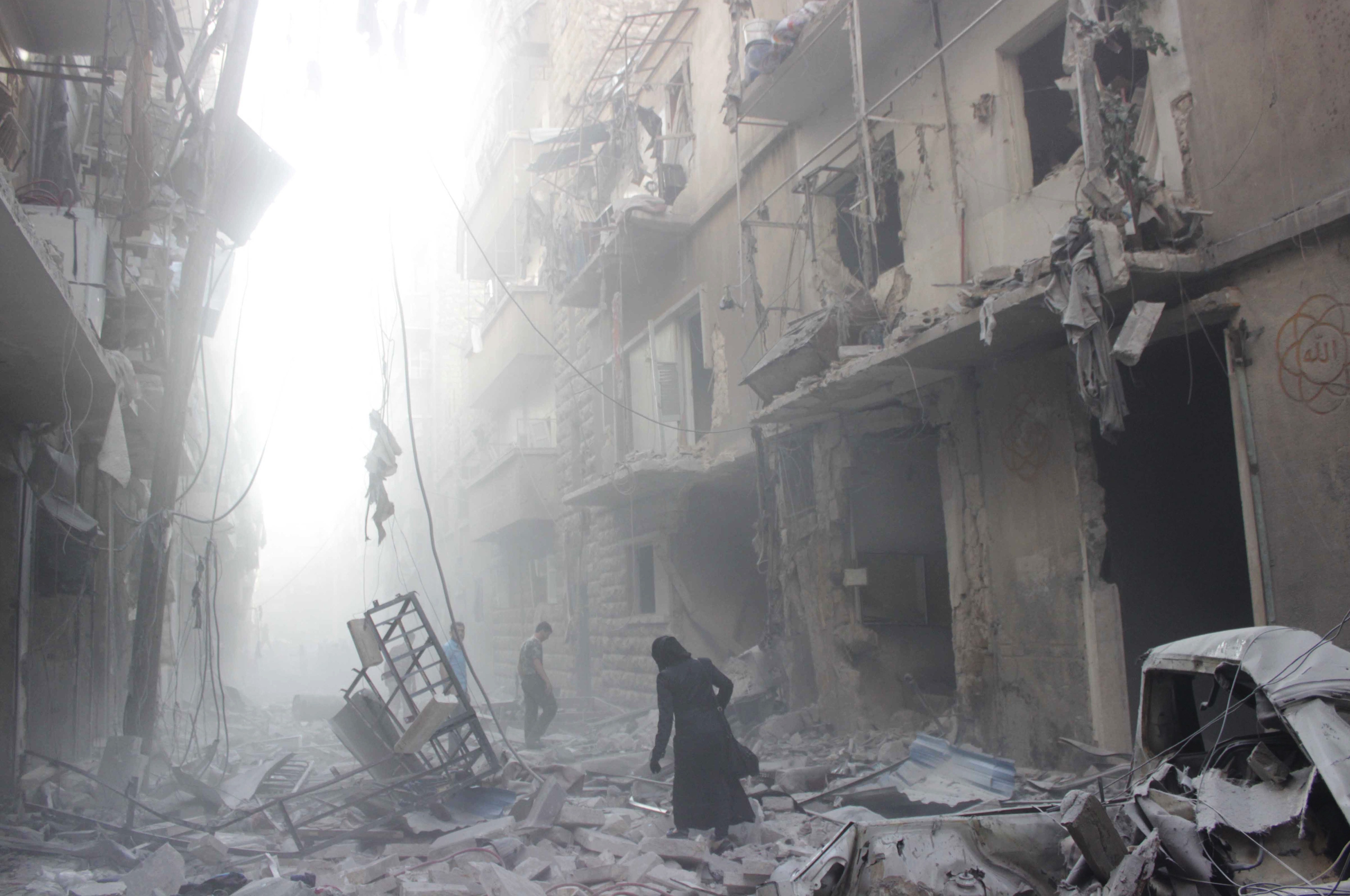
(Photo: A Syrian woman makes her way through debris following a air strike by government forces in the northern city of Aleppo on July 15, 2014. By Karam Al-Masri/AFP/Getty Images.)

Haters Be Calling This War A “War”

How dare we. State Department spokeswoman Marie Harf tries to spin how dropping bombs on two countries to destroy an entity that has yet to attack the US doesn’t count as a preemptive war:

Allahpundit watches the clip:

Preventing a dangerous enemy from hitting the U.S. by hitting him first sounds pretty preemptive-y to me. If I understand her correctly, the reason this isn’t preemptive war a la Bush is because it isn’t war, period. A war is something you engage in against a nation-state; we don’t recognize ISIS’s caliphate, ergo, they’re just a bunch of terrorists and preemptive war against terrorists is simply counterterrorism. I think that’s why you’re seeing such a moronic sustained effort today among White House mouthpieces to avoid using terms like “war” and “victory,” with Harf refusing even to accept “war on terrorism” as a label at the beginning of the video [above]. (Obama himself never once described the new “effort” against ISIS as a “war” [Wednesday] night, by the way.) The parallels here to 2003 — preempting a threat to the U.S. by overthrowing a brutal regime in the heart of Iraq — are too obvious and too politically uncomfortable to adopt Bush-era terms like “war” and “preemption” too. And of course, the more you talk about it as a new “war,” the more the public’s left wondering why an Article I declaration of war by Congress is unnecessary.

Asawin Suebsaeng catches John Kerry making the same claim:

“If somebody wants to think about it as being a war with [ISIS], they can do so, but the fact is that it’s a major counterterrorism operation that will have many different moving parts,” Kerry said Thursday on CNN. “I don’t think people need to get into war fever on this,” he told CBS News’ Margaret Brennan. … It is true that this latest round of airstrikes and other actions against ISIS is not a war in the classic sense. It isn’t as flashy or big-budgeted as past wars, and significantly fewer boots are on the ground. It is not a war in the sense that war has not been declared, but by that standard, the one that Kerry fought in (that disastrous one that served as the basis of three Oliver Stone movies) wasn’t a war, either.

Froomkin interprets the attitude Obama projected in his Wednesday night address:

This was not going to be a huge deal, he indicated. He called it an “effort,” not a war, and stressed that “this effort will be different from the wars in Iraq and Afghanistan. It will not involve American combat troops fighting on foreign soil.” There was no talk of shock and awe; what Obama had in mind was a ”counterterrorism campaign” that “will be waged through a steady, relentless effort.” And Obama’s lack of any specificity regarding the scale of the effort, the timing, goals for partner participation, or any kind of metrics for success was either cover for him not really having a viable plan — or a brilliant rhetorical strategy to keep open the option of ratcheting everything back once the hysteria passes. Or both.

Mary Ellen O’Connell underlines that in international law, the kind of preemptive defensive operation the Obama administration envisions is still illegal:

Late last month, Yale law professor Harold Koh, the former legal adviser in Obama’s State Department, asserted that the United States had the right to attack ISIL under international law to “to avert humanitarian disaster and to protect U.S. nationals and vital interests.” But international law is clear: The right to use force in self-defense arises following a significant armed attack against a country when more such attacks are likely. The use of force in self-defense must target the territory of the state responsible for those attacks. The United States has faced only one such situation under current law: It occurred on Sept. 11, 2001, and led to the war against Afghanistan, which gave safe haven to Osama bin Laden and the al Qaeda forces that orchestrated and carried out the 9/11 attacks. There simply is no right under international law to resort to major military force to avert humanitarian disasters or to protect nationals or “interests.”

Indeed, the administration is trying to claim authority for this operation under the 2001 AUMF that opened the way for the war in Afghanistan. That’s transparently illegal too, but Massimo Calabresi doubts that will make a difference:

If Obama is breaking the law, don’t expect much to come of it in the short term. The consequences of Obama’s legal interpretation, beyond his own discomfort, are not likely very great. The Bush administration showed the bar for legally constraining presidential counterterrorist actions is high, and even when it is surmounted there are little or no penalties. Politically, the president has nothing to fear: no matter how angry they are about the new effort against ISIS, the left wing of Obama’s party isn’t going to impeach him, and the right won’t either, at least not for going after Islamic extremists. In the long term, perhaps Obama’s legal legerdemain will boost those who want to come up with new, clearer legal frameworks for international counterterrorism operations. But for now Obama, like Bush before him, seems determined to act without them.

And that scares the crap out of Jonathan Hafetz:

Going to war against ISIL through the rubric of the AUMF has significant implications. Among them is the deterioration of the levers of democratic accountability for waging armed conflict in an age of global terrorism. It suggests not only the relative ease with which the United States will go to war, but also the way in which new military actions are subsumed under a more generalized war against extremist groups. War is becoming increasingly open-ended, while also more able to avoid democratic checks, as each successive military operation gets subsumed within an existing–and ever growing–conflict. War doesn’t end; it just expands, all without the friction that the separation of powers is designed to provide.