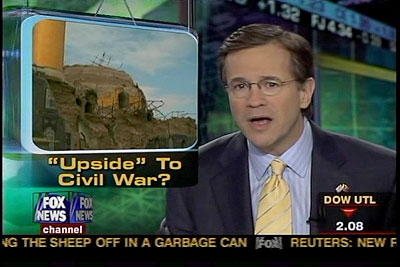
I’ve been wondering that myself with respect to the Samarra mosque. A blogger remembers a previous Mosque attack with Iranian intelligence connections.
Month: February 2006
Quote for the Day
"One can’t doubt that the American objective in Iraq has failed," – William F. Buckley Jr. I’m still not so sure. But I await the denunciation of Bill Buckley as a liberal.
Picture of the Week
Iraq, Saudi Arabia, Oil
A reader, who has long been a very acute observer of world markets, sees a looming spike in oil prices that make our current troubles seem mild:
"When a successful attack is mounted on Saudi oil fields, there is no telling where the price of oil might end up, but at a minimum, the premium which has been built in to oil prices from the risk of supply interruptions, is likely to rise.
I am sending this to you as I read the newspaper reports are of an attack on the Abaqiq oil refinery in Saudi Arabia. This will not be the last attack. The Eastern province of Saudi Arabia is a Shia hotbed. Given the events in Iraq in recent days which were directed at Shia, the timing of this attack is important. Whether the Saudi security forces were able to foil this attack or not almost does not matter. If we have learned anything from what has happened in Iraq, it is that there is no shortage of suicide bombers, no end to their ingenuity and they are tenacious in achieving their objective. When suicide bombers start targeting Saudi energy infrastructure we assume there will be more attacks. My feeling is this is not in oil’s pricing structure given the immediate jump in oil prices which took place on the news. I also think it is something else to consider when assessing the aftermath of the bombing of the Golden Shrine in Iraq. The price target I have for oil later this year is $85-$95."
We have to consider the possibility that Iraq’s already depressed oil production may be halted by civil war in the near future.
Summers’ End
Peter Berkowitz blames the Harvard president’s refusal to stand up resolutely enough for free speech, including his own. He was cashiered because he was too apologetic. Appeasement never works. They get you in the end.
Robbie George and Murder
Not a kind piece on theocon Princeton professor, Robert P. George, by Max Blumenthal. And, judging from his writing, Blumenthal’s ideological and partisan extremism is even more intense than his father’s. But I was struck by this quote from George about the killing of abortionists. It was the first time I’d read it:
"I am personally opposed to killing abortionists. However, inasmuch as my personal opposition to this practice is rooted in a sectarian (Catholic) religious belief in the sanctity of human life, I am unwilling to impose it on others who may, as a matter of conscience, take a different view."
George is being funny, of course. But he sees no moral difference between an abortion and the murder of an abortionist. Both are murders of fully-formed human beings, in his view. Check out this full symposium for a glimpse into the theocon soul about domestic terrorism and murder. Most contributors to the symposium condemn all abortion killers unequivocally. George, in contrast, decides to take a cleverer approach. Hadley Arkes argues that the theocons need to develop a Straussian discourse that allows them to say they are against murder in public, while writing something so subtle and esoteric that real intellectuals will understand the truth. Money quote:
"This is one of those melancholy cases in which we would need the equivalent of a Leo Strauss emergency box: break the glass, pull the lever, and quickly summon to our side a writer schooled in the art of covert teaching or ‘writing between the lines.’ … Would the media, for instance, have been filled as they have in this case with reports of ‘religious zealots’ if a band of Jews had killed guards and executioners on their way to work in Auschwitz? Would we have heard stories of the killing of innocent workers, who were merely carrying out orders, and pursuing a policy that was fully ‘lawful’ under the laws of the Third Reich?"
I.e.: bang, bang, you’re dead. These two people are among the closest advisers of our current president on ethical and moral issues.
Clinton and the Cartoons
If you thought Bill Clinton’s initial response to the Danish cartoon furore was appalling, this story will only make you feel worse. I can’t believe the former president actually urged legal action against Jyllands-Posten. Did he? Or is this wishful thinking on the part of the Pakistani media?
Shiites vs. Zalmay
Another ominous development in Iraq. Sadr is calling for calm. We still don’t know who bombed the Samarra mosque.

The Danes Notice
Reports of our modest solidarity vigil outside the Danish embassy are already showing up in Denmark. My own photos from the event can be found below.
Quote for the Day
"Iraqi police today found at least 29 bodies scattered in Baghdad. Each corpse was handcuffed and had single gunshots to the head, in the style often attributed to Shiite death squads believed attached to the Ministry of Interior," – from the L.A. Times.
 The Dish