Read this fascinating and revealing interview with Kanan Makiya, who saw the decision-making process of the war against Saddam close up. His view of the Bush administration is that, while many in it had good intentions, the president never reconciled the warring parties within his own government, and Condi Rice at the NSC never forced a unified policy between the White House, the State Department, the Pentagon or the CIA. The result was the "unbelievable mess" we are still struggling to recover from. Money quote:
"You either do an occupation and you do it well, or you don’t do it in the first place. But you don’t do it in a half-assed way, with inadequate troop levels to boot!
The United States government never deployed enough troops. It opted for an occupation but didn’t provide the wherewithal to do the job properly. Here again is this tension between the Pentagon and the Department of State. State wants an occupation, but Rumsfeld ‚Äî who has theories about how to conduct warfare in the modern age with less and less troops ‚Äî never wanted an occupation. In fact, he may never even have been for Iraqi democratisation. He was just an in-and-out kind of a guy. It was the other people within the defence department, in particularly the really extraordinary figure of Paul Wolfowitz, who argued the political case for democracy."
But Rumsfeld trumped Wolfowitz. My own view is that Cheney and Rumsfeld had and still have no interest in democratization, and have been "to-hell-with-them hawks" from Day One. But the real responsibility lies with the president who, as Makiya points out, seemed unable to lead decisively. Makiya is admirably frank about his own mistakes as well – particularly his misreading of the state of the Iraqi army in the last days of Saddam, which, by the time of invasion, had already basically disintegrated. But that new insight leads us to a better understanding of the last three years, and where we are now:
"When the war came the army did not fight. There was no Iraqi defeat in 2003 in the sense there was a defeat of the Nazis or the Japanese armies in World War Two. The army just disintegrated. There was no war of liberation in that sense. Our liberation and our civil war are occurring now, simultaneously, so to speak."
There is still hope. Illusions have been shattered by reality, but that in itself is a ground for renewal. I think we’re doing about as well now as we can be, thanks to Khalilzad, peace be upon him. I believe we need to stay longer and not withdraw in any significant degree until we have given the nascent Iraqi state a chance to live and breathe. Iraqis will have to do the rest. And Makiya has exactly the right message for them:
"A great deal of politics, not only in Iraq but the Middle East as a whole, and across the left for that matter, is about elevating victimhood. This is a legacy we have to overcome.
Think of the Palestinians. They have done this to excess, to the point of self-destruction, so many times. Their rhetoric rests on the fact that they were victimised. It is a fact they were victimised, but it isn’t enough to be political on that basis. You have to go beyond victimhood. People cannot bow and genuflect before you solely because you are a victim. You have to lift yourself up by your own bootstraps and not be a victim. Don’t think like a victim even if you are one."
And so we await the Iraqi Mandela. And pray.
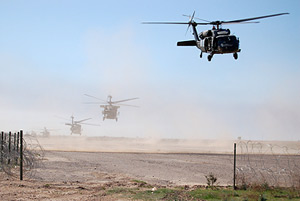
(Photo: Lyle Grose/101st Brigade/Getty.)
 The Dish