According to this Pew poll, Americans favor torturing detainees in some circumstances by a wide margin. There’s a reason John Kerry didn’t bring it up in the debates. And there’s a reason Cheney and Rumsfeld know they can continue the practice: they have widespread public support. Most disturbing to me are the high numbers of self-decribed Christians favoring torture: only 26 percent of Catholics oppose it in all circumstances, while only 31 percent of white Protestants rule it out entirely. If you combine those Christians who think torture is either never or only rarely acceptable, you have 42 percent of Catholics and 49 percent of white Protestants. The comparable statistic of those who are decribed as "secular," which I presume means agnostic or atheist, is 57 percent opposition. In other words, if you are an American Christian, you are more likely to support torture than if you are an atheist or agnostic. Christians for torture: it’s a new constituency. Another part of the Bush legacy.
Month: March 2006
Malkin Award Nominee
"One doesn’t want to be accused of inhuman callousness; but I am willing to confess, and believe I speak for a lot of ["To-Hell-With-Them-Hawks"] (and a lot of other Americans, too) that the spectacle of Middle Eastern Muslims slaughtering each other is one that I find I can contemplate with calm composure," – John Derbyshire, National Review.
Quote for the Day

"My mum wrote me a letter the other day and she said, ‘Son,’ – she’s 86 years old – she said, ‘Son, please don’t become a Democrat’.
And I told my mum, I called her and I said: ‘Mum, you know what? I want my party back. I don’t want to become a Democrat. I want my party back.’
The Republican Party that I knew, that I grew up in, a moderate party, a party that believed in fiscal discipline, a party that believed in small government, a party that had genuine conservative values. This is not a conservative leadership. This is radical leadership. I called them neo-Jacobins. They are radical. They’re not conservative. They’ve stolen my party and I would like my party back," – Larry Wilkerson, Colin Powell’s former chief aide.
Vive la Resistance!
The Mystery of Isaac Hayes
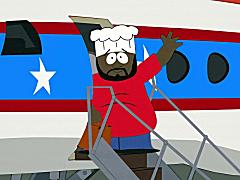
Chef’s back! But only as an image in tonight’s episode. And there’s something very strange about the slowly unfolding saga of Isaac Hayes and South Park. It’s worth recounting the chronology again, just from the public record. The Scientology episode, "Trapped in the Closet" ran November 16, last year. On December 7, the "Bloody Mary" episode aired. On January 4, Hayes gave the following interview to the Onion:
"AVC: There’s some pretty harsh satire on South Park. They don’t really care who they offend.
IH: But that’s their thing! Their success was built on that cutting-edge stuff. I’ve had to defend them a lot of times. One time on BET Tonight I defended them because Tavis Smiley, the host on that show, was coming at me. It was a call-in show, too, so people were calling in. I told them not to take this stuff seriously. If you do, you’ll get in trouble. Just enjoy it. Remember your high-school yearbook? You look at those pictures now, you laugh, right? That’s what South Park is. You got to laugh at it. Because we cursed, but we just didn’t dare let the principals, the teachers, or the preachers hear it. And we didn’t turn out bad, okay? Just look at it that way. Also, usually there’s some kind of moral message at the end for the kids, by the Chef.
AVC: They did just do an episode that made fun of your religion, Scientology. Did that bother you?
IH: Well, I talked to Matt and Trey about that. They didn’t let me know until it was done. I said, "Guys, you have it all wrong. We’re not like that. I know that’s your thing, but get your information correct, because somebody might believe that shit, you know?" But I understand what they’re doing. I told them to take a couple of Scientology courses, and understand what we do. [Laughs.]"
That sounds pretty grown-up and easy-going, and like the normal Isaac Hayes, no? But on January 18, Hayes is admitted to "an undisclosed Memphis hospital" for "exhaustion." On March 18, he resigns from the show, citing its "bigotry." That’s a major change of tune from his Onion interview, which was conducted after the "Bloody Mary" episode as well. What happened to change his mind so drastically? Then we have this Fox News story by Roger Friedman:
"I can tell you that Hayes is in no position to have quit anything. Contrary to news reports, the great writer, singer and musician suffered a stroke on Jan. 17. At the time it was said that he was hospitalized and suffering from exhaustion.
It’s also absolutely ridiculous to think that Hayes, who loved playing Chef on "South Park," would suddenly turn against the show because they were poking fun at Scientology. Last November, when the "Trapped in a Closet" episode of the comedy aired, I saw Hayes and spent time with him in Memphis for the annual Blues Ball.
If he hated the show so much, I doubt he would have performed his trademark hit song from the show, “Chocolate Salty Balls.” He tossed the song into the middle of one of his less salacious hits and got the whole audience in the Memphis Pyramid to sing along."
Something doesn’t add up here.
Drum, Yglesias, Krugman
A reader writes:
"I hate to sound like I’m degenerating into ad hominem, but Kevin Drum seems to lack a basic understanding of the federal budget. You are absolutely right to slam him for taking entitlements off the table. But there’s more direct dishonesty in the way he treats your proposals.
For starters, you need to call him out on the idea that Medicare pays for itself. That’s simply not true. Not even close. The lion’s share of Medicare – and I’m talking 2006 when the prescription drug bill hasn’t even come online – is subsidized by general revenues, not the HI payroll tax. Second, crediting you with $0 on corporate welfare is brutally dishonest. Yes, there’s corporate welfare on the tax side, but there’s also about $100 billion on the spending side: everything from the Export-Import Bank to the Advanced Technology Program to the Manufacturing Extension Partnership to the "Byrd Amendment" to Oil & Gas R&D Program and literally scores of other corporate subsidies not done through the tax code."
I think Kevin may have misunderstood my first post because of my own loose language. But I do see something at work here. It’s very important for some on the liberal-left to tar all conservatives with the Bush brush. His embrace of spending gobs and gobs of other people’s money is what some on the left have always wanted. Bush has already conceded their basic point: "when someone hurts, government has got to move." All they need to do now is to raise taxes and then fix the Medicare plan to screw the drug companies and bingo! As I’ve said now for years, the only real fiscal difference between Bush Republicans and Kennedy Democrats is the difference between Big Insolvent Governent and Big Solvent Government.
But many left-liberals don’t want this analysis to sink in with centrists, principled Republicans or fiscally conservative Democrats. So their preemptive move is to discredit the real conservatives who would actually like to restrain spending, rein in entitlements and keep much of the tax cuts (while reforming the tax code to eliminate the myriad deductions). So they have to insist that people like me and Bruce Bartlett are dishonest or have supported the Bush program all along, even when they know full well we haven’t. This is the Krugman line as well. The aim is to discredit conservatism as a whole for a generation. Bush has done much of their heavy lifting for them. But they still need to discredit the handful of die-hard fiscal conservatives left.
A Turning Tide?
A big victory for conservatives over Christianism in New Hampshire.
Bush and Christianism
There’s an engrossing discussion of Kevin Phillips’ new book over at TPM Cafe. I found this comment by Phillips interesting:
"When Bush was at the City Club in Cleveland on Monday, someone in the audience cited my book and asked whether Bush would comment on how he felt about the relevance of the Apocalypse to the current-day Mideast. He spent five minutes evading the issue and the word. He has to. If he has to talk about these things, he’ll lose a lot of people, and if he ducks, true-believers may start to wonder."
One of the great failings of the MSM is that they simply do not understand the religious and theological underpinnings of the Rove Republican party. Some are beginning to catch on; but a lot of it has to do with a lack of religious or theological training and expertise among many journalists. Even those of us who do have a background in theology can miss a lot. As a Catholic, I’ve had to do a lot of reading on American evangelical Protestantism to get even a rough grasp of what it’s about. Even now, I miss many nuances, I’m sure. But reporters don’t have to know everything; they just need to ask questions. Why doesn’t someone ask Bush whether he believes in the Rapture or what he thinks of the "Left Behind" series? Why not ask him how his Christianity is reconciled with his own administration’s embrace of "water-boarding" as a "coercive interrogation technique"? Many in the MSM are biased liberals; many do their job well; but many more simply don’t have the background to ask the right religious questions. It’s homework time.
Looking for the Bright Side in Iraq
That was what ABC News’ Jake Tapper tried to do. And then tragedy struck. This is gripping footage.
(Bad link now fixed. Sorry.)
What You’d Cut
A reader makes one early suggestion:
You made a good start, and I applaud your efforts. Another area where I think major savings could be made is in the area of health care. Indeed, the available evidence suggests that if the United States were to replace its current complex mix of health insurance systems with standardised, universal coverage, the savings would be so large that we could cover all those currently uninsured, yet end up spending less overall. That’s what happened in Taiwan, which adopted a single-payer system in 1995: the percentage of the population with health insurance soared from 57 per cent to 97 per cent, yet health care costs actually grew more slowly than one would have predicted from trends before the change in system.
That would also help us to deal with the pain of the other middle class entitlement cuts which are bound to come.
I’ve long feared universal health care but there are good and bad ways to do it. I’m certainly open to the idea that we may be reaching a point at which the inefficiencies of our current system may require cutting the Gordian knot. Mitt Romney’s idea of mandatory insurance, subsidized by government, is interesting. I’d like to sever the link between employment and health insurance. But I don’t want to go to a British-style system. Trust me, I experienced it.
Kevin Changes The Subject
I’m trying to absorb this post from Kevin Drum, and this rather nasty accusation from Yglesias. In order to right our fiscal mess, I proposed means-testing social security, scrapping the Medicare prescription drug entitlement, extending the retirement age, and so on. Drum then makes the point that he’s talking about actual government programs, i.e. discretionary spending, not entitlements. So he claims that the government will save nowhere near enough by my proposals. And, in that respect, he’s right. But he wants to set the ground-rules by eliminating from any consideration by far the largest bulk of our unfunded liabilities! No fair. If entitlements are sacrosanct, of course you’re going to have to raise income taxes or payroll taxes, by a whopping amount. And I’m sure Drum and Yglesias and others cannot wait to do so in some form or other.
My whole point is to put middle-class entitlements on the table and to cut them substantially. Even though you may disagree with it, that’s not a free lunch, and it’s deeply unfair to claim it is. It’s also designed to protect the really needy. It’s interesting, though, that the big government left is so hostile to small government conservatives. It’s as if they really don’t believe we exist or are sincere. But we do and we are. We have yet to see what an honest direct attempt to argue for real entitlement cuts would do to our current political debate, because almost no politicians are ballsy enough to propose them. My hunch is that the American people would be prepared to make serious cuts in middle-class entitlements to save our fiscal standing. At some point, of course, they’ll have no choice. Responsible conservatives will tell them that now. Or raise their taxes. Which is it going to be?
Update: In Kevin’s defense, we may be writing past each other. In my original post, I wrote about balancing budgets. What I meant was addressing our underlying fiscal imbalance; not balancing the budget for the next fiscal year now. My original term was perhaps too vague and subject to misunderstanding. But I hope it’s clear what I meant now. And I’m certainly not trying to be dishonest. Au contraire. I’m trying to keep conservatives honest about what keeping the tax cuts would realistically require.
 The Dish