Here’s a thought. I have plenty of conservative readers who are disgusted with the current GOP spending binge. Some in the blogosphere have launched a perfectly admirable anti-pork campaign. But we all know that’s peanuts. I’ve laid out a rough and ready spectrum of cuts I’d be happy to make to get us to long term balanced budgets. I’ve linked to an expert study. But what would you be happy to give up? Do you have some bright, new ideas to save money? Which entitlement programs would you slash? Email them to me with the content line "What I’d Cut" and I’ll happily post the most trenchant or interesting. It behooves those of us who still count ourselves as small-government conservatives to make the case. God knows most Republicans won’t.
Month: March 2006
Accounting
Glenn Reynolds endures the same pounding that I’ve been getting.
The Ambien Administration
My most recent Sunday Times column is now available, as in olden times, in a little box down on the right, called "Latest Essays."
Bush Better Than Lincoln?

A reader channels Victor Davis Hanson:
"I believe that if you compare the conduct of the Iraq war by the Bush administration with the record of Lincoln during the Civil War and Roosevelt during World War 2, the record will show that Bush is doing a better job than either Lincoln or Roosevelt.
Check out ‘Battle Cry of Freedom’ by James McPherson, a history of the Civil War era. Lincoln faced continuous vilification by the Democrats and did not think until late in the campaign that he would win re-election. The Union military during the Civil War lost dozens of major battles and suffered hundreds of thousands of casualties due to incompetence and bad decisions going all the way up the chain of command to Lincoln. Reading ‘Battle Cry of Freedom,’ you realize nothing ever changes, and that Bush is doing better than Lincoln when the two are compared. The confederate raiders like Quantrill were as bad or worse than the insurgents operating today, and Lincoln‚Äôs suddenly changing the reason for going to war, from saving the union to freeing the slaves, was as controversial and criticized as the decisions made by Bush. The critics in 1862-1864 ridiculed the idea that slaves could be made free men, even as critics today ridicule the idea that Arabs can have a modern democratic government.
Ku Klux Klan terrorists were active in the post Civil War south to such a large extent that President Grant, 1869-1877 kept large numbers of federal troops in the South and needed to conduct fairly large military campaigns against the Klan. When President Rutherford Hayes withdrew federal troops from the South as part of his deal with the southern states to win the presidency, the KKK was able to terrorize and keep black Americans deprived of their civil rights until the 1960s. Even though the remnants of the confederacy were still fighting 100 years after the civil war, Lincoln is not regarded as incompetent for failing to prevent the depradations committed by the KKK.
In World War II, the US marine corps suffered major casualties at Iwo Jima and Tarawa because of bad planning and leadership, on even simple matters of sending in reinforcements and pre-landing bombardment. Hundreds of army soldiers drowned in a D-day practice landing because their backpacks were too heavy. The Army suffered heavy casualties at Omaha beach on D-day because it was not scouted properly. The Army was undermanned at the battle of the Ardennes in 1944 because the USA deployed 100 fewer divisions than the planners said was necessary. The lines were stretched so thin because of the shortage of infantry that the Germans successfully broke thru during their 1944 winter offensive, Bradley and Montgomery gambled that the germans would not attack in the Ardennes sector.
When the Soviet Union occupied Eastern Europe after WW II, Roosevelt (and Truman) were blamed for awhile for not preventing this in the aftermath of the war. In addition, communist governments took over in China, North Vietnam, and North Korea, as a result of the destruction of pre-existing dictatorships in Japan and Germany. Even though Roosevelt failed to plan against the communist takeovers in Eastern Europe, China, Korea, and Vietnam, he is not considered incompetent.
I would argue that by any fair, realistic comparison with past wars, the Bush administration has run the Iraq war with a minimum of American military and Iraq civilian casualties, and has accomplished as much as Lincoln or Roosevelt accomplished in their wars. The news media of the time never complained about America firebombing Japanese and German civilian populations."
(Photo: David Burnett for Time.)
Fire Rumsfeld
John Tierney has an excellent (TimesDelete) piece in the NYT today on the inexcusably negligent post-war planning for the Iraq occupation. Money quote:
"Two months before the Iraq war began, David Kay reported to the Pentagon for a job in the agency being formed to run postwar Iraq. Kay, a former Defense Department scientist and weapons inspector in Iraq, was supposed to oversee the police.
He assumed this meant preparing for the looting and crime to be expected when any regime collapsed. But those problems didn’t seem to be on anyone else’s mind, he told me, recalling his first day on the job.
‘I said our first priority should be to establish order quickly, but that was considered a peripheral issue,’ he said. ‘The attitude was that it’s not a problem, and if something happens the military will deal with it. I had one of the worst feelings ever in my gut, that this was going over a cliff.’"
Kay was one of many who urged some kind of force to prevent the rampant "industrial strength" looting (I’m using Bremer’s words from his book) that continued long after the initial invasion. The looting included arms sites, and weapons that were subsequently used to kill Americn troops and innocent Iraqis. People urged a police effort long before the war, immediately before the war, and they urged it immediately thereafter. In the ensuing anarchy, they kept asking and asking. And Rumsfeld’s response was: "stuff happens." How are any of us supposed to have confidence in recallibrating this war when we have this buffoon still running it? The president keeps making speeches about how he is adapting to make progress on the ground. No doubt, some fine people are indeed making progress and they merit our firm support. But nothing the president can say in trying to restore confidence in this effort would be as effective as getting rid of the obstinate, arrogant incompetent who has brought us this "unbelievable mess". Fire Rumsfeld now.
Three Years On
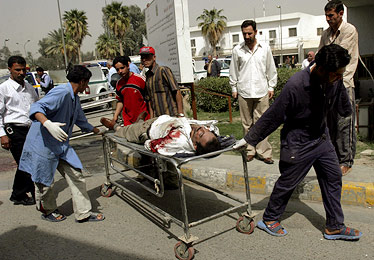
I’m just back from a panel discussion at Columbia on the Iraq war. I was out-classed by my fellows: Victor Davis Hanson, Ken Pollack, Joe Klein and Noah Feldman. The crowd was large but not too hostile. The general atmosphere was one of intense sadness at so much incompetence after so much potential. I learned a few things. I was not as aware as I should have been about how much Iran now controls the Ministry of Interior in Iraq; which makes dealing with them all the more necessary. Noah, Ken and I remain at some level befuddled by what can only be called the irrationality of the Bush administration’s policies. I’m still amazed that, according to Joe, there are six times as many analysts devoted to China in the D.I.A. as devoted to Iraq. I’m still staggered that, despite insistence from Bush appointees on the ground, the administration refused to provide more troops when they were desperately needed. I still find baffling the enormous gap between the stakes the president enunciated and the casual, on-the-fly, on-the-cheap way in which this war was waged. I can see why it might provoke conspiracy theories and paranoia. I have come to the provisional conclusion that it is a function of the president himself. He is interested in the grand idea but utterly bored by its execution. He is also incapable of good management. The more you read about the screwing up of Iraq, the more you see that a lot of it was due to internal administration squabbles that the president was unwilling or too personally uncomfortable to resolve. He seems terribly awkward in the face of complexity and difficulty, of grappling with his own errors, as if he can simply will them away, rather than actually grapple with them.
I found out that John Kerry focus-grouped the question of whether he should bring up Bush’s legalization of torture in the presidential debates. I discovered (and should have known) that VDH opposes torture and supported the McCain Amendment. Feldman believes that the law itself was riddled with loopholes. VDH still won’t criticize this administration. His response to every factual elaboration of staggering ineptitude is to point to other wars and larger errors. At this point, the only thing defenders of Rumsfeld can do is direct attention elsewhere or sigh and hope that in the long view, everything will turn out okay. Maybe they will. But it seems to me that the American public is rightly losing patience with this crew – and that itself will affect the war. Patience is essential to pulling through. But is it at all reasonable to expect the American public to be patient with an arrogant, dismissive incompetent like Rumsfeld? There are limits to what human nature can accomplish. If the president wants the country to hang in there, he needs to replace his defense secretary – preferably with a tough-minded Democrat. If Iraq needs a national unity government to get through the next three years, then America needs a least a little bit of one itself. Over to you, Mr Bush. Are you serious about winning this war? Or are you still winging it?
(Photo: Samir Mizban/AP)
The Case Against Ehrman
Here’s an interesting critique of "Misquoting Jesus."
We can Do It!
How to keep the tax cuts and reduce government to match ’em. Well, it’s much more specific than my wish list.
The Pleasure Police
They’re on the march. In Georgia, there’s a bid to ban the sale of anything that even tastes like marijuana. I’m not talking about candy that actually gets you high. I’m talking about candy that has no THC but merely tastes like pot:
"This dope candy, I believe, is a gateway product to other drugs," said Fort, who has spearheaded the effort to have it outlawed in Georgia. If Fort’s bill were to become law, selling the marijuana-flavored candy would be a misdemeanor on the first offense. A second offense would be a felony punishable by up to five years in prison – which is comparable to the punishment for selling real marijuana.
These puritans are out of their tiny minds. But you knew that already, didn’t you?
(Hat tip: Demmons.)
What I’d Cut
Kevin Drum has challenged me to detail how I’d balance budgets while keeping Bush’s tax cuts. (A small clarification: I’d keep the estate tax as it once was; and I’d add a buck to the gas tax pronto.) I’d prefer experts like Brian Riedl or Veronique de Rugy to propose detailed cuts. But my back-of-the-envelope wish-list is that I’d repeal the Medicare drug entitlement, abolish ear-marks, institute a line-item veto, pass a balanced budget amendment, means-test social security benefits, index them to prices rather than wages, extend the retirement age to 72 (and have it regularly extended as life-spans lengthen), abolish agricultural subsidies, end corporate welfare, legalize marijuana and tax it, and eliminate all tax loopholes and deductions, including the mortgage deduction, (I’d keep the charitable deduction). For good measure, I’d get rid of the NEA and the Education Department. I’m not an economist, so I do not know whether this would do the trick entirely, and I’m open to debate on any of the particulars. But you get my drift. Maybe someone out there could do the math. I’m also fascinated by Charles Murray’s new proposal to abolish the entire welfare state and replace it with with cash grants to individuals. I look forward to conservatives continuing to insist I’m a lefty. I also look forward to ferocious opposition from the left. But the bottom line is that the middle class and the prosperous elderly are far too pampered by government in this country. They need to get rid of their debilitating and unaffordable dependency.
 The Dish