Evangelicals and St Patrick

Stpatsm

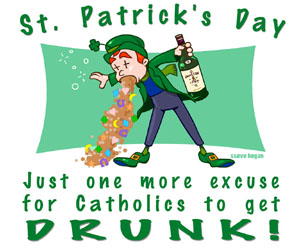
Some true believers are aware of the Satanic evil behind today’s festivities:

"Right at this very moment, the Pope is instructing his new cardinals, all wearing dresses the color of Satan’s rump, to open the lower dungeons of the Vatican and let loose their annual storehouse of malignant leprechaun spirits to steal gold from wealthy, blessed Evangelicals and spread green leprosy into the homes and upholstery of True Christians.
As always, Landover Baptist is well prepared for the demonic onslaught this year. "Saint Patrick’s Day is like green beer – something the Lord never intended," says Pastor Deacon Fred."

Yes, I know it’s a parody. Buy your Protestant merchandise here.

Matt and Trey Fight Back

Yep, I can now confirm that Viacom and Comedy Central caved in to the Scientologists and Tom Cruise, but the South Park team are unrepentant. Here’s their official statement:

"912_1 So, Scientology, you may have won THIS battle, but the million-year war for earth has just begun! Temporarily anozinizing our episode will NOT stop us from keeping Thetans forever trapped in your pitiful man-bodies. Curses and drat! You have obstructed us for now, but your feeble bid to save humanity will fail!  Hail Xenu!!!

– Trey Parker and Matt Stone, servants of the dark lord Xenu."

As the alternative universe Cartman would say, "I love you guys!"

If you want to know the theological context for this statement, check out Wikipedia.

Ambivalence About Winning The War

A reader writes:

"There may well have been people on the ‘anti-Bush left’ who wanted the war to fail ‘solely to attack the president,’ as you suggest. However, let me offer another more nuanced view, giving myself as an example. I’ve never been a Bush supporter, and could easily be counted as ‘anti-Bush.’ But I’m not anti-Bush just for the thrill of it. I have what I believe to be good reasons, among them many that you yourself have noted over the course of the last couple of years.  What has scared and outraged me perhaps more than anything else about Bush is the extent to which he has followed a ‘narrative’ that is simply not supported by any empirical evidence and, more importantly, that he has apparently not been particularly interested in empirical evidence or expertise, period. It’s as if the discussion about the Iraq war, and how to wage it, has been a private conversation between Bush and his Maker (with Rumsfeld and Cheney chiming in).  I really don‚Äôt care what Bush’s religious beliefs are, as long as he doesn’t run the country and wage wars according to those beliefs alone, unencumbered by empirical facts or the opinions of experts. But that appears to be precisely what he’s done. 

Now, tens of thousands of deaths and billions of dollars later, Iraq is on the verge of civil war. And so, I’ve found myself actually ambivalent about how this war turns out. On the one hand, of course I want the United States to succeed. The potential consequences of losing the war in Iraq are horrendous. But on the other hand, I worry that if we finally do succeed in Iraq, Bush and his ‘base’ will conclude that, yes, if they just ‘listen to God,’ (and no one else), things will turn out just fine. And that conclusion, I fear, could be worse for this country than losing this war. I feel like I‚Äôm weighing two great potential catastrophes ‚Äì one, a failed state where Iraq used to be; and the other, a United States ‘cut loose’ from its traditional basis of rational assessment and empirical evidence, ‘guided’ by a president who thinks the rest of us should just ‘trust him,’ since God is whispering directly into his ear. I honestly don’t know which is the greater catastrophe. Hence the odd ambivalence about how the war ends."

This, I think, is the consequence of the Rovian conflation of politics and religion. It corrodes a democratic polity like acid. It turns patriots into people ambivalent about their country’s success. The great challenge for liberals but especially conservatives today is how we can best rescue our secular politics – and sincere faith – from the theocratic poison that has been opportunistically injected into both.

Email of the Day

A reader writes:

"With regard to your item on sexual orientation and security clearances, I too am troubled by the change in language. But I can see an innocuous explanation for this – maybe they thought the previous language was too restrictive in terms of allowing the government to disqualify people who engage in irresponsible sexual behavior (eg. cruising, going to bathhouses, or the like – straight people are also usually disqualified if they go to swingers’ clubs or engage in wife-swapping.) Whereas more responsible sexual behavior would seem to fall under the "strictly private, consensual, and discreet" banner.

Also, speaking from personal experience, I have several openly gay friends who hold high-level security clearances, including one who has the highest level of clearance and lives with his long-term partner. So far I haven’t heard anything about them losing clearance. But really the only way to calm the concerns about this is for the Administration to come out and say specifically what behavior is allowed and disallowed under the new regulation. And sadly, in the current political environment I can’t see the Administration making any public statement that even indirectly approves of homosexuality. So, unfortunately we’ll have to wait and see if they start turning away gays and lesbians for security clearances before making a final judgment."

Agreed. You can hope for the best. But vigilance is now more necessary than ever. I’m afraid I’ve given up hoping for decent treatment of homosexual citizens in this administration. How many other significant American minorities will the president of the United States never be seen addressing or even meeting? If you make a conservative estimate of 9 million gay Americans, isn’t it astonishing that the president has never been seen in a public event with any of them? And that no one in the administration has ever talked with a gay representative in public? This may not be because Bush is personally bigoted toward gay people. There’s evidence he isn’t. But even appearing with an openly gay person in public would prompt a small revolution in his base. And so gays are the only minority this administration treats as "untouchables." Policy is made with regard to us – like barring our relationships in the constitution – and it never even occurs to Karl Rove to consult with any gay people about it. We’re so used to this radical exclusion from our own president, regardless of whether we’re Republican or Democrat or other, that we don’t even notice it any more. But it is amazing when you think about it. And telling.

New Hope In Iraq?

David Ignatius sees glimmers that may merit cautious optimism. The prospect of civil war may have been the one indispensable goad to Iraq’s leaders to get serious about a national unity government. Money quote:

"One seeming obstacle to unity has been fear about the role of Iran. To finesse that issue, [Shiite leader Abdul Aziz] al-Hakim said he is urging Iran to talk with the United States about Iraq’s political future. Khalilzad himself has been quietly exploring what he calls the "modalities" for such U.S.-Iran talks on Iraq."

And then today, we find that some elements in Iran’s government have responded to Hakim’s invitation in a positive fashion. Scott McClellan has confirmed that Zalmay Khalilzad has been authorized to negotiate with Iran solely on the issue of Iraq. It is not in Iran’s interests to see Iraq descend into civil war, and for the conflict there to broaden into a regional Shiite-Sunni conflict. And so, as I put it the other day, "sometimes the darkest days are inevitable – even necessary – before the sky ultimately clears." Here’s hoping – but still not confidently expecting – that those skies may be clearing.

A New Old Feature

When I moved to Time.com, several of you asked for the return of that little box I used to have on my old site that listed my most recent articles, with links to read them. We’ve now added it to the new site, and it’s down there on the right, titled "Latest Essays". Thanks for the input. When I’m done with the book, we’ll be adding more new features. Feel free to suggest any.

That First Week

David Brooks has a great column today which is too important to be available for non-subscribers. He recounts how many distant pundits saw immediately the problems in the invasion almost as soon as it started. Rumsfeld and Franks didn’t, which is why, in Bush’s house of mirrors, one was given the Medal of Freedom and the other is still in office, refusing to concede any errors. The worries the rest of us had were specifically the insufficient troops and emerging guerrilla resistance in the first days of armed conflict on the ground. Since I’ve been beating myself up lately for getting things wrong before the war, I went back to my own archives to see what I was thinking in March 2003. I was worried, but still gung-ho. The tone of my comments about the anti-war crowd is hubristic  and occasionally cringe-inducing, to be honest (although it remains a matter of historical fact that some on the anti-Bush left clearly wanted the war to fail solely to attack the president). Still, I was clearly rattled by the emerging reality, even from my distant perch, even in the first few days. Some money quotes:
March 24:

"The question, to my mind, is who these resisters really are. Senior Saddamites who know they could get killed when power shifts? Islamist terrorists? Opportunists? Regular soldiers? It’s extremely hard to tell; and it certainly helps reveal the difficulties ahead for governing a country where such units can melt away into residential neighborhoods.
Do we have enough troops in time for the final battle? Have we gone too fast too soon? Those seem reasonable concerns to me, although I’m not qualified to take a side in the argument. But it is not too unreasonable to worry that with one northern front denied us, we need overwhelming force to smash through to Baghdad quickly enough. Do we have enough? And do we have enough humanitarian follow-through available soon enough to build support in the South?"

A day later, my concerns were deepening:

"It seems to me that we may have under-estimated the psychological effect of president George H. W. Bush’s brutal betrayal of the Iraqi people in 1991, at the behest of the U.N. No wonder Iraqis are still skittish about Americans and fearful that this interlude may end. The allied strategy of simply skirting past major cities also means that Saddam’s henchmen may still be in control there, and so feelings are still deeply skeptical, mixed or shrouded. I also think that we hawks might have under-estimated the Iraqis’ sense of national violation at being invaded – despite their hatred of Saddam."

Two days later, I was still fretting, while providing material on the other side of the argument:
March 26:

"The Shi’a population in the South is still not sure of an allied victory. It seems we under-estimated their skittishness about an allied war – due in large part to their understandably bitter feelings at being betrayed in 1991. If we had more overwhelming force in the region, that may have been less of a problem. But it appears we don’t, for reasons of logistics and Turks but also of war planning."

By March 27, I was beating myself up again:

"It may also be true that some of us have again under-estimated something: the power of a totalitarian cult over its enforcers. The guys fighting us are the equivalent of the SS. We’re invading a milder version of Nazi Germany – only after eleven years of relative peace. These guys have barely been softened up at all. Why did conservative hawks like me not believe our own rhetoric about the horrors of totalitarianism? The point about such systems, as Orwell showed, is not just their brittleness and evil, but their success in indoctrinating and marshalling the shock troops. I’m chagrined at my own optimism in this regard. I should not have been surprised by the ferocity of the elite’s defense of itself."

By March 31, I had come to the same conclusion that Francis Fukuyama was to assert three years later:

"The experience of the collapse of the Soviet Union perhaps lulled us into over-confidence."

The point is not to exonerate myself. I was too confident before the war, trusted the Bush amdinistration far too much and was too scornful of the opposition’s bias to hear some of their substantive arguments. But I was quickly adjusting to reality. The point is: if even I could see this, why couldn’t Rumsfeld or Bush? Or Franks?

Of course, there were some even more optimistic than the president or me. I wasn’t the person who declared: "This war is going to be over in a flash." That was Bill Clinton, the man whose formal 1998 policy of regime change in Iraq was finally being implemented.

Can Feingold and Kos Save Bush?

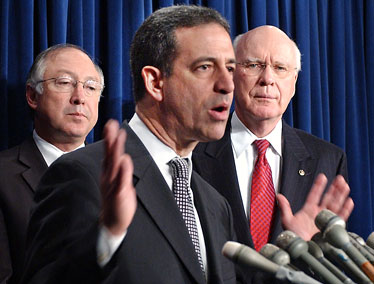
Feingold

One thing has struck me these past few years about the right in America. As it has slowly abandoned its own principles – limited government, individual freedom, balanced budgets, federalism – it has been forced to resort to three fundamental issues to keep itself alive. The first was the war on terror, the second fundamentalist Christianity, and the third, hatred of the left. The first has waned somewhat, not because we aren’t still at war and in great peril, but because it is manifestly obvious that this administration is stunningly incompetent in its execution of the war. There’s only so much you can do to defend it at this point. The evangelical base whose support for Bush is entirely for religious rather than political reasons – the theocratic heart of the GOP – will never stop believing, as long as the Supreme Leader refuses to show any doubt and keeps preventing vaccines from being developed, puts pro-lifers on the Court, and keeps up the pressure on gays. But the rest – and they’re critical – are motivated entirely by being anti-left.

The most depressing aspect of this was the vile "Swift Boat" attack on John Kerry in the last election campaign. But you only have to watch O’Reilly or read Powerline or listen to Sean Hannity or David Horowitz to know that the only thing that really gets them fired up any more is loathing of liberals. The only way the GOP base will be motivated to vote for an incompetent, exhausted, fiscally insane administration is if they get to vote against "libruls". Michael Moore, the Daily Kos, Paul Krugman, George Clooney, et al. are therefore the GOP’s last, best hope this fall. Feingold’s call for censuring the president is the best thing to happen to Bush for a long time. Hillary will help, whatever she actually does. The question is merely whether the anti-left card will work any more. It barely did the trick last time – in a buoyant economy, in wartime, against a candidate as pathetic as Kerry, Bush could have lost if a few thousand votes in Ohio hadn’t been beaten out of the anti-gay scrub. My gut predicts a huge swing against the GOP this fall. So watch out for the anti-left hate and hysteria from Republicans. It’s coming. It’s all they’ve got left.

(Photo: Dennis Cook/AP)