Two Iraq Realities

Life_in_baghdad_photo

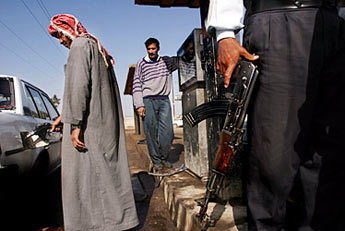
What is the real state of Iraq? Is it this rosy picture painted by Ralph Peters, who accuses Western journalists of lying? Or is it the experience of these actual Iraqis explaining their situation? Or some impenetrable mixture of the two? One quick comparison. Peters:

"’The electricity system is worse than before the war.’ Untrue again. The condition of the electric grid under the old regime was appalling. Yet, despite insurgent attacks, the newly revamped system produced 5,300 megawatts last summer–a full thousand megawatts more than the peak under Saddam Hussein. Shortages continue because demand soared–newly free Iraqis went on a buying spree, filling their homes with air conditioners, appliances and the new national symbol, the satellite dish. Nonetheless, satellite photos taken during the hours of darkness show Baghdad as bright as Damascus."

Here’s Time’s bureau manager, Ali al-Shaheen, on exactly the same point:

"My house is in what you might call a middle-class neighborhood in central Baghdad. I should start with the caveat that things there are better than in many other parts of the city – and the country.
But, we have state-supplied electricity six or seven hours a day. And this is actually an improvement! During the summer, we get three or four hours of electricity a day. Almost every house has a generator, running almost constantly. You can imagine the noise and pollution from thousands of generators – hundreds of thousands, if you count all of Baghdad.
Another problem is that all the generators run on gasoline, and prices have shot up. One litre of gasoline used to cost 20 Iraqi dinars before the fall of Saddam; now, it’s 250 dinars. Just as demand has soared, supplies have fallen, so you see long queues of people at gas stations. These are a favorite target for suicide bombers.
Before the war, we had 20 hours of electricity a day in Baghdad. Of course, other parts of the country were not so lucky; in some places, there was only 12 hours of electricity."

I link. You decide.

(Photo: Samantha Appleton/Aurora Photos.)

“Stuff Happens” Watch

Not long after defense secretary Donald Rumsfeld states unambiguously that U.S. forces will stand by if the nascent civil war in Iraq accelerates, we read this:

"On Monday, in Sadr City, the Shiite section in Baghdad where the terrorist suspects were executed, government forces vanished. The streets are ruled by aggressive teenagers with shiny soccer jerseys and machine guns.
They set up roadblocks and poke their heads into cars and detain whomever they want. Mosques blare warnings on loudspeakers for American troops to stay out. Increasingly, the Americans have been doing just that.
There seems to be no minimum age to join the action. A playful boy named Musa, who said he was 11 but looked about 8, was part of a 4-foot-tall militia struggling to drag chunks of concrete into the street to block cars on Monday.
"We’re guarding the road," Musa explained.
He was carrying a toy pistol. Some of the other boys had real ones."

I wonder if Rumsfeld has ever read Hobbes.

Fatigue

The Bushies are exhausted. I know it sounds like a cop-out for various offenses and screw-ups, but from seeing some of them close-up and hearing accounts from others, I have no doubt it’s true. These have been grueling years for any president’s administration. But Bush’s reluctance to fire anyone, and his discomfort going outside his familiar array of loyalists, is also part of the problem. I think it’s obvious the White House needs a major staff culling and influx of new blood. It’s also obvious that this president simply couldn’t handle the change. Or maybe I’ll be proven wrong. In that case, one small suggestion: can we please start with the defense secretary? Some of us would like to win this war.

“An Unbelievable Mess”

If you really want to know how the debacle of the Iraq invasion went awry, you can read this astonishing memo from John Sawers, Mr Blair’s envoy in Baghdad, just after the fall of Baghdad and just as Paul Bremer was arriving. The memo was recovered as part of the Gordon/Trainor investigation, in "Cobra II". Here it is:

"Subject: Personal: Iraq: What’s Going Wrong?

1. A Baghdad First strategy is needed. The problems are worst in the capital, and it is the one place we can’t afford to get it wrong. But the troops here are tired and are not providing the security framework needed. We need a clear policy on which Ba’athists can return, a more concerted effort on reconstruction, and an imaginative approach on the media. For all this, money needs to be released by Washington. The clock is ticking.

Detail

2. Four days in Iraq has been enough to identify the main reasons why the reconstruction of Iraq is so slow. The Coalition are widely welcomed, but are gradually losing public support.

3. Garner’s outfit, ORHA, is an unbelievable mess. No leadership, no strategy, no coordination, no structure, and inaccessible to ordinary Iraqis. Bremer’s arrival is not a day too soon. Garner and his top team of 60-year old retired generals are well-meaning, but out of their depth. Tim Cross is widely seen as the only senior figure offering direction …

4. It is clear that Baghdad is the biggest problem. Other parts of Iraq are getting organised: there are minimal Shia/Sunni tensions; town councils have been agreed in the sensitive cities of Mosul and Kirkuk; and so on. But Baghdad has the worst security, a poor level of essential services and no information flow …

Security

5. No progress is possible until security improves. Crime is widespread (not surprising as Saddam released all the criminals). Car-jackings are endemic. Last week the Ministry of Planning was re-kitted out ready to resume work; that night it was looted again. The evening air is full of gunfire. There is still a climate of fear on the streets and that is casting a shadow over all else.

6. A big part of the problem is the US Third Infantry Division. They fought a magnificent war and now just want to go home. Unlike more mobile US units they are sticking to their heavy vehicles and are not inclined to learn new techniques. Our Paras company at the embassy witnessed a US tank respond to (harmless) Kalashnikov fire into the air from a block of residential flats by firing three tank rounds into the building. Stories are numerous of US troops sitting on tanks parked in front of public buildings while looters go about their business behind them. Every civilian who approaches a US checkpoint is treated as a potential suicide bomber. Frankly, the 3rd Inf Div need to go home.

7. The military culture in the capital needs to change before their replacements (another heavy armour division) arrives. An operational UK presence in Baghdad is worth considering, despite the obvious political problem. Transferring one of our two brigades is presumably out of the question, but one battalion with a mandate to deploy into the streets could still make an impact. CGS saw the problem last Friday and can offer more professional advice.

8. Re-forming the Baghdad police … needs to be accelerated. The police need to start patrolling with sympathetic soldiers, rather than with one police car sandwiched between four Humvees. Weapons, uniforms, funds, vehicles, access to fuel and a functioning judicial process are all problems.

De-Ba’athification

9. The other fear among ordinary people in Baghdad is that the Ba’athists could still come back. ORHA have made mistakes, appointing quite senior party figures in the trade and health ministries, at Baghdad University and so on. Several political leaders I have seen say a line should be drawn at the "firqa" level of the Ba’ath party and all those at that level and the three above should be excluded, about 30,000 in all. Whatever, we need to set out a clear policy.

Reconstruction

10. With security and credible de-Ba’athification will come the chance for durable reconstruction. Power is back, though is not robust. Water is running but is not potable. 40% of Baghdad’s sewage is pouring into the Tigris untreated. A GSM mobile phone system is desperately needed as communications are dire. Bechtel who have the main contract are moving far too slowly.

11. Quick results projects are also needed to show there is progress. We need visibly successful projects, however small: schools and hospitals reopening, new bakeries, food distribution points. That is not a substitute for long term development, but it would meet genuine needs.

Information

12. Baghdad has no TV, and no newspapers apart from party political rags. I was given two fliers yesterday, one calling for the assassination of all Ba’athists, the other for the killing of all US forces. That, and rumour, are the only information flowing. An ORHA TV project is due but its content will be tightly controlled and it risks not being credible. I have pressed them, as a start, to broadcast a Premier League game each day, but the Americans don’t yet get it.

13. More progress is being made with radio: the BBC (English and Arabic) should be up on FM this week. But, as all political leaders have stressed, Baghdad needs independent newspapers, radio stations and terrestrial TV stations. One idea is to give satellite dishes and screens to cafes so that people can have access to pan-Arab channels – but it needs funding.

14. OFU-iA also needs a public face. Bremer’s people already have this in mind, as ORHA’s bunker image is painfully apparent.

Funds and public sector salaries

15. Finally, money needs to be available, not least to pay police officers and public service workers. This is held up in Washington. The US administration are refusing to release Iraqi money to pay salaries. Decisions are needed on salary levels and which currency should be used.

15. There are hundreds of small problems needing attention. But the big five areas set out above, and security, is both the most important and most sensitive. There will be an instinct in Washington to allow Bremer time to find his feet. That will take another week or more – and the clock is ticking. I will talk to him, but will have to feel my way at first."

What’s clear is that the Brit felt a sense of extreme urgency just weeks after the invasion. He felt that a massive overhaul was needed then. His first demand was that Baghdad be secured. Almost three years later, I asked an administration source what the goal was for the next twelve months. The source said: securing Baghdad. Two and a half years later, they still hadn’t managed to control the capital. The chaos still exists, the good will has been squandered, the project on life-support. The issue is and was competence. And the man who was responsible for this – Donald Rumsfeld – is still in his job.
The NYT and Conservatives

Another clunker from David Sanger:

"Mr. Bush was clearly seeking to manage expectations and answer a new group of critics — neoconservatives who have said that because Iraq is now liberated, it is up to the Iraqis themselves to defend the country and piece together a government acceptable to all factions. Among them have been William F. Buckley Jr. and Francis Fukuyama, who have expressed doubt about the speed with which the Iraqis will embrace democratic change."

Where do you start? You have a conflation of neocons who have criticized the conduct of the invasion, but still believe that democracy is ultimately the solution to our current predicament in the Middle East; and traditional cons who stress the cultural difficulty/impossibility of jump-starting democracy in Iraq; and paleo-cons ("to-hell-with-them" hawks) who want to pull out straight away. I don’t know of any neocons in the "to-hell-with-them" category. I certainly don’t think that’s how Fukuyama would describe his current position. I know shorthand can be necessary in journalism, but anyone who doesn’t know the big differences between Fukuyama’s intellectual journey and William F. Buckley’s really shouldn’t be writing about them. Maybe if we could just persuade some on 43rd Street to stop writing about Buckley as a "neocon," it’d be a start.

Bush and the Details

Bushnail
At this, point, alas, president Bush’s assurances on Iraq have to be taken with a hefty dose of skepticism. Every first-hand report from there – often from Iraqi bloggers themselves – speaks of spiraling chaos and sectarian division. Even Instapundit has been forced to stop linking to Iraq’s bloggers, whose first-hand testimony of terror and rampant insecurity would sadly hurt morale. But that doesn’t mean that the whole picture is gloomy; or that there aren’t some signs of progress. That’s why I’m grateful for the president’s detailed account of his side of the story. Here’s the president’s empirical, sober, and un-Cheney-like account of why there’s still hope in Iraq. He gave the speech yesterday. It’s the first of several. Money quote:

"Having Iraqi forces in the league has been critical to preventing violence from spinning out of control.
For example, on the day of the Samarra bombing, the Iraqi national police responded to an armed demonstration in an area immediately adjacent to Sadr City, where an angry Shia crowd had surrounded the Sunni Al-Quds mosque. The Iraqi brigade commander placed his troops — who are largely Shia — between the crowd and the mosque and talked to the crowd using megaphones and calling for calm and urging them to disperse.
After a two-hour standoff, the crowd eventually left without incident. And the national police remained in position overnight to guard the mosque until the threat was over.
The fact that Iraqis were in the lead in negotiating with their own countrymen helped defuse a potential confrontation and prevented an escalation to violence.
In another Baghdad neighborhood, a similar situation unfolded. A group of armed militia members had gone in and occupied the Almeda (ph) Mosque. An Iraqi army brigade quickly arrived on the scene, and the brigade commander negotiated with the group and secured their peaceful departure.
Once again, because Iraqi forces spoke their language and understood their culture, they were able to convince the Iraqi militia to leave peacefully.
Not all Iraqi units performed as well as others. And there were some reports of Iraqi units in eastern Baghdad allowing militia members to pass through checkpoints.
But American commanders are closely watching the situation, and they report these incidents appear to be the exception, not the rule."

These kinds of speeches are important. They show ideology ceding to reality – finally – in the president’s mind. I didn’t know this, for example, and am encouraged by it:

"Because the Iraqi people are the targets — primarily the targets of the bombers, Iraqis are increasingly providing critical intelligence to help us find the bomb-makers and stop new attack attacks. The number of tips from Iraqis has grown from 400 last March to over 4,000 in December.
For example, just three weeks ago, acting on tips provided by local citizens, coalition forces uncovered a massive IED arsenal hidden in a location in northwest of Baghdad. They found and confiscated more than 3,000 pieces of munitions and one of the largest weapon caches discovered in the region to date."

Senator McCain has rightly pointed out that we have one president for the next three years; and we are at war. Criticizing him is fine; but rooting for him to fail isn’t. I fear it may be too late to rescue Iraq from disintegration. I hope it isn’t. No one knows right now. But explaining to Americans the details of what is going on, and not hiding from them the truth of the dangers and trials ahead, is essential to victory.

More, please.

(Photo: Brooks Kraft/Corbis.)

Quote for the Day

"Senator, when you took your oath of office, you placed your hand on the Bible and swore to uphold the Constitution. You did not place your hand on the Constitution and swear to uphold the Bible," – Jamin Raskin, getting to the point, in a debate over a proposed constitutional amendment to the Maryland state constitution to prevent gay couples from having legal marriage rights.

What They Censored

The Internet is a wonderful thing. It allows you to read what some don’t want you to read. The full Alasdair Palmer article, expunged from the digital Sunday Telegraph "for legal reasons", is now here. When you read it, you’ll see why it wasn’t good for you. I’m trying to find out the real story. But I also have three weeks to finish writing a book.