Hindsight, In Retrospect

The NYT piece today summarizing new findings about Saddam’s side of the pre-war has many fascinating nuggets, not the least of which is the following:

"The Iraqi dictator was so secretive and kept information so compartmentalized that his top military leaders were stunned when he told them three months before the war that he had no weapons of mass destruction, and they were demoralized because they had counted on hidden stocks of poison gas or germ weapons for the nation’s defense."

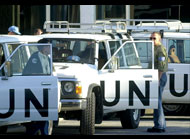
How could they have been stunned? Had they not been reading Paul Krugman? Photo_nov_2002_un_1 The evidence that George W. Bush was spinning WMDs was "obvious long ago to any commentator who was willing to look at the facts." It just wasn’t obvious to the top military leaders in Iraq three months before the invasion. Some of them, even after they had been told by Saddam that the cupboard was bare, found Colin Powell’s presentation convincing.

What we’re seeing is classic screw-up. A dictator boasts of WMDs that he doesn’t have, primarily to keep his domestic opposition scared and to keep up the ambiguity internationally to deter any attack. But that ambiguity is what made the attack inevitable. For Saddam it was rational enough. If he admitted to WMDs, allowed total U.N. access to his country and scientists to leave, then his spell of domestic terror would have disintegrated, and he feared an uprising. But if he played the shell game one more time, maybe he could buy off the West yet again, after twelve years of success. That’s what he calculated. And he calculated wrong.

(Photo: Hussein Malla, AP)

Quote for the Day II

"[The White House has] a transmitter but not a listening device. They’ll say, ‘What are you hearing, what’s going on?’ You tell them things aren’t good on the Hill, you’ve got problems here, you’ve got problems there, or ‘I was in Detroit and boy did I get an earful.’ And their answer is, ‘Everybody’s just reading the headlines, we’ve got to get our message out better.’ There’s denial going on, and it starts at the top." – a Republican operative in the New York Times today.

Quote for the Day

31106024

"Religious faith is the evocation of a sentiment (the love, the glory, or the honour of God, for example, or even a humble caritas), to be added to all the others as the motive of all motives in terms of which the fugitive adventures of human conduct, without being released from their mortal and their moral conditions, are graced with an intimation of immortality: the sharpness of death and the deadliness of doing overcome, and the transitory sweetness of a mortal affection, the tumult of a grief and the passing beauty of a May morning recognized neither as merely evanescent adventures nor as emblems of better things to come, but as aventures, themselves encounters with eternity." – Michael Oakeshott, On Human Conduct.

(Photo: AS, Washington, DC, March 11, 2006.)

Islam and Sex

A reader sends in a clarifying quote:

"It is impossible to describe our daily lives and surroundings without touching on homosexuality.  In Iraq, and throughout the Arab world, a puritanical lifestyle reigns supreme, based in part on the clear segregation of men and women. The severe restrictions on having anything to do with contact between the sexes has produced a special way of life … The atmosphere was one of unceasing desire and curiosity; it is no wonder that Arabic poetry is suffused with sadness, fantasy and yearning … This way of life also increased the incidence of homosexual behaviour in the Baghdad I knew: Boys and adults molested children and some deviants even sought sexual release with animals. Quite a few women became lesbians, perhaps because their confinement in their homes and their limited access to men led to boredom and the search for emotional release," – Mordechai Ben-Porat (a Baghdad-born Jew who became a member of the Israeli Knesset) in his book, "To Baghdad and Back."

The War, the Left, and Revisionism

Another insightful contribution to the debate about pre-war judgments and arguments:

"The probable fiasco of our Iraq policy leaves many of the war’s opponents, like Krugman, feeling vindicated and often smug. Shouldn’t they be as disappointed as any of us that having failed to prevent it, the war didn’t at least work out for the best? Well, this is among the less appealing aspects of human nature that the utopian left often ignores until it exhibits those qualities themselves.

The same correspondent wisely and generously offers, ‘If you supported him and the invasion of Iraq‚Äîwell, that’s  understandable. But if people balked ‚Äî well that’s understandable, too.’ However, those on the left like Krugman don‚Äôt acknowledge difficult choices and honest judgment calls. Everything ‘was obvious long ago to any commentator who was willing to look at the facts‚Ķ. [P]undits who failed to notice the administration’s mendacity a long time ago either weren’t doing their homework, or deliberately turned a blind eye to the evidence.’ Because the Krugmans cannot see clearly past their own ideological predispositions, it doesn’t occur to them that for others, descriptors like ‘rush to war,’ after twelve years of sanctions and cat and mouse games, seemed completely thoughtless.

Similarly, opponents of military action often denied the reality of any threat from Iraq not by claiming the absence of WMD, but by confidently asserting that a secularist dictator like Hussein would never cooperate with fundamentalist Moslems like Al Qaeda by providing them with WMD. I spent much of 2002 and 2003 asking such people if they had ever heard of the Molotov-Ribbentrop Pact.

The point is there were reasonable arguments to be made on both sides, but there are those who will never acknowledge as much. Claims now that there were general claims then of an absence of WMD are an attempt to rewrite history and achieve a kind of retroactive, total victory over the perceived ‘real enemy’ ‚Äì GWB.

Along the same lines are attempts to suggest that you were extreme in your warning of what to expect from some on the left. There may not have been material assistance, but it remains a fact that the American Sociological Association cheered in 2004 when Arundhati Roy said in a speech before it: ‘The Iraqi resistance is fighting on the frontlines of the battle against Empire. And therefore that battle is our battle.’ Chomsky called the U.S. ‘a leading terrorist state.’ And many on the left believe it. Katha Pollitt, in the pages of the Nation, called the American flag a symbol of ‘jingoism vengeance, and war.’ And Not in Our Name, on its website, and many of the thousands of participants in the rallies organized by International ANSWER made clear who they believed the enemy to be ‚Äì and it was neither Saddam Hussein nor Al Qaeda. I could go on.

As always, there are many lessons to be learned from our errors, including those of electing someone to the presidency as ill prepared for the office as George Bush, and the arguably criminal incompetence with which the war has been waged. But we won’t learn those lessons by allowing history to be manufactured for the satisfactions of cheap political one-upmanship."

Agreed.
Quote for the Day II

"Does that mean I walk into a raging battle to confront the soldiers? Does that mean I walk the streets of Baghdad with a sign saying ‘American for the Taking’? No to both counts. But if Jesus and Gandhi are right, then I am asked to risk my life, and if I lose it, to be as forgiving as they were when murdered by the forces of Satan," – Tom Fox, Christian activist, who was kidnapped, tortured and killed by unknown Iraqis.

Catholics and Adoption

The decision by Boston’s Catholic Charities to give up all adoption services because of being required by the Vatican to break state law and refuse any and all gay adopters is one of the saddest things I’ve heard about in a long time. A reader comments from a particular perspective:

"I was raised Catholic, but, incidentally, I’m also adopted from South Korea through none other than Catholic Charities. I would have grown up in an orphanage in Korea, as that used to be the solution to children like me who were born out of wedlock, except that my biological mother decided to put me up for adoption. Her one specific request, and I feel it’s an important and notable one, given the circumstances, was that I was to be raised Catholic. I’m not entirely sure why, but I’d like to think it was because of how they treated her and their reputation, both of which are sterling in terms of adoption.

My Mom’s Irish and my Dad’s Italian-Lithuanian and a career military doctor, so I would have to say that I feel as American as anyone else and, for all the trouble I’ve had with my faith, especially in recent times with all of the Church’s misguided decisions, pronouncements, and corruption, I still long to actually and truly believe. But, to hear this, even though I have not grown up in a homosexual family, tells me that clearly the Church’s priorities are so skewed, if not outright bankrupt, that I almost feel inclined to pursue a different branch of Christianity. It seems inconceivable that this is their excuse to dismantle such an important part of Catholic Charities, and, for a student currently studying abroad like me, it is just another push in the long chain of events that give me great misgivings about the Church, especially in America, and about our treatment of homosexuals."

Dan Savage has some choice points to make on the subject here. I’ve said it before, but I’ll say it again: one day the Church will apologize to gay people for the wounds it has inflicted on their souls and psyches. Not in my lifetime, perhaps. But one day. And now, they’re punishing children to maintain their doctrinal purity. May God forgive them.

Sounds Like Good News

From Omar:

"Sheikh Usama said today that the "Nakhwa" 4,000 man-strong tribal force he’s supervising has succeeded in capturing yet another 169 infiltrators coming mostly from the Jordanian borders during the past week.
The sheikh also spoke of disbanding 9 terror groups working with Zaraqawi’s al-Qaeda in Iraq and confirmed that the recently captured infiltrators were mostly non-Iraqi Arabs with some Iraqis guiding them in and providing logistics and that they brought weapons, explosives and sophisticated maps with them with a selection of targets pointed on those maps:

‘Our main problem is the vast size of Anbar as well as having shared borders with 3 countries; Saudi Arabia, Jordan and Syria and recently we have that more and more infiltrators are coming through the borders with Jordan rather than the other two countries‚ĶWe have rid about 90% of the province of Zaraqwi’s criminal thugs and we are coordinating our work with the ministries of defense and interior and we had several meetings with Iraqi officials as well as General Casey. Now we believe Zarqawi had escaped to Salahiddin province and we are cooperating with the tribes of Salahiddin to find out where this criminal is hiding.’"

We’ll have to wait and see if this pans out. But it’s encouraging to see such apparently successful cooperation between Iraqis and coalition forces; and to hear an Iraqi speak so candidly of the government war against terrorism.