A devastating critique, if a little tough on Disraeli.
Month: March 2006
Mea Culpa
What I got wrong about the Iraq war. But why I still haven’t given up. My new Time essay here.
Quote for the Day
"Yes, you could say I am libertarian. I believe in liberty for all, equality and human rights, freedom and democracy, free-market ethics, and I hate extremism in everything. I believe in life more than death as being the way to happiness," – an Iraqi Shiite, risking his life translating Ludwig von Mises into Arabic. His best weapon? The Internet. Jonathan Rauch keeps hope alive here.
Rick on Dick
An elegant skewering of the veep. This sentence sure rings true:
"Now that the Armstrong incident has receded into the mists of time, where it can be calmly considered in historical perspective, the shotgunning of Harry Whittington, in itself, does indeed appear as of less than global significance."
Er, yes.
Oscarfreude

It was a great night for Mickey. Gloating and excitement can be read in full here. Yes, he still cares. I actually enoyed the show Shales loathed. Yes, Jon Stewart couldn’t bring it off, but he seemed to be unaware that these people take themselves very seriously. Of the good things I loved: Tomlin and Streep, natch, reminding us that many of those other stiff, ungainly people on stage are actually actors in their spare time; Dolly Parton, Dolly Parton, Dolly Parton; the gay cowboy clip sequence (give me a break, okay?); PSH thanking his mom for his first Oscar; and Lauren Bacall, showing what real reality television is. Dialogue in Sullivan household:
"She’s drunk."
"No, she’s just old."
"Will she finish?"
"Where’s she going?"
Two minutes of slapping-the-carpet laughter.
"Where’d she go?"
Now that’s an Oscar night. My favorite awful moments: Clooney telling America to go screw itself; the slow-mo dance set for Crash, which seemed to involve a Robert Wilson version of a cop feeling a woman up; everything about that Pimp number; the silly Brits in their bowties; the silly frogs with their cuddly toys. What more can you ask for?
(Photo: Vince Bucci/Getty)
Faith and Reason
Thanks for your emails about my postings over the weekend. My own position is pretty well summed up here:
"Ehrman’s dilemma–how can scripture be inspired and true, when it contains numerous factual inconsistencies and contradictions?–is actually an old one. Augustine and many other early church fathers recognized the human limitations in divine scripture, and developed sophisticated, non-literalist interpretations of scripture.
Ehrman, unfortunately, falls victim to a false and rather sophomoric choice: scripture is either purely God’s words (essentially, it is dictated by God) or purely human words (perhaps noble and meaningful, or mendacious and corrupt, but nonetheless not divine). Christian fundamentalism and most of Islam choose the former; Ehrman chooses the latter, but, in doing so, has become the mirror image of his fundamentalist upbringing. Certainly, Catholic theology and doctrine, along with most mainstream Protestant thought, reject that dichotomy, opting instead to say that scripture is God’s word expressed in human words. As Vatican II held in Dei verbum (The Dogmatic Constitution on Divine Revelation), both God and humans are "true authors" of scripture, and that accordingly God made "full use of their [human] powers and faculties" in the formation of scripture (Dei verbum, #11). That is, Scripture is truly and fully inspired by the Holy Spirit, and expresses that divinity through human agents. The divine and the human work hand-in-hand, with all of the possibilities and limitations implied therein.
In a Q&A session this past Thursday to the clergy of the diocese of Rome, Pope Benedict made precisely this point: "This synergy [between God and humanity] is very important. We know that the Koran, according to Islamic faith, is the word verbally given from God, without human mediation. The Prophet didn’t enter into it. He only transcribed and communicated it. It is the pure word of God. For us [Christians], however, God enters into communion with us, leads us to cooperate with him, thus creating this subject [of the church] and in this subject his word grows and is developed. This human part is essential."
Both fundamentalism and atheism, however, fear this divine-human synergy; they are two sides of the same puritanical coin. Fundamentalism in all of its religious forms, on the one hand, is marked by a fear of contamination of the divine by the human, which contradicts the foundational principle of Christianity: God has become incarnate as a human being, Jesus Christ, and has thus chosen to be near to us, to truly and fully be one of us. Christianity, by its very nature, positively celebrates the union of God and humanity.
Atheism, on the other hand, is marked by a fear of the contamination of the human by the divine. It holds that for one to be truly human, one must kill the divine. "God" is the master who enslaves us, taking away our freedom. This is Nietzsche, and it is the burden that Pope Benedict has taken upon himself in his preaching and writing; his encyclical Deus caritas est is nothing other than the attempt to show that God is not the enemy of human flourishing, but its very possibility. The divine gives life to the human; it doesn’t take it away. Aquinas would say that faith perfects (and does not destroy) reason, grace perfects (and does not destroy) nature.
You know this, of course, but it may help in steering between the Scylla of atheism and the Charybdis of fundamentalism. That "third way," as you put it, is the only credible (and reasonable) option."
This is the third way I’m trying to steer toward in my book. I fear that Ehrman was indeed a victim of his early fundamentalism. It’s a spiritual condition hard to recover fully from. One thing I do know: nothing that comes genuinely from Jesus sounds anything like the dictates of contemporary fundamentalism.
Demagogues and Democrats
The Bush administration has left a big gaping electoral hole: the populist, xenophobic, isolationist tendency in America. Will the Republicans fill it? Or the Democrats? My take here.
Moderate Muslims Rally
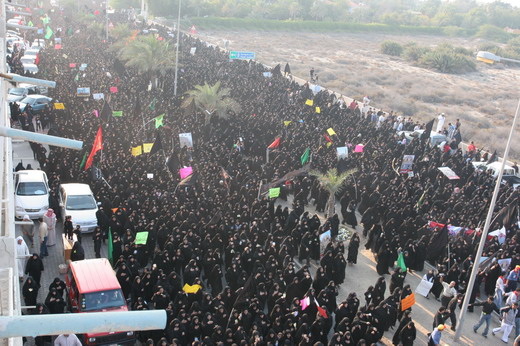
It’s hard not to be impressed by this astonishing public display in Bahrain of the real face of moderate Islam – appalled by the blasphemy of the Samarra mosque bombing. Here’s a slogan worth cheering: "No Shia, no Sunni. All of us denounce the exclusivists (terrorists)." Gateway Pundit has the goods. Invaluable commentary here. Photo courtesy of Montadayat.org. Many of the demonstrators were Shi’a, seeing themselves as the victims of sectarian attack. But their response is to build bridges, not to burn them. All this happened last Wednesday. Have you seen a mention of it in the MSM? Me neither.
Dogs In Elk

A reader sent me this dated list-serv exchange Salon.com "table talk" blog involving a traumatized dog owner. What happens when you live in New Mexico and an elk decides to keel over in your backyard? All the local dogs think it’s the Rapture and the carcass becomes an all-you-can-eat buffet and a daycare center. Money quote:
"Anne V – 02:44 pm PDT – Sep 9, 1999 – I did call my vet. He laughed until he was gagging and breathless. He says a lot of things, which can be summed as *what did you expect?* and *no, there is no such thing as too much elk meat for a dog.* He is planning to stop over and take a look on his way home. Thanks, Lori. I am almost surrendered to the absurdity of it.
Lori Shiraishi – 02:49 pm PDT – Sep 9, 1999 – He is planning to stop over and take a look on his way home. So he can fall down laughing in person?
Anne V – 02:50 pm PDT – Sep 9, 1999 – Basically, yeah. That would be about it."
All dog-owners have been there, but this one really takes the biscuit. Second money quote:
"Here are some things I have learned, this Rosh Hashanah weekend: 1. almond milk removes elk blood from curtains and pillowcases, 2. We can all exercise superhuman strength when it comes to getting elk carcasses out of our yard, 3. The sight of elk ribcages hurtling over the fence really frightens the nice deputy sheriff who lives across the street, and 4. the dogs can pop the screens out of the windows, without damaging them, from either side."
Just passing indispensable information along, as only the blogosphere can.
When Faith Evaporates

The Washington Post has an engrossing story today about theologian and Biblical scholar, Bart Ehrman, author of "Misquoting Jesus: The Story Behind Who Changed the Bible and Why." The story of people who lose faith is as old as time, of course. But what’s interesting about Ehrman’s journey from fundamentalism to agnosticism is how Biblical scholarship played such an important role. The legion of inconsistencies and the vast treasure of scriptural scholarship that has come into our hands in the last few decades proved too much for Ehrman to maintain the fundamentalist mantra:
"In Matthew, Mark and Luke, you find no trace of Jesus being divine," he says, his voice urgent. "In John, you do." He points out that in the other three books, it takes the disciples nearly half of Christ’s ministry to learn who he is. John says no, no, everyone knew it from the beginning. "You shouldn’t think something just because you believe it. You need reasons. That applies to religion. That applies to politics … just because your parents believe something isn’t good enough."
When you look at the rise of fundamentalism in the West in the last couple of decades, this context is often over-looked. It is the Darwinism of our time in its impact on religion. What we now know about the thousands of different texts in the New Testament, the thousands of discrepancies, the layer upon layer of historical re-writing, the more the contrast between what Jesus may have said and what his church came to teach emerges.
Jefferson, in other words, was onto something. But this attempt to ask who Jesus really was is, of course, very unnerving to believers. I remember distinctly deciding not to study theology in college, despite my intense interest, because I was frightened that the more I understood, the less I would believe. And so fundamentalism becomes more attractive in modernity. Why? Because it is the only kind of faith that simply banishes all such arduous and nerve-wracking sifting and thinking and doubting. A Christian faith that tries to integrate current Biblical scholarship into active doctrine and action requires a huge amount of nerve and tenacity. The end of that path for Ehrman was agnosticism and reason. Many more are choosing fundamentalism and authority as an alternative. The question is not whether a third way will be popular or triumphant. It may very well be neither. The question is whether it is the only Christian option compatible with truth. And that can hardly be a minor issue for faith.
 The Dish