Ken Silverstein crunches the data and comes to a conclusion: "He is funny like Karl Rove is sexy."
(Broken link now fixed.)
Ken Silverstein crunches the data and comes to a conclusion: "He is funny like Karl Rove is sexy."
(Broken link now fixed.)
Blair backs nuclear power for Britain’s future. If you truly want to address global warming, it seems to me an unavoidable decision. Money quote:
"The facts are stark. By 2025, if current policy is unchanged there will be a dramatic gap on our targets to reduce CO2 emissions, we will become heavily dependent on gas and at the same time move from being 80% to 90% self-reliant in gas to 80% to 90% dependent on foreign imports, mostly from the Middle East, and Africa and Russia.
These facts put the replacement of nuclear power stations, a big push on renewables and a step change on energy efficiency, engaging both business and consumers, back on the agenda with a vengeance. If we don’t take these long-term decisions now we will be committing a serious dereliction of our duty to the future of this country."
Isn’t it great to observe a political leader who’s actually concerned about the next generation?
I see that Dick Morris recently touted a Gore candidacy. Al’s doomed now.
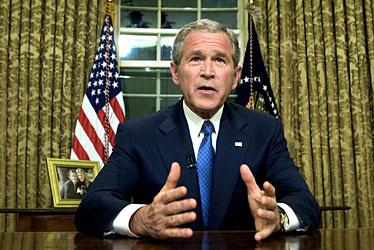
There are no signs of reconciliation toward the president after his speech on immigration. Here’s Gary Bauer in his daily email to supporters:
"I understand the overnight ‘snapshot’ polling data on the president’s proposal was pretty good, but I cannot say the same for the reaction of conservatives. Your messages to me were overwhelmingly negative, suggesting you view this plan as little more than a ‘dressed up amnesty’ bill."
Here’s Richard Viguerie, a man who once rhetorically cast Ronald Reagan from the "conservative" movement:
"[Bush] may get his way, but he won’t get it this year. He may get it next year because the conservatives will be so angry at the Republican leadership – starting with the president, but the congressional Republicans also – that I’d be surprised if many, many don’t stay home, turning the congress over to the Democrats. And, of course, the Democrats, next year, would give the president what he wants because then they’ll be able to govern America for the rest of the 21st Century [with the support of former illegal aliens who had become newly-legalized voters]."
Not happy.
(Photo: Brendan Smialowski/AFP/Getty.)
The buzz spreads. And intensifies.
"When I put the book down I thought, ‘what a load of potential codswallop’. That’s still going on in my mind. But I’m very happy to believe that Jesus was married. I know that the Catholic church has problems with gay people and I thought that this was absolute truth that Jesus was not gay," Ian McKellen, giving Opus Dei one reason to like the Da Vinci Code.
All right then, if you insist. The term "money" when used as an adjective was first coined, I believe, to describe critical moments in pornographic movies, i.e. the "money shot." But it broadened in the late 1990s, largely thanks to the movie, "Swingers," to be a form of general approbation. As in: "There’s nothing wrong with letting the girls know that you’re money and that you want to party." I use it in the spirit of both meanings for people who give good quote.
Mark Blumenthal dissects the latest polling numbers on the NSA data-gathering program. Given the state of the Republicans and the Bush presidency, a Democratic campaign against the NSA program would be Karl Rove’s wet dream. (Ick.) This revelation should help the president as well. I’m not saying the program isn’t worth investigating. I’m just saying the politics of it play for the Republicans.
It was legendary at the New York Times – and made for terrible journalism as the AIDS epidemic first surfaced in New York City. Larry Gross remembers the dark lining of the old New York Times.
Are they simply different forms of the same kind of thought-system? One reader finds their take on history the common thread:
It seems to me that Marx attempted a "science of history", but as B. Croce pointed out, you can’t have a "science" without controlled experiments, and you can’t do controlled experiments on history.
Ethically, Marxism and Christianity are very similar – in a sense, ethically Marxism is Christianity without god and the supernatural. It is an attempt to put Christian morality on a "scientific" footing. Isn’t "to each according to his abilities. . ." a sort of repackaging of "do unto others. . . ."?
Both Marxism and Christianity share "dramatic" story lines about history – they both posit a kind of shape, purpose and inevitable result to history, the process Hegel distilled from Christianity and left for Marx, Hitler and New World Order fans.
I think if one wants to be "scientific" about history, one would have to simply admit that we can’t really know a whole heck of a lot about it it terms of its dynamics. We can offer a lot of theories, but how on earth do you test them? There are simply too many variables. How do you stand outside of history to experiment on it?
It seems to me that the real distinction isn’t between atheists and Christians or Christians and socialists, etc, the real distinction to me is between people who think they know how history is going to turn out, and those who don’t have any idea whatsoever how it is going to turn out, and suspect that there may not be any way in the world to know how it is going to turn out.
This latter distinction is, to my mind, one of the central divides right now. My own view of history, which rests on Michael Oakeshott’s revolutionary work on the subject, is that it indeed has no direction that we as humans can see. And one key difference between what I’d call a conservative and what I’d call a Christianist is exactly this: the Christianist is convinced that there is a direction, that it is leading to the Apocalypse, and that salvation lies in the future. The conservative, though he may believe in God and follow a traditional faith rooted in ritual and mystery, nonetheless sees history as opaque and directionless; its salient characteristic is radical contingency; and he is interested, as Oakeshott was, in an idea of salvation that has nothing whatsoever to do with the future.
The key defining divide of our time is no longer that between right and left, I think, but between fundamentalist faith and humanist doubt. I favor the latter, with a non-fundamentalist kind of faith to sustain it. And the struggle within conservatism right now is essentially between those who see history as without direction and those who see history as an unfolding of divine Providence. For these reasons, a conservative will reject Marxism and the eschatological Christianity of Paul and the extreme Whiggery of some neoconservatives. And he will find in Darwin and Jesus two natural allies.
Yes, I guess my book is going to push a few envelopes.
 The Dish
