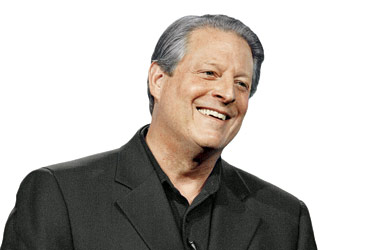
Richard Milhous Gore?

One reader sees the parallel:

In a troubled time of war, we get a barely-rebuffed VP who embodies an administration remembered as a halcyon period of peace and prosperity … In ’60, Nixon lost by the hair of his unshorn whiskers in a televised debate; in ’00, Gore lost by the whiff of his sighs in a televised debate… Both lost to more likeable, slightly more hawkish opponents (though JFK never pulled a 29 approval rating)… After bitter defeat, both weather embarrassment (losing California governorship; endorsing Dean), only to regain respect (abetting Republican gains in ’66; joining Apple and Google before they went supernova, making well-received environment movie).

Hmmm. A blogger picked up on the meme as well. TNR weighs in here.

Why A General Quit

Here’s another enraging and fascinating story of how yet another man with integrity in the U.S. military came up against Rumsfeld, and lost. Money quote:

Over the course of the year-long tour, Gen. Batiste says he had to deal regularly with troop shortages. On three occasions, he was ordered to send soldiers to help other U.S. units in the cities of Najaf and Fallujah to put down revolts. Typically, the Army holds a couple of units in reserve to deal with unforeseen flare-ups. But the desire to keep the force as lean as possible meant there were no extra troops in Iraq.
Each time his soldiers left their area, attacks, intimidation and roadside bombs spiked, Gen. Batiste says. "It was like a sucking chest wound," he says. Relationships that soldiers had painstakingly built with local sheiks — who had been persuaded to cooperate with U.S. forces at great risk to themselves and their families – were lost when the soldiers were sent elsewhere, he says.

Fire Rumsfeld Now.

The Case for Gore

Gorefrederickmbrowngetty_1

I’m struck by how many emailers concur with my correspondent yesterday. Here are a couple of typical ones:

Yes it could well be Gore in ’08. There are many reasons but the most powerful is his statesman’s status. He has a unique, unassailable position in having won 2000 but lost in the Supreme Court, and his wilderness years have strengthened and matured him, allowed him to speak his mind forthrightly and without calculation. After all, what further could anyone do politically to Al Gore that he has not already suffered?

Personally, I found his recent speeches absolutely electrifying; I was truly stunned by his transformation. He has become America’s conscience, and is warm, articulate and impassioned. He has gone through the valley of tears and what did not break him has strengthened and transformed him – I will use that word again. In comparison, Hillary’s politcal calculations look tawdry and obvious.

Another heartland Democrat agrees:

Hillary’s problems are beyond her weakness with the liberal wing of the Democratic Party – which I would argue isn’t so much its base as its activism – as is her high negative Q ratings and the persistent reluctance of voters to elect a woman president. (This is the elephant in the living room, the thing nobody wants to talk about but which lurks in the subconscious of the American psyche.) Gore has a somewhat "softer" image than Hillary, is considered far more likeable – which he has enhanced over the past five years – and still harkens back to the "good ol days" of the Clinton Administration (which recent polls, to nobody’s surprise except Bush loyalists, indicate Americans in retrospect preferred).
Here in the Heartland, which so many of the East Coast pundits seem to ignore so easily – yet historically proves to be the bellwether for voting trends – Gore plays considerably better than Hillary. Rank and file Democrats, including Yellow-dog Democrats such as myself, will still vote for Hillary – but I think most of us would prefer Gore.

Josh Marshall gets it as well. Check out Gore’s SNL appearance here. Review here. My own preference for Bush over Gore in 2000 was primarily because I feared Gore would increase government spending and regulation too much. Yeah: I know. Gore’s credibility on the environment – a growing issue – his history of foreign policy hawkishness but opposition to the Iraq war, and his general association with what has become Clinton era nostalgia, do indeed make him an interesting possibility. Then there’s just the karma. If we’re looking to heal the wound of 2000, who better?

Quote for the Day II

"It’s time for you to get some new cell phones, quick," – a senior federal law enforcement official, to ABC News.

The government is now apparently tracking calls made by reporters to sources to stop and prevent leaking. So a program designed to monitor potential terrorists has swiftly become one able to monitor journalists. Why am I unsurprised? Josh makes the obvious but vital point here. The issue is not just whether something is legal; it’s whether it’s open to abuse.

Christianism and the Military

One of the most disturbing aspects of the rise of Christianism has been the attempt to coopt the armed forces. We have already seen what happened at the Air Force Academy, where Christianists corralled individuals, Christian and otherwise, into public praying along the lines of the religious right. We have seen a top army general publicly depicting the war on Islamist terrorism as a fight between Christ and Muhammed. We have another general sending out campaign pamphlets from his work computer, urging the election of Christianists to Congress. No one objects to private and voluntary prayer groups that allow servicemembers a choice as to how they collectively pray. But in public meetings, where everyone is present, the prayers should indeed be non-sectarian, inclusive, perhaps ideally be a moment of silence, as current military rules insist. That’s what the Christianists object to. They seek to impose their faith as the public one for all Americans, and have slipped such a provision into the military appropriations bill. The National Conference on Ministry to the Armed Forces opposes it. Others do too:

Among the provision’s opponents is the chief of Navy chaplains, Rear Adm. Louis V. Iasiello, a Roman Catholic priest.
"The language ignores and negates the primary duties of the chaplain to support the religious needs of the entire crew" and "will, in the end, marginalize chaplains and degrade their use and effectiveness," Iasiello wrote in a letter to a committee member.

Still, the Christianists forge ahead, controlling the majority political party, and seeing their opponents as opposing Christianity itself. The ironies are acute. We are currently attempting to construct an Iraqi army that has nothing to do with sectarian or religious loyalties. At the same time, Christianists are trying to turn the U.S. military into their own sectarian force. The religious neutrality of the military is integral to a free and secular society. That’s why the Christianists have taken it on in America; it’s why the Islamists oppose it in Iraq; and that’s why they both have to be stopped.

Congrats, AEI

Ayaan Hirsi Ali faces deportation from Holland for lying on her asylum form over a decade ago. She claimed she was fleeing an arranged marriage, when in fact she was merely fleeing the constrictions of Somalia. AEI is lucky to have her. A former illegal immigrant? A person devoted to freedom of speech? A person of color willing to criticize other persons of color? Sounds like an American to me.

Quote for the Day

"One thing the Bush administration says it can do with this [NSA] meta-data-[gathering] is to start tapping your calls and listening in, without getting a warrant from anyone. Having listened in on your calls, the administration asserts that if it doesn’t like what it hears, it has the authority to detain you indefinitely without trial or charges, torture you until you confess or implicate others, extradite you to a Third World country to be tortured, ship you to a secret prison facility in Eastern Europe, or all of the above. If, having kidnapped and tortured you, the administration determines you were innocent after all, you’ll be dumped without papers somewhere in Albania left to fend for yourself," – Matt Yglesias, American Prospect. Apart from that, American liberty is alive and well.

Christianism, Debated

Leaves1

I’m not quite done yet. Here’s one point worth dealing with. It’s the notion that everyone has a religion, whether they call it that or not – including "secular humanism" – and that trying to curtail Christianity or Islam or any other faith from direct application to political life and civil law creates a double-standard. People can bring their secular worldviews into politics, but Christians cannot bring their religious doctrines. No fair, many argue. In fact, these rules are actively discriminatory against Christian fundamentalists. Hence the so-called "war on Christianity."

This argument is based, I believe, on a misunderstanding of religion. The difference between a world-view, based on empirical evidence or reason or personal experience and open to debate, and a religion, based on an inerrant text or revelation or church authority and closed to doubt, is that the religion demands to be taken much more seriously. It insists on its own divine authority – as it must – and that authority cannot be held hostage to the results of a political conversation or debate or election. It rests on God Almighty. By definition, therefore, the conflation of our politics with the will of God makes political discourse largely impossible, because we don’t all believe in the same God or even in God at all. And so the introduction of religious authority into politics makes all our political dealings inseparable from profound differences over the deepest things – the meaning of life, the existence of God, the nature of God, and so on.

Politics, as we have come to understand it in the West, cannot operate on those grounds. It did once. And Europe was filled with the smoke from the burning flesh of heretics. The decision to remove such profound issues from politics was definitive of the West’s emergence from the dark ages, and it is integral to any understanding of the American experiment in limited government and individual liberty. The absolute demands of fundamentalist faith make the West’s tradition of civil compromise impossible; and they constantly push the boundaries of what is acceptable to God, as religious purists outdo each other in proving their righteousness – whether it be keeping comatose patients alive for decades or defining a zygote as a full human person. Hence our politics has degenerated into a "culture war." Wars are what happens when politics become impossible. And that is the corrosive effect of Christianism; and why it must be resisted – for the sake of American discourse and for the sake of a vibrant, humble apolitical Christianity.