A CNN poll finds a slim majority believing Bill Clinton was more honest as president than George W. Bush is. And that was the best news for Bush in the poll.
Month: May 2006
McCain, The Healer
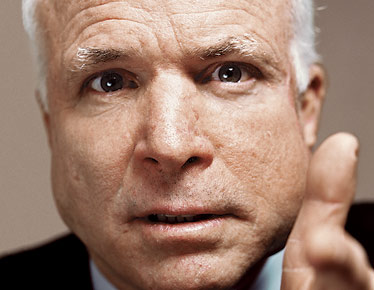
The speech is, to give my first impression, a truly inspired piece of work. It’s funny at times, sharp, moving, sincere, self-deprecating. What it manages to do is something that, sadly, Bush has been unable to do. It manages to argue forcefully for the moral cause of the war against Islamist terrorism and yet to defend the dignity and value of our strong and impassioned debates about it. It’s about reconciliation – and not just within Republican circles. It’s about reconciliation at a national level, a way to get beyond the polarization of the last few years, without descending into hazy delusions about the core and real disagreements that still divide us:
Americans deserve more than tolerance from one another, we deserve each other‚Äôs respect, whether we think each other right or wrong in our views, as long as our character and our sincerity merit respect, and as long as we share, for all our differences, for all the noisy debates that enliven our politics, a mutual devotion to the sublime idea that this nation was conceived in ‚Äì that freedom is the inalienable right of mankind, and in accord with the laws of nature and nature’s Creator.
We have so much more that unites us than divides us. We need only to look to the enemy who now confronts us, and the benighted ideals to which Islamic extremists pledge allegiance – their disdain for the rights of Man, their contempt for innocent human life – to appreciate how much unites us.
The tone is one in which McCain uses his advanced age – which will surely be a factor in the coming election – as an advantage. He provides a narrative of his life that portrays him as a former hot-head who has learned his lessons. He’s trying to defuse two potential liabilities with a single story. It’s artfully done:
Let us exercise our responsibilities as free people. But let us remember, we are not enemies. We are compatriots defending ourselves from a real enemy. We have nothing to fear from each other. We are arguing over the means to better secure our freedom, promote the general welfare and defend our ideals. It should remain an argument among friends; each of us struggling to hear our conscience, and heed its demands; each of us, despite our differences, united in our great cause, and respectful of the goodness in each other. I have not always heeded this injunction myself, and I regret it very much.
McCain is telling us – showing us – that he is ready to bind up the wounds and lead America. That’s what this speech suggests – and it may well become the theme of his presidential run. And, although I am less of a believer in government than McCain is, it may be what this country desperately needs, in a very perilous time. I know I’m a sap for McCain. Always have been. But he may soon be America’s indispensable leader. And a critical part of that leadership will be undoing the divisions that have been allowed to deepen and calcify in the last five years. If he runs against Hillary, it will be as a healer against a figure who, fairly or unfairly, represents salt in America’s ideological wounds. It’s a winning message; and a necessary one.
(Photo: Ben Baker/Redux.)
McCain’s Speech At Falwell U
The text is here.
Gays, Seniors, Marriage, and Burke
A reader makes an interesting sociological point:
I wonder how much influence the rise of "companionship" marriage has had (and will have) on the acceptance of gay marriage. People like Maggie Gallagher and Ramesh Panunu have argued (correctly) that the principal function of marriage has always been child rearing. That may no longer be true. As life-spans climb into the 80’s, married couples are likely to spend more of their lives as "empty-nesters" than as child-rearers. And while seniors are hardly sexually inactive, there is no doubt but that sexual activity decreases with age. Yet the divorce rate among seniors is significantly less than the rate among couples of child-rearing age. Moreover, the re-marriage rate among seniors who lose their spouses is fairly high, even though there is no chance that the "second marriage" will produce children.
All of this suggests that society is gaining considerable experience with living arrangements where sexual and child-rearing considerations are secondary. And such arrangements appear to work at least as well as child-rearing marriages. As society becomes accustomed to the idea of people living together for the sake of companionship, with sex as a real, but secondary, consideration, the idea of gays living together in committed relationships is likely to seem similar to relationships between older heterosexual couples. Indeed, I suspect that if gay marriage ever becomes widespread, it will be most widespread between couples over 40.
The point of all this is that the nature of an institution, such as marriage, can change through forces having nothing to do with the debates over that institution – in this case, the "graying" of America. And these forces can have unanticipated "side-effects" which can prove far more important than the reasons consciously advanced for and against changes in such an institution.
Absolutely. This, I would argue, is the true conservative position. It’s something Hayek and Burke and Oakeshott would have immediately grasped. A conservative starts not from some a priori doctrine – 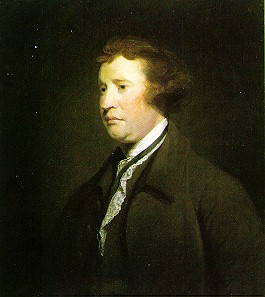 i.e. that "marriage" is for procreation and child-rearing only. He starts from the society he lives in. What does marriage mean now? How has organic social change – the new equality of women, the emergence of openly gay people, the graying of the population, the availability of contraception – made our current arrangements anachronistic? The conservative will then set about – carefully and conservatively – reforming social institutions so that they adapt and coopt the new social realities.
This is the central theme of Burke (along with a deep distrust of power). It’s the essential teaching of Oakeshott. And when you ponder this, you realize that our recent adaptations of the institution of civil marriage – including mixed race couples, gay people, allowing for second marriages as people live longer, seeing marriage as primarily companionate rather than reproductive – are not a means to the destruction or "abolition" of civil marriage, but to its survival in an always-changing society. The theocons are not conservatives in this sense; they are reactionaries. They follow a model of the family that is fixed a priori by theology, and that is oblivious to society as it now is – in fact actively hostile to society as it now is. This mindset was the object of Burke’s scorn; and it was Oakeshott’s primary foe. Yet it now defines a core part of American conservatism. Therein lies the problem.
Get A Grip
Jonah Goldberg posts an endless letter hyperventilating about how I somehow didn’t provide full context for a couple of quotes and links to NRO’s Corner blog yesterday. Maybe I should indeed have elaborated that the NRO debate about "racial superiority" was not about Americans’ purported racial superiority to potential immigrants, but fears of potential immigrants’ purported racial superiority to Americans. Well, excuuuse me. Two links not enough? I just found it interesting that the whole concept of "racial superiority" or "inferiority" was being debated at all. As for Herr Derbyshire, readers know by now, I’d hope, that I find his eccentric celebration of prejudice to be more amusing than shocking. And then there are those moments when a gleam appears in the eye of a dotty uncle when he talks about rounding up illegal immigrants "in greatly increased sweeps", and depleting their numbers by "attrition" … and you wonder what he’d tolerate given half the chance. Look: Jonah Goldberg isn’t John Derbyshire; and Ramesh Ponnuru isn’t Ann Coulter. But they choose to hug them close. Sorry if that gets embarrassing from time to time. Deal with it.
Christianism, Debated

Another email:
The problem with Christianism is a theological as well as a political one. The Republican Party is very happy to lock the Evangelicals into being its permanent, hardcore political base. However, one has to look at the reason why Evangelicals are so easily lured by political ambitions.
For me, the reason is clearly arrogance, which is best expressed by the lay clergy of Evangelical Churches. Any person with a big-enough ego and a flair for the stage can be a preacher. Becoming part of the clergy is not a "calling" as it is in non-Evangelical Christianity, it is not a painful, strenuous, humbling personal experience, it’s showbiz. An already big-ego on the preacher’s podium bloats up beyond imagination when adulated by the thousands of church-goers who flock into the mega-churches, and the result is what traditional Christianity calls "exaltation", the preacher loses any sense of proportion and plays God.
Which is why there appears to be no conscientious objection to make unChristian calls of "taking out" foreign leaders, or advertising "God wants you to be rich" workshops between sermons, or calling "godless" all those who are not Evangelicals.
And people like Howard Dean go on Pat Robertson’s show and give him legitimacy. And we’re giving John McCain a hard time!
(Photo of Tom Coburn and James Dobson by John Clanton/Tulsa World/AP.)
Herr Derbyshire
The immigrant is fretting about the racial status quo in America and has an ideal solution for the immigration issue:
One: That all legal immigration into the U.S.A., excepting only cases crucial to our national security, be halted forthwith.
Two: That Congress authorize the federal government, as a matter of the highest priority, to construct high walls along our entire northern and southern borders, supplemented by electronic monitoring devices and manned patrols in much greater numbers than at present; and that Congress designate all necessary funds for this effort.
Three: That by widespread and rigorous enforcement of employer sanctions, and greatly increased sweeps of suspect workplaces, and by responding with dispatch to citizen reports, the enforcement arm of our immigration services begin the human but speedy removal of illegal immigrants from our nation, by attrition and deportation; and that Congress designate all necessary funds for this purpose..
There are a few dissents, of course. My favorite:
"But Derb, I really think you’re wrong about the racial-superiority thing."
Fade out to Brokeback jokes, torture humor, and zygote rights. Ah, conservatism. I hardly knew ye.
Snowed Under
Tony Snow’s first day at the office … well, let’s just say there were some kinks.
The Shire

I mentioned my recent trip to my home town on the blog, but I got to write a longer diarist page on it for The New Republic. I discovered a few things about my home town I’d never known before. Here it is.
The Last Word on Colbert
James Wood gets it all perfectly right, as he often does:
So we have a heaven-made circularity: Colbert, abjuring comedy for bitter irony, attacks the MSM like the bloggers do; the MSM decide not to mention Colbert, or decide that he wasn’t funny, or was rude; and the bloggers get to cry foul, charging that this shows, at best, exactly what is wrong with the cloth-eared MSM – or, at worst, that a conspiracy to silence Colbert has begun. At which point the MSM, in their stolid, evenhanded way, write up the "controversy." Who can blame the bloggers?
James can also write a sentence like the following:
On this, I’m with the foul-mouthers, the underground men, the crazies, the semi-literates with their paranoid monikers.
Me too. James: get thee a blog.
(Photo: Mandel Ngan/AFP/Getty.)
 The Dish