A War for Oil?

Ngas0428_01_1

One thing that today’s high gas prices strongly suggest is that, whatever else it was, the Iraq war was surely not about oil. If you care about cheap oil above everything else, you’d have found some deal with Saddam, kept the oil fields pumping, and maintained the same realist policy toward Arab and Muslim autocracies we had for decades. Or you could have just seized the Southern oil fields. Instead, we risked losing all of Iraq’s oil fields at the beginning of the war, and now face a crippled supply just as India and China are booming and the U.S. is growing fast. (Instability in Iran, Nigeria and Venezuala don’t help either.) I have unmixed feelings about this. The high price of gas is the best thing to have happened to the U.S. in a very long time. It alone, given the paralysis of the government, will force a market-driven push into new energy technologies, deter SUVs, and provoke the kind of technological research which will benefit us in the future. A smart overview of the entire situation can be read on this blog. I’m longing for gas at $4 a gallon. Yes, I know it hurts people. But pain is the only medicine for America’s oil addiction. And if you have an SUV, decisions have consequences. Live with them.

(Photo: Patrick Andrade/Polaris for Time.)
The Incoherence of Tom Hayden

It still amazes me how the far left is still much, much more concerned with bringing George Bush down than in building Iraq up. The contempt some of them once had for the Iraqi people’s fate – they were quite happy to see Iraqis consigned for decades to Saddam’s tender mercies – is now matched by their zeal to abandon the country to Jihadists and theocratic Shiite thugs. Yes, the Bush administration richly deserves a shellacking for its conduct of the war. But handing al Qaeda a failed state on a plate right now seems to me an odd priority for a group that claims to want something they call "progressive." Tom Hayden echoes the Arianna line today in her celebriblog, and decides to take after George Packer. As you might expect, it’s the usual incoherence. Here’s one typical passage:

Packer sees the US troops not as occupiers, not the cause of violence, but as "buffers" between violent Iraqis. The same civilizing role was claimed by the British when they sent troops to Northern Ireland in 1969; thirty years later they signed the Good Friday Agreement but still haven’t permitted free elections. Baghdad is simply the next Belfast, in this view.

Huh? Does Hayden believe that U.S. troops have caused ethnic division and hatred in Iraq in three short years? Did such divides not exist beforehand? Were they not the critical force behind the construction of Saddam’s divide-and-massacre strategy? And of Iraq’s very borders? As for Britain’s colonial presence in Northern Ireland, it has existed for centuries, and represented one side in the conflict. The current coalition in Iraq have been there for three years, represent no ethnic faction, and are there as a support for an attempted multi-ethnic government. And then there’s this bizarre assertion that Britain has not yet allowed free elections in Ulster (with the implication that this has also been the case in Iraq). Huh? Ulster has had several seats in the House of Commons under free elections for decades. London and Dublin have been attempting to broker regional government there for decades. The Irish republic is a booming democracy. Moreover, Iraqis have had more democratic options in the last three years than in the previous several decades. Did Hayden not notice the moving spectacle of a people formerly in bondage finally getting to vote? Or is that something the left has no interest in any more?

Iran and Deterrence

A reader writes:

In your post, "What did Ahmadinejad Mean," to demonstrate his malign and undeterrable nature you quote Rafsanjani saying:

"If a day comes when the world of Islam is duly equipped with the arms Israel has in possession, the strategy of colonialism would face a stalemate because application of an atomic bomb would not leave any thing in Israel but the same thing would just produce damages in the Muslim world."

It is worth noting that this is almost exactly the same line that China took during the Cold War: That it did not need to worry about nuclear retaliation because the US and its allies had more concentrated targets, whereas China’s vast hinterlands would allow it to resist nuclear attack with manpower left to burn.  "As long as there are green mountains, who needs to worry about firewood?" asked Mao with characteristic directness; "It is the United States that should be afraid of using nuclear bombs against us, because its densely concentrated industries are more vulnerable."  But China in spite of its professed indifference to nuclear retaliation was and remains deterrable.

While you are a great fan of taking murderous dictators at their word, I think that you apply the principle too broadly.  No national leader speaks truthfully when pursuing a strategy of deterrance — the whole point of a deterrance strategy is to appear more crazy and undeterrable than your rival.  You postulate an odd sort of dictator who is rational enough to tell the truth but too crazy to know how to lie when it manifestly suits his interests.

Any approach to strategy that does not take account of deterrability, and make a serious effort to estimate it, is going to lead to all manner of grandiose invade-the-world schemes. Yet oddly enough one does not see a great deal of such analysis coming from the White House these days, or from its pundit and blog subsidiaries. The phrase "fundamentally unserious," though overused, might well apply here.

The problem with deterrence and Iran’s current regime, I think, lies in its fundamentalist religious orientation. When you live in the imminent expectation of a much-wanted Apocalypse, then deterrence may not work against you. We are dealing with a religious movement in which suicide bombing is a virtue. How do we deter suicide bombers? We cannot. How do we know that Iran’s leaders do not have the same psychology on a far greater scale? We do not. The Soviets, in comparison, were rational. Religious fanatics, especially those eager for eschatological oblivion, are not. There’s the rub.

Email of the Day

A reader writes:

I couldn’t agree more with Caitlin Flanagan’s assessment of the Democratic Party, and even more so with her take on the pundits of the far left (Barbara Ehrenrich drives me ’round the bend). I am firm in my faith and go to church every Sunday with my family (at an Episcopal church where our priest is gay and has a partner.)  My husband works and pays the bills. (Math is not my thing. I mow the lawn and make repairs around the house.) I left a career that I loved to stay at home with our daughter and I’ve enjoyed every minute of it (even the school volunteering part, a little). I’ve never voted Republican and probably never will. And sometimes it feels as though neither party claims the likes of us.

Moussaoui

A vile human being. I oppose the death penalty, but if I had to make an exception, it would be him. That said, I wasn’t on the jury, didn’t hear all the evidence, and the system gives them the power to decide such a sentence. The silver lining is that we do not make this monster a martyr. The rule of law was followed; our society allows even this murderous religious fanatic due process. In that sense, Moussaoui got this wrong as he has gotten everything else wrong. He lost. America won. And the fight against him and his allies continues.

What Did Ahmadinejad Mean?

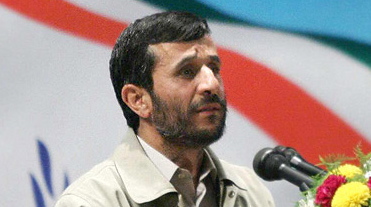
Ahmad_1

Thanks for your emails on the Cole-Hitchens fight. The deeper argument is whether we should take Ahmadinejad’s threats in any way seriously. Last month, Ahmadinejad said the following:

"Like it or not, the Zionist regime is heading toward annihilation. The Zionist regime is a rotten, dried tree that will be eliminated by one storm." … He did not say how this would be achieved, but insisted to the audience of at least 900 people: "Believe that Palestine will be freed soon."

We are told that Ahmadinejad has no power. What about the organizer of Iran’s latest war-game, Mohammad Ebrahim Dehghani, a top commander in Iran’s Revolutionary Guards? How about Ayatollah Ali Akbar Hashemi-Rafsanjani, the runner-up to Ahmadinejad in the rigged Iranian elections of 2005? He was Iran’s president from 1989 – 1997. According to Wiki, he

is currently the Chairman of the Expediency Discernment Council, that resolves legislative issues between the Parliament and the Council of Guardians and advises the supreme leader on matters of national policy.

In 2001, at the height of his powers, Rafsanjani made the following remarks in a speech to fellow Islamists:

"If a day comes when the world of Islam is duly equipped with the arms Israel has in possession, the strategy of colonialism would face a stalemate because application of an atomic bomb would not leave any thing in Israel but the same thing would just produce damages in the Muslim world."

We are told not to take any of this seriously. And the Tehran theocrats may well be bluffing about their current and future capacity. I don’t think we should take the bait they are currently offering us, and react excessively to their provocations. I certainly don’t favor pre-emptive military action at this point. But that the mullahs would nuke Israel if they could seems to me well within the bounds of possibility. How many genocidal dictators in history do we need to ignore or explain away before we take them at their word?

(Photo: Irna/AFP/Getty Images).

Thomas More and Torture

A reader writes:

Your point [about the rule of law] is well taken, and I would imagine a Sir Thomas More of modern sensibilities would likely agree with you. But I am not sure he is the shining example of opposition to torture via abuse of executive authority. I have great respect for the man (and the movie), and have affection for him due in no small part due to his vicious enforcement of law, but certainly there is someone less famous for brutal torture techniques that you could invoke to oppose brutal torture techniques.

Quote for the Day II

"The Democrats made a huge tactical error a few decades ago. In the middle of doing the great work of the ’60s – civil rights, women’s liberation, gay inclusion – we decided to stigmatize the white male. The union dues – paying, churchgoing, beer-drinking family man got nothing but ridicule and venom from us. So he dumped us. And he took the wife and kids with him.
And now here we are, living in a country with a political and economic agenda we deplore, losing election after election and wondering why.
It’s the contempt, stupid," – the wonderful Caitlin Flanagan, Time.

Dean’s Revenge

Last week, a long time Democratic activist, Paul Yandura, criticized the pusillanimous way in which the Democratic party takes gay money and then fails to exercize even minimal courage in standing up and defending gay equality and dignity. According to the Washington Blade, Howard Dean responded by firing Yandura’s domestic partner, Donald Hitchcock, from his position as DNC gay outreach adviser. Paul and Donald are friends of mine, for the record. And Dean denies any connection between the two events. But I don’t buy it. I don’t trust Dean for a second. He’s an angry, petty man, whose support for gay people has always been transparently opportunistic. Yandura’s criticism of the Democrats is dead-on, especially with respect to the Clintons. He deserves support from gay Dems and Republicans in our shared struggle for civil equality and simple moral courage.