Giuliani in Drag

I’ve long been struck by the memory of president Bush’s encounter with a transgendered member of his own Yale class at a reunion. Bush intuitively understood that transgendered men and women deserve respect and acceptance:

Louise Casselman, who was at that White House Yale reunion with her husband, Kirk Casselman and a Bay Area contingent, says that although Yale was still all-male in 1968, one alum has since had a sex-change operation. "You might remember me as Peter when we left Yale," said the woman upon coming face to face with the president. George W. didn’t pause for a moment, reports Casselman, grabbed the alumna’s hand, and said "Now you’ve come back as yourself." Casselman says the host was generous and open.

That is, of course, how civilized, educated people behave. Now compare it to the sophomoric Giulianidrag prejudice proudly displayed at National Review. You have a cover-story whose image is Rudy Giuliani in drag as a symbol of everything "conservatives" would find distasteful in a Giuliani candidacy. To be clear here: a straight man dressing up as a woman for pantomime purposes is just … a straight guy comfortable with his masculinity having fun. It’s been done for ever. It has nothing to do with sexual orientation or being transgendered or even cross-dressing as a form of personal expression. It’s just high jinks. There’s no conceivable reason why any sane conservative would object to a leader having a good time, and not taking himself too seriously. And yet Kathryn-Jean Lopez believes it’s
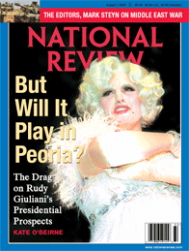
a great image to get to the heart of conservative misgivings about him.

What can she mean? That Giuliani is publicly tolerant of and comfortable with gay people and supports civil unions for gay couples? But what does drag have to do with that? Does K-Lo equate all gay love with drag? John Podhoretz, scion of New York Jewish intellectuals, speaks for the Christian heartland:

I  understand that liberals think conservatives are so stupid they won’t be able to draw a distinction between a stunt and the real thing. But not conservatives themselves!

Fair enough – but does JPod therefore mean that the "real thing" would indeed be a problem? Or should be? And what is, for JPod, the "real thing"? Someone who is transgendered? Is that something inherently offensive to "conservatives"? Notice we’re not talking about any policy position here – just a prejudice toward a tiny minority of people who are different from the rest of us. Empirically, there may well be a case that such a person could never command any popular support. But NR seems to go further than that. Rather than resisting such prejudice, they accept and foment it, deploying images designed to exploit homophobia for political ends. JPod’s contempt for gay people as such is demonstrable. And this is what conservatism, in some quarters, has now sadly become.

Losing Iraq II

In Hitch’s words, there was never a more valiant supporter of regime change in Iraq than Peter Galbraith. Like many of us repelled by the tyranny of Saddam and concerned about the possibility of WMDs in the hands of terrorists, Galbraith supported the war. He now sees, as I think we now are all Fiasco forced to acknowledge, that the only hope for a half-way stable Iraq in the near term is among the Kurds. The Iraqi civil war – enabled and abetted by Bush’s, Cheney’s and Rumsfeld’s criminal negligence and arrogance – is unstoppable now. Every window of opportunity we have had has been squandered. The fundamental mismatch between extraordinary ends and cheap, half-assed, brutal means has led us to this impasse.

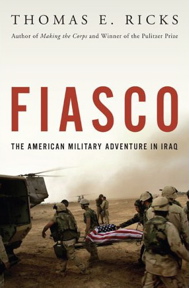
The great danger is that withdrawal could mean the establishment of an al Qaeda redoubt in the Sunni regions and a Shiite enclave in the South, allied with Iran. Given the empirical data from Iraq, it seems profoundly unlikely that we can stop the latter. But we might be able to forestall the former, by air-power and a base among the Kurds. I’d like to read a more through analysis of Galbraith’s argument – especially the risks it entails. But it is the most realistic proposal I’ve read in a while – and deserves serious consideration. Given the manifest negligence of the president and defense secretary, who can have any confidence in a more ambitious strategy? They are the architects of a fiasco far more dangerous than Vietnam, and far more avoidable. Money quote from Michiko Kakutani’s review of Thomas Ricks’ new book, "Fiasco":

An after-action review from the Third Infantry Division underscores the Pentagon’s paucity of postwar planning, stating that "there was no guidance for restoring order in Baghdad, creating an interim government, hiring government and essential services employees, and ensuring that the judicial system was operational." And an end-of-tour report by a colonel assigned to the Coalition Provisional Authority memorably summarized his office’s work as "pasting feathers together, hoping for a duck."

Observing this, many of us have gone from denial to despair to grim hope to acceptance that the scale of the task was greater than even the pessimists foresaw and the means deployed to achieve it almost pathetically unequal to the goal. I guess a miracle may eventually emerge. Maybe a de facto Iraqi partition after more bloodshed and sectarian massacres may pave the way for a more peaceful future. We can hope. But Baghdad is fast turning into what Beirut once was – a cualdron of unrestrained sectarian hate and violence, fomented by a few empowered by the incompetence in Washington. I’m left with contrition at my own small contribution to the misunderstanding; and abiding, deep, and furious anger at the administration who conducted this war with such arrogance and negligence. This president’s betrayal of the Iraqis, his betrayal of the armed forces, his betrayal of those who supported him, is profound. Some of his supporters will forgive him. This much I’m sure of: History won’t.

Losing Iraq

I fear the cycle of civil war is now beyond our control – or anyone’s control. Here’s an email from an American soldier in Northern Iraq about the fast-deteriorating situation:

Baghdad has descended into complete anarchy, as near as I can tell. We have police investigators in Northern Iraq who are scared to drive down there to attend an IPS investigator’s course for fear that they will be stopped by Sunni or Shia checkpoints and killed. And these guys are police! I imagine the situation is terrible for ordinary citizens.

This is the dark side of the big shift in the U.S. strategy/presence over the last year. As we’ve reduced our forces, disengaged from the cities, and consolidated on massive super-FOBs like Balad and Camp Victory, we have lost the ability to impose our will on the streets of Iraq. At this point, I don’t know how effective U.S. forces can/will be in imposing order. We just don’t have the combat power, nor the presence in the city, nor the right mix of constabulary and civil affairs units. It’s frustrating.

And so one of the biggest military fiascoes in American history lurches toward another down-draft.

An Inconvenient Truth

Inconvenient

I finally saw the Gore movie yesterday. It’s thoroughly persuasive about the reality of global warming and the contribution of carbon dioxide emissions to it. I’d recommend it strongly to anyone. Its blindspots were, however, obvious. No mention is made anywhere of the fact that Al Gore was a very powerful vice-president for eight years in a critical period for this issue. His fulminations against others’ indifference would have been a little more credible if he’d at least addressed and explained his own failure to do anything when he was able to. It’s also striking that Gore could have used the movie to argue for a serious increase in the gas tax – and he didn’t. The movie’s final recommendations – recycle! write your congressman! ride a bike! reset your thermostat! – were truly lame after the alarm of the rest of the movie. I think a serious gas tax and a tough increase in mandatory fuel economy standards in the U.S. are essential to prompting the technological breakthroughs that alone can ameliorate this. And yet Gore balked. Just like he did when he was in power.

King George Watch

If you thought the notion that this president is a threat to the constitution is a "fringe" or "hysterical" notion, then a bipartisan panel the American Bar Association must now be "fringe" and "hysterical". His expansive and substantive use of "signing statements" to gut the separation of powers is unprecedented. Well, not quite. There are precedents, just not in America:

The issue has deep historical roots, the panel said, noting that Parliament had condemned King James II for nonenforcement of certain laws in the 17th century. The panel quoted the English Bill of Rights: ‘The pretended power of suspending of laws, or the execution of laws, by regal authority, without consent of Parliament, is illegal.’

King George indeed.