Malkin Award Nominee

"Should we ever make the mistake of capturing any of the perpetrators of the war crime against PFCs Menchaca and Tucker alive, we can forget about interrogating them in order to catch the rest, according to the Supreme Whores. Well, unless they’re willing to give up information if we ask ‘pretty please?’, since anything other than that has been deemed illegal by those blackrobed tyrants. Are we exaggerating? Try doing anything to those mutilating darlings of the Supremes in order to extract life-saving intel from them, and then wait for the Supreme Whores to decide that you were ‚Äúhumiliating‚Äù them in doing so.

Five ropes, five robes, five trees.

Some assembly required," – (filed under "Religion of Pus, Useless Swine" by the "anti-idiotarian rottweiler blog". (Hat tip: Instapundit.)

Surrender, Viacom!

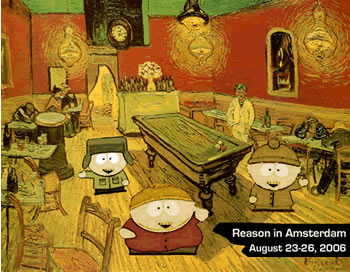
Reasonamsterdam_sm

And they did. South Park’s Scientology episode will now return to rotation. It was a shameful acquiescence to corporate pressure and Tom Cruise’s ego, but now that MI:3 is over and done with, Viacom discovers it has some balls. I’m afraid their reputation for freedom of expression is shot, but they deserve some credit for doing the right thing eventually. This is as good a moment as any to plug an upcoming conference I’m speaking at, alongside Matt Stone and Trey Parker in Amsterdam late next month: "Libertarianism in Europe."

Quote for the Day

"Hearing firsthand about Islamic culture increased my understanding, but it also made me nervous about my own society. The very things we resist in Islam, some Christians find tempting. We, too, seek political power and a legal code that reflects revealed morality. We, too, share a concern about raising our children in a climate of moral decadence. We, too, tend to see others (including Muslims) as a stereotyped community, rather than as individuals. Will we turn toward our own version of the harsh fundamentalism sweeping Islam today?" – Phillip Yancey, seeing the Christianist temptation, and resisting it.

I fear that, to some extent, the transition has already occurred in America. The article, however, is in the evangelical magazine, Christianity Today. And, to my mind, it’s a very hopeful indicator of where the debate about faith and power is headed. There are many more evangelical Christians queasy about their leadership’s capitulation to power and control than you’d believe from the press or the GOP leadership. They are beginning to fight back to reclaim their faith from those who want to use it to gain power.

Washington’s Ethics

A reader writes:

There is a third renunciation of power undertaken by Washington which should be mentioned alongside those you mentioned in your posting. Washington, as commander-in-chief of the Continental Army, explicitly renounced acts of military terror against Loyalists and the Undecided, and he forbade any acts of torture or war crimes on the part of American soldiers against British and in particular Hessian forces who were captured in battle.  He also required, even during the direst of circumstances when his Army was literally starving for food and clothing in the winters of 1776-77 and 1777-78, that the citizenry be compensated as best as possible for any foodstuffs and clothing requistioned by the Army. 

In all, Washington is truly remarkable due to his rectitude and reticence, something that stands in stark contrast with the manner in which the Executive Branch is conducting itself today.

“Letting Go?”

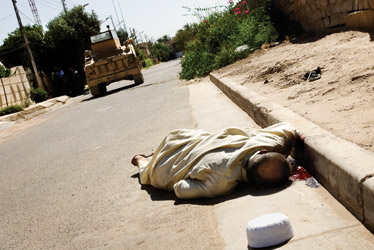
Baghdadfrancopagettitime_2

Don’t miss Lawrence Kaplan’s gripping and indelibly depressing first-hand account of the war now with a momentum of its own in Iraq. Money quote:

A conventional wisdom has emerged in Washington, arguing that U.S. forces have been "hunkering down" – the title of a recent article in the Atlantic Monthly – and patrolling less. Indeed, the president himself has pledged "less U.S. patrols, less U.S. presence." But this does not make it true. After the February bombing of the Shia mosque in Samarra, the number of U.S. patrols quadrupled in Baghdad. On a recent week, the Army sent 1,100 of them into the capital. It did so for a simple reason: Letting go has become the whole point of American policy, but officers know that, every time they let go of a sector, it comes apart at the seams.

Lawrence is close to despair at the barbarism that seems to be slowly engulfing the entire country. He alternates between wanting to up the ante, and fearing that the pathologies of Iraqi culture and society are just too powerful at this point to resist. His recent Plank post is harrowing to read:

Would more U.S. troops alter Iraq’s homicidal dynamic? Not really, given that, on the question of sectarian rage, America is now largely beside the point. True, U.S. troops can be–and have been–a vital buffer between Iraq’s warring sects. But they cannot reprogram their coarsened and brittle cultures. Even if America had arrived in Iraq with a detailed post-war plan, twice the number of troops, and all the counterinsurgency expertise in the world, my guess is that we would have found ourselves in exactly the same spot. The Iraqis, after all, still would have had the final say.

I guess he can be criticized for this ambivalence. Josh puts the boot in here. But it is honest – more honest than some other dead-enders on the right. And he has been there. Iraq may be turning several neocons into realists. It has certainly been a chastening experience for me. I don’t believe, with Lawrence, that there is nothing we could have done to prevent the current blood-bath and slide toward civil war. I still think it was doable under the right conditions. I hold Rumsfeld and Cheney and Bush accountable for being unserious about a deadly serious business (and my own gullibility in not seeing their faults soon enough and in not being skeptical enough about cultural difference in the Middle East). We will never know what we might have achieved if we had had a halfway competent president and defense secretary. But we are where we are. And hope is currently a difficult thing to feel.

(Photo: Franco Pagetti for Time.)

Correction, Please

John Hinderaker at Power Line writes:

"I think the over-the-top coverage of Abu Ghraib, the prison where no one died after it was reclaimed from Saddam Hussein, is the definitive proof of the American media’s bias against its own soldiers."

Does Hinderaker consider this person, murdered by the C.I.A. at Abu Ghraib, dead?

Agcorpse3_1

Money quote:

Al-Jamadi died in a prison shower room during about a half-hour of questioning, before interrogators could extract any information, according to the documents, which consist of statements from Army prison guards to investigators with the military and the CIA’s Inspector General’s office.

One Army guard, Sgt. Jeffery Frost, said the prisoner’s arms were stretched behind him in a way he had never before seen. Frost told investigators he was surprised al-Jamadi’s arms ‘didn’t pop out of their sockets,’ according to a summary of his interview.

Frost and other guards had been summoned to reposition al-Jamadi, who an interrogator said was not cooperating. As the guards released the shackles and lowered al-Jamadi, blood gushed from his mouth ‘as if a faucet had been turned on,’ according to the interview summary.

The military pathologist who ruled the case a homicide found several broken ribs and concluded al-Jamadi died from pressure to the chest and difficulty breathing.

The fact that one of the most popular conservative bloggers is still in denial about Abu Ghraib, let alone the dozens of other torture-facilities set up by this administration, speaks volumes.