“Black and Mormon”

Blackandmormon

It isn’t easy – even now. Below is a YouTubed 2004 news story on a black professor at Brigham Young University, Darron Smith, who edited a book on the LDS church and its history of racial discrimination. At the time of the book’s publication, "Black and Mormon," Smith was a member in good standing in the church. BYU fired him thereafter. Here’s a Mormon blog entry on him as well.

Malkin Award Nominee

"Schumer is a Radical Communist Jew – he is clearly in that part of the Jewish religion that supports Socialism and Communism. They claim to be secularist so they can attack all the other religions and hide their true affiliations. New York is full of these children of Communist immigrants of the early 20th century. FDR used them in very responsible positions during his Presidency to enact his Socialist programs and to get the approval of the Supreme Court, which he packed with Socialist thinkers. At that time Communism was on our side in the war. There are thousands just like Schumer but he is by far the most dangerous–George Soros is a close second. Look for the Radical Communist Jews in the MSM, Hollywood, the ACLU, and in the Judiciary as Judges and Lawyers," – a commenter on Hugh Hewitt’s blog, outraged at some mild words of faint praise for the senator from Mr Hewitt.

Elsewhere in the comments section, Schumer is described as someone in the same class as "Yosip Broz Tito, Nicolai Ceusescu, and other third rate Communist thugs," as a "sick bastard," a "dirty dog," "deceitful slime," and one reader even emotes: "the mear sight of this scum sickens me." In this company, Hewitt really does come off as a moderate.

A Liberalism of Doubt?

A reader of The Conservative Soul writes:

It was wonderful to read such a deep statement of a modern Christian faith, and such a profound description of what it means to be a principled conservative.   But as a centrist liberal, I found I was writing a second book in my head as I read yours. The title of this parallel-universe book was, of course, "The Liberal Soul- How We Lost It, How to Get It Tcscover_29 Back". I started thinking seriously about a liberalism of doubt – what it would be like, and how we can make progress toward it.

If I had to sum up the lesson of your book in one phrase it would be "humility, as Jesus taught it". 

Have we liberals been humble in the spirit of Jesus? In many ways, no, and we would be better liberals if we were.  All too often, liberals have been like a Victorian Lady Bountiful – throwing money at the problems of the poor, but without truly respecting either the poor people we were attempting to benefit or the taxpayer who provided the money.

As a small example, I was against welfare reform in the 1990s, because I was afraid that poor children would go hungry.  But there was a tinge of elitism there.  I would never have settled for life on the dole, since I was a smart person who needed a career –  but it didn’t bother me nearly as much as it should that I expected inner-city single mothers to accept life on the dole. A truly humble person would have seen that was an atrocity.

If we had truly respected the taxpayers we expected to contribute to social programs, we would have instituted ferocious measures of effectiveness – and cut off any program that wasn’t achieving its objectives. Conservatives would still have objected to social programs, but I suspect conservatives of doubt would have objected much less if liberals of doubt were totally committed to effective programs with zero waste.

Liberals of doubt might also wonder if the abortion of an eight month fetus is really a minor event. There’s a lot to be learned on both sides.

Indeed, there is. In the book, some conservative critics who refuse to read it might be surprised by some of my positions. I favor banning abortion in the second and third trimesters (and reversing Roe), and favor the old Christian approach to balancing various goods in deciding when to allow a terminally ill person to die. I truly believe that all procured abortion is a profound moral wrong – I just respect those who sincerely disagree about the moral status of an early embryo and fetus, and see the law as a way for us to be able to live together with varying views, rather than as instrument to impose one view on everybody alike. I think late-term abortion is one of the most grotesque practices in America today, and would have no qualms in voting to criminalize it. All this is in the book. But it is so offensive to the Christianist right that they have vowed not to read or buy it. That tells you something, I think, about how extreme they have become. I am glad that so many liberals appear to have more open minds.

Rumsfeld and Abu Ghraib

Agpile

General Karpinski has some credibility as the former commander of all military prisons in Iraq. When she says that Rumsfeld personally signed off on the Abu Ghraib abuses, she is not easily dismissed (although you can expect pro-torture Republicans to do so). The evidence that Rumsfeld was personally involved in the torture of al-Qatani in Gitmo is well documented. He even micro-managed the length of time Qatani was required to stand, chained to the floor. That Rumsfeld sent the Gitmo torture-architect, General Geoffrey Miller, to Abu Ghraib to "Gitmoize" it, is also well documented.

But that he actually signed off on key measures to inflict prisoner abuse at Abu Ghraib, and to violate the Geneva Conventions by ensuring certain prisoners were never registered (so they could be tortured without a paper trail) is news. All of this needs thorough Congressional investigation, and criminal charges if necessary. There was a reason the Bush administration rushed through the Military Commissions Act before the last election. It was their last chance to give Rumsfeld, Cheney, Gonzales and Bush retroactive legal impunity for their war crimes. They succeeded. But international law can still be brought to bear. And the light of day can still be shed on what these men ordered, and what torture techniques they endorsed and monitored. This is not over.   

America’s “Divine Founding”

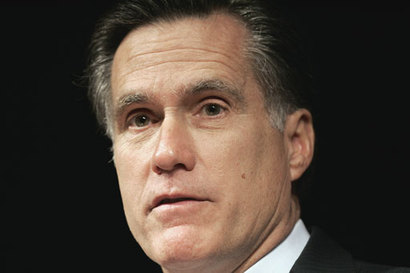
Romneypauldancyaap_1

It turns out Mitt Romney has indeed addressed the question of whether he wears sacred Mormon religious garments under his own clothes. This is from an Atlantic Monthly profile in 2005 by Sridhar Pappu:

Mitt Romney is not Rick Santorum, who is evidently incapable of being photographed without a Bible in his hand. But after reading about how deeply committed his father was to the faith (for instance, making the decision to run for governor of Michigan only after discussing it with David O. McKay, the president of the Mormon Church, and spending twenty-four hours fasting and praying), I finally asked Romney, "How Mormon are you?"

"How Mormon am I?" he said. "You know, the principles and values taught to me by faith are values I aspire to live by and are as American as motherhood and apple pie. My faith believes in family, believes in Jesus Christ. It believes in serving one’s neighbor and one’s community. It believes in military service. It believes in patriotism; it actually believes this nation had an inspired founding. It is in some respects a quintessentially American faith, and those values are values I aspire to live by. And I’m not perfect, but I’m one aspiring to be a good person as defined by the biblical Judeo-Christian standards that our society would recognize."

"Do you wear the temple garments?" I asked uncomfortably, referring to the special undergarments worn by members of the Church of Jesus Christ of Latter-Day Saints. (The underwear has markings denoting the covenants of the Mormon faith, and is meant to serve as a reminder of the high standards Mormons are expected to uphold. The rules governing its wear and disposal seem as complex as those pertaining to, say, the American flag.)

He answered, "I’ll just say those sorts of things I’ll keep private."

He may have to say more than that in a national campaign. People will want to know about secret handshakes, secret rituals, tithing, and so on. Would part of his presidential salary go to the LDS church, for example? Does he tithe already?

For my part, I’m uninterested in Romney’s personal religious practices. But I am concerned that Romney believes that America had a "divine founding". When? Does he mean the Declaration of Independence? Does he mean the period when Mormons believe Jesus arrived in America and hung out for a while shortly after the resurrection? Or when exactly? A person’s private faith is irrelevant to me. But if it means he holds that one country on earth has a special divine founding, then that has serious ramifications for foreign policy, at the very least. Could someone fill me in on what Romney may mean by America’s "divine founding"? Obviously Washington and Jefferson weren’t gods (although Mormons believe they now could be, right?) So what role did the Mormon God play in founding America? This is an important question for understanding a potential president’s political philosophy. And since the theocons believe in bringing religious doctrine into the public square as a basis for political decisions, and Romney is the theocon candidate, how can they object to the dialogue?

(Photo: Paul Sancya/AP.)

Sacrilegious Spelling

A reader corrects me:

I admit that I am one of those people who cringes when I see a misspelled word and normally I let it go. In this instance, however, I feel compelled to say something because it impacts the definition of the word. You and a reader debated whether it was "sacreligious" to post pictures of Mormon undergarments.  This spelling is incorrect and clearly implies a religious connection in the word itself.  The correct spelling is "sacrilegious" and is derived from the words "sacer," meaning sacred and "legere," meaning to take away. 

I believe you and your reader both made the mistake of assuming that sacrilege is an act of disrespecting something religious. But it isn’t – it’s the act of disrespecting something sacred. Not everything religious is sacred. And certainly some non-religious ideas (conservatism?) can be considered sacred. I can’t speak for Mormons, but frankly, I hope they don’t consider their undergarments sacred, even if they are mandated by their religion.

From several Mormon readers, the answer seems to be: yes, their undies are sacred. I apologize for the bad spelling and have fixed it.