[Clive]
Jack Keane and Frederick Kagan sketch in more detail about their plan for Baghdad:
Of all the "surge" options out there, short ones are the most dangerous. Increasing troop levels in Baghdad for three or six months would virtually ensure defeat…. The only cure is to maintain our presence long enough either to root out the hiding enemy or to defeat him when he becomes impatient. A surge that lasted at least 18 months would achieve that aim.
It goes without saying that Juan Cole thinks the idea is doomed from the start. What’s the most depressing part of his list of "10 myths about Iraq"? Perhaps this:
The parliament was not able to meet in December because it could not attain a quorum. Many key Iraqi politicians live most of the time in London, and much of parliament is frequently abroad.
Meanwhile the NY Review of Books is running a long article by journalist Christian Caryl on how the country looks from ground level:
We have little impression of Iraqis as people trying to live lives that are larger and more complex than the war that engulfs them, and more often than not we end up viewing them merely as appendages of conflict.
Her thoughts on the courageous Iraqi blogger, Riverbend are an especially interesting mix of praise and criticism:
It is also the mistakes of the young Baghdad woman, her limitations, that make her narrative worth reading. The daughter of an upper-middle-class family, she is a progressive Muslim and an idealistic Iraqi nationalist, intent on demonstrating to her American readers the high level of Iraq’s cultural and economic development. And yet she is also distinctly oblivious to some of the darker sides of Saddam’s regime. "Some would say that they [the Kurds] had complete rights even before the war," she notes at one point, in a characteristic moment of blindness (she has apparently never heard of the poison gas attacks Saddam’s regime staged against Kurdish civilians). "The majority of Iraqis have a deep respect for other cultures and religions," she argues elsewhere. She decries American policies that seem to her aimed at dividing Iraqis into ethnic and sectarian communities, and makes a great point of emphasizing the mixed Sunni-Shia origins of her family.
As the story progresses, though, reality begins to catch up… Riverbend reminds me of those Soviet patriots who failed to understand the events that ushered in the final agony of the USSR. Many of those who lived well under the system were unable to see its crimes for what they were, making them dismissive or uncomprehending when the once-oppressed began to express their own political demands.
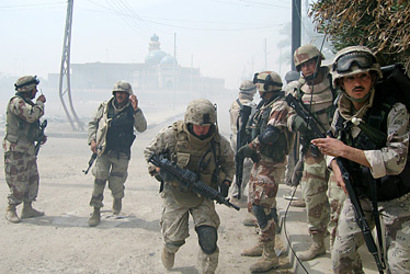
[Picture: Todd Pitman/AP]


 The Dish
